Saved
Art

Guerrilla art

Guerrilla art doesn’t hang on walls—it hijacks perception.

Worth your time?3.5/5Yes.Study the whole thing.What works, what does not, who it is for ↓
9:47in productionCh. 1 · Not American. Not avant-garde./ 9:47 · ceiling 15 min
4 chapters · 9:47Ceiling 15:00

The brief is written and checked. The video joins this page when it is cut.4 chapters · 1 min read · 9:47 planned

Read the brief

Guerrilla art is a UK-born street art movement defined by inseparability from environment, psychological effect over permanence, and roots in post-graffiti practice. Its earliest documented instance was in 1978 in Wellington, New Zealand. It has no external boundary between image and environment. The surface is fundamental to meaning. It depends on urban dynamics to avoid becoming 'art for art's sake'. Production focuses on cause and effect, not the material piece. It aims to produce an effect in local residents’ minds—not necessarily meaningful art in itself.

Chapters & takeaways4
  1. 0:56
    Not American. Not avant-garde.

    It began in the UK, not New York or Berlin—and its DNA is graffiti, not Dada or Situationism.

  2. 2:02
    No boundary between image and environment

    There is no frame. No wall is neutral. The surface *is* part of the statement.

  3. 3:54
    Depends on modern life—or it’s just decoration

    It only works when tied to the rhythms of city life—commute, weather, decay, surveillance.

  4. 5:39
    Aims for minds, not museums

    Its success is measured in local reaction—not critical acclaim, resale value, or Instagram shares.

1 more chapterFewer chapters
Worth your time?

Yes. Study the whole thing.

3.5/ 5
What works
  • as a corrective to object-centred art
  • as a test of environmental literacy
  • as a reminder that location is meaning
What does not
  • define a decade
  • influence named artists
  • displace graffiti
  • start a movement
Study it if
  • urban residents
  • street-level observers
  • people who move through cities daily
Skip it if
  • gallery curators
  • art collectors
  • museum audiences
Who should study it, and who should skipHide who it is for
The written brief1 min read

What the thing is

Guerrilla art is street art that dissolves the boundary between image and environment. It prioritises psychological effect over permanence. It is site-specific and responsive to urban dynamics.

Where it came from

It originated in the UK. Its earliest documented instance was in 1978 in Wellington, New Zealand. It is rooted in post-graffiti practice.

What it gets right

It treats the city as co-author. The surface matters as much as the mark. It forces attention to context, not craft.

What it gets wrong

It risks meaninglessness by design. It does not aim to produce meaningful art in itself. That is a choice, not a feature.

Why it matters now

It exposes the limits of art divorced from place. In an age of digital displacement and algorithmic curation, it insists on physical presence, local reception, and real-world consequence.

Is it worth your time

Yes—if you care how art operates in public space, not as object but as intervention.
Same beat · Art4 of 103
8:41
Relational art1996Relational art is a 1990s fine art tendency defined by Nicolas Bourriaud in 1998 (first used in 1996). It treats human relations and social context as its medium. It produces collective meaning through participatory encounters. It displaces the artwork-as-object with the artwork-as-gathering. It claims art should be a way of living—not a representation of one.
8:28
PointillismPointillism is a precise, rule-bound technique—not a mood or movement. It was invented by two people, in one year, as a formal challenge to Impressionist handling. Its legacy lives less in galleries than in every screen and printer that trusts the eye to complete the image.
9:42
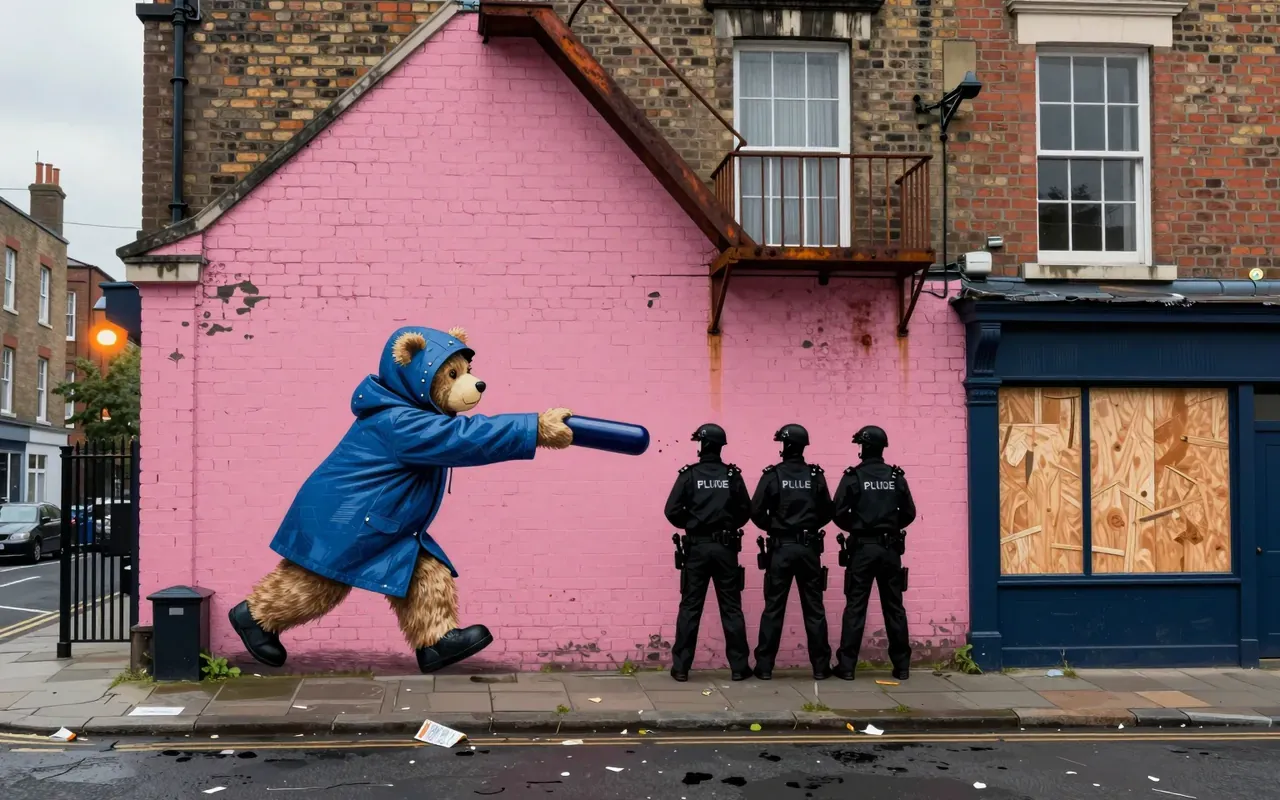
BanksyBanksy is a pseudonymous England-based street artist whose practice centres on stencilled, satirical interventions placed on publicly visible surfaces. He emerged from the Bristol underground scene in the 1990s. His first known large-scale mural was The Mild Mild West in 1997 on Stokes Croft. Banksy makes satire legible on city walls. His stencils deliver punchlines fast. They occupy surfaces people pass daily. They force confrontation without requiring attention. The method relies on evasion—but that evasion obscures authorship, dilutes accountability, and turns political gesture into branded ambiguity. His work established a template for art that operates outside institutions but trades on their validation—exposing the friction between subversion and market absorption.
8:31
Op art1960Op art is a 1960s perceptual practice rooted in figure-ground tension and optical phenomena. It uses pattern and line—often black and white—to produce illusions of movement, vibration, depth and after-images. It emerged in the early 20th century, gained prominence in the 1960s, and is closely tied to the Bauhaus and constructivist traditions.
Up next in Culture

Guerrilla marketing

· 8:00

Guerrilla marketing doesn’t build brands—it borrows attention and returns nothing.

8:00