culturebriefs
8:28in productionCh. 1 · Dots, not blends/ 8:28 · ceiling 15 min
Art · Movements & scenes

Pointillism

Pointillism isn’t about light—it’s about forcing your eye to do the work the palette refuses to do.

Pointillism is a precise, rule-bound technique—not a mood or movement. It was invented by two people, in one year, as a formal challenge to Impressionist handling. Its legacy lives less in galleries than in every screen and printer that trusts the eye to complete the image.

Chapters & takeaways5
  1. 0:59
    Dots, not blends

    Pointillism builds images from isolated dots—not blended strokes.

  2. 2:03
    A deliberate break

    Seurat and Signac launched it in 1886 as an offshoot of Impressionism.

  3. 2:58
    The eye does the blending

    It outsources colour mixing to the viewer—and wins brightness as a result.

  4. 4:05
    Brushwork over theory

    It’s about brushwork style, not colour theory—unlike Divisionism.

  5. 5:04
    Analogous to pixels

    Its logic mirrors CMYK printing and RGB screens—two centuries before digital displays.

Worth your time?

Yes. Study the whole thing.

4/ 5
What works
  • as a demonstration of perceptual mechanics
  • as a bridge between pigment and pixel
  • as a historically bounded technical experiment
What does not
  • define a decade
  • influence named artists beyond Signac and Seurat
  • displace Impressionism broadly
  • found a school or movement
Study it if
  • artists interested in optical mixing
  • designers working with raster systems
  • students of 19th-century French art
Skip it if
  • casual viewers seeking emotional immediacy
  • those looking for philosophical or political statements
The written brief1 min read

What the thing is

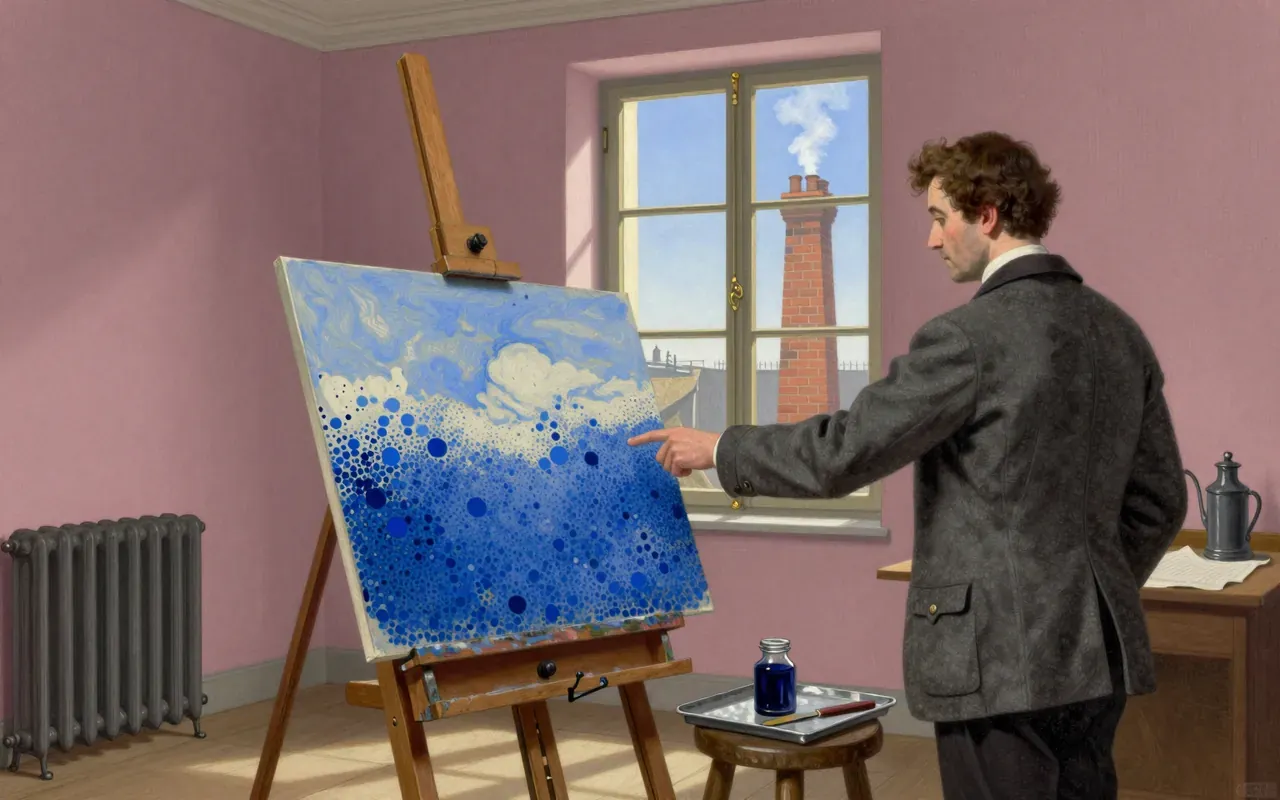
Pointillism is a painting technique that forms images using small, distinct dots of colour applied in patterns.

Where it came from

Georges Seurat and Paul Signac developed Pointillism in 1886 in France, branching from Impressionism.

What it gets right

It treats the viewer’s retina as part of the medium. Dots stay separate until perception merges them. This delivers brighter tones than pigment mixing allows.

What it gets wrong

It confuses brushwork with science. It prioritises dot application over colour theory—unlike Divisionism, which it is often mistaken for.

Why it matters now

Its optical logic prefigures digital display: RGB screens and CMYK printing both rely on discrete colour units resolved by the eye—not pigment blends.

Is it worth your time

Yes—if you care how colour behaves in the eye, not just on the palette.
Same beat · Art4 of 98
9:47
Guerrilla artGuerrilla art is a UK-born street art movement defined by inseparability from environment, psychological effect over permanence, and roots in post-graffiti practice. Its earliest documented instance was in 1978 in Wellington, New Zealand. It has no external boundary between image and environment. The surface is fundamental to meaning. It depends on urban dynamics to avoid becoming 'art for art's sake'. Production focuses on cause and effect, not the material piece. It aims to produce an effect in local residents’ minds—not necessarily meaningful art in itself.
8:10
Arte Povera1967Arte Povera was a materially specific, institutionally embedded, temporally tight Italian art movement. It used perishable matter and physical forces to stage critique—but never left the gallery circuit it claimed to dismantle.
9:01
Cubism1907Cubism is an early-20th-century avant-garde art movement that began in Paris and flourished across the 1910s and 1920s. It involved analyzing, breaking up, and reassembling subjects in abstract form, depicting them from multiple perspectives rather than a single viewpoint. A major innovation was the introduction of collage in 1912. The movement is historically divided into phases—Analytic Cubism (1910–1912) and Synthetic Cubism (1912–1914)—each marked by distinct formal strategies. It emerged from collaborative work in the studios of Picasso and Braque and rapidly expanded to include numerous artists across painting, sculpture, architecture, literature, and design.
9:18
Fauvism1904Fauvism was a short-lived French painting movement (1905–1908) that treated colour as architecture and brushwork as velocity. It fused Post-Impressionist intensity with Neo-Impressionist technique and Tahitian colour fields—and was shaped by the visual experience of driving. Its strength was its sensory immediacy; its limit was its lack of structural logic beyond intensity. It matters now because it shows how technology alters perception before theory catches up.
Up next in Culture

Polenta

· 9:11

Polenta is not Italian heritage—it’s maize replacing famine food, then migrating with the poor.

9:11