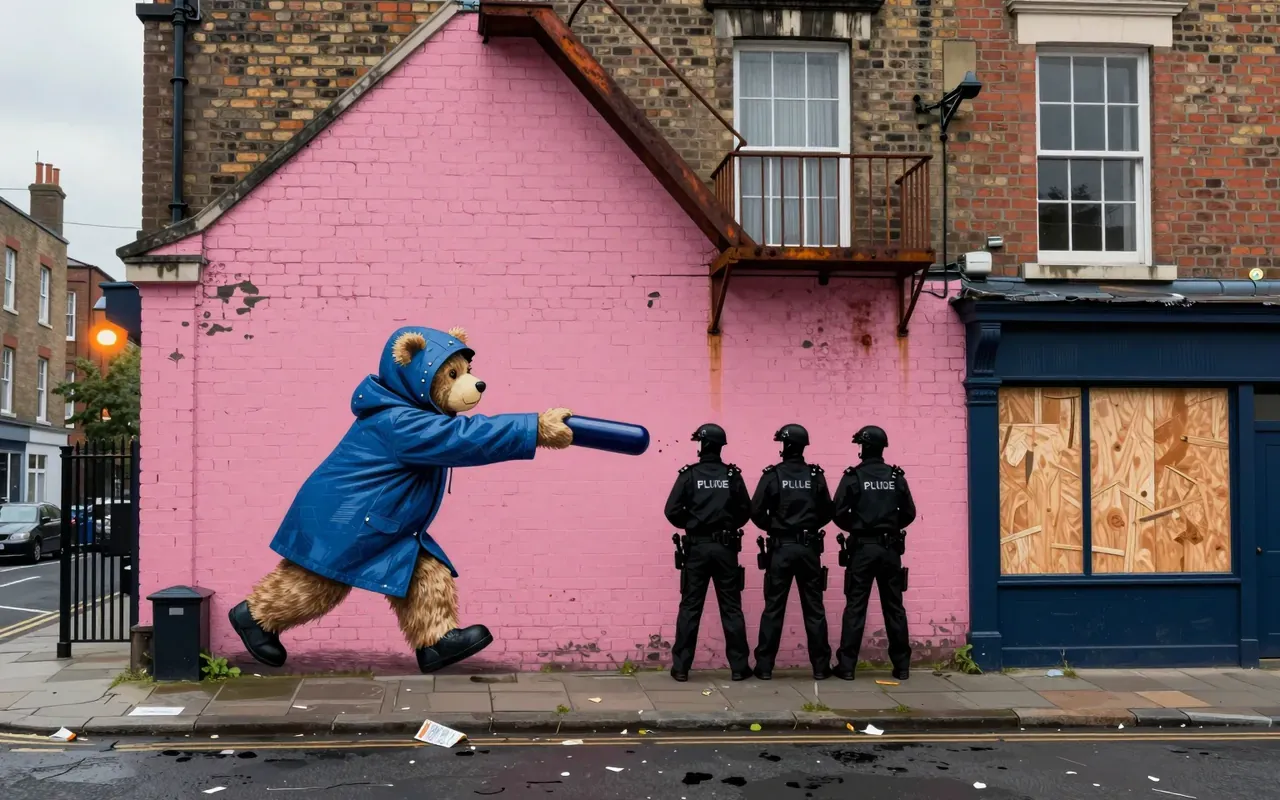
Banksy is a pseudonymous England-based street artist whose practice centres on stencilled, satirical interventions placed on publicly visible surfaces. He emerged from the Bristol underground scene in the 1990s. His first known large-scale mural was The Mild Mild West in 1997 on Stokes Croft. Banksy makes satire legible on city walls. His stencils deliver punchlines fast. They occupy surfaces people pass daily. They force confrontation without requiring attention. The method relies on evasion—but that evasion obscures authorship, dilutes accountability, and turns political gesture into branded ambiguity. His work established a template for art that operates outside institutions but trades on their validation—exposing the friction between subversion and market absorption.
Anonymity isn’t a quirk—it’s the operating system.
2:17
The Speed of Satire
Stencilling wasn’t just faster—it made satire mobile, repeatable, and hard to stop.
4:00
Where the Work Lives
Public walls weren’t canvases—they were broadcast zones with built-in audiences.
5:40
Local First, Global Later
He was embedded in Bristol long before he was famous—playing football, not posing for interviews.
Worth your time?
Yes. Study the whole thing.
3.5/ 5
What works
The Mild Mild West
Banksy's stencilled rat motifs
his early Bristol wall interventions
What does not
culture/literature
culture/photography
culture/movements-and-scenes
Study it if
readers who track how tactics migrate across culture
people who question why some artists stay anonymous while others chase visibility
Skip it if
those seeking definitive biography
readers looking for influence claims beyond the document
The written brief1 min read
What the thing is
Banksy is a pseudonymous street artist whose practice centres on stencilled, satirical interventions placed on publicly visible surfaces.
Where it came from
He emerged from the Bristol underground scene in the 1990s. His first known large-scale mural was The Mild Mild West in 1997 on Stokes Croft.
What it gets right
Banksy makes satire legible on city walls. His stencils deliver punchlines fast. They occupy surfaces people pass daily. They force confrontation without requiring attention.
What it gets wrong
The method relies on evasion—but that evasion obscures authorship, dilutes accountability, and turns political gesture into branded ambiguity.
Why it matters now
His work established a template for art that operates outside institutions but trades on their validation—exposing the friction between subversion and market absorption.
Is it worth your time
Yes—if you want to understand how anonymity, speed and public space became tools of cultural leverage in the 2000s.