What the thing is
Ukiyo-e is a genre of Japanese woodblock prints and paintings.
The word translates as “pictures of the floating world”. Its subjects were female beauties, kabuki actors and sumo wrestlers, scenes from history and folk tales, travel scenes and landscapes, plants and animals, and erotica. Most works were prints. “Ukiyo” was homophonous with an older Buddhist term meaning “this world of sorrow and grief”, and the newer word came to describe the hedonistic spirit of the lower classes.
Where it came from
It emerged in Edo in the 1670s under the Tokugawa shogunate, made by and for the chōnin (merchant) class. Production declined steeply after the Meiji Restoration of 1868.
Edo became the seat of the Tokugawa shogunate in 1603, and the chōnin (merchants, craftsmen and workers) sat at the bottom of a four-class order. Deprived of political influence, they benefited most from the city’s economic growth, and became wealthy enough to decorate their homes with art that had once been beyond their means. The city grew from a population of 1,800 to over a million in the 19th century. Earlier woodblock printing in Japan had been reserved for Buddhist seals and images until the 17th century. In the Kan’ei era (1624–1643), illustrated folk-tale books called tanrokubon were the first books mass-produced by woodblock.
Hishikawa Moronobu produced the first ukiyo-e woodblock prints. By 1672 he was signing his work, and he began making single-sheet images rather than only book illustrations. Colour came slowly: it was at first added by hand for special commissions, and in 1744 the benizuri-e were the first successes in colour printing from multiple blocks. After Suzuki Harunobu’s nishiki-e, from 1765, full-colour production became standard, with up to a dozen blocks per print.
What it gets right
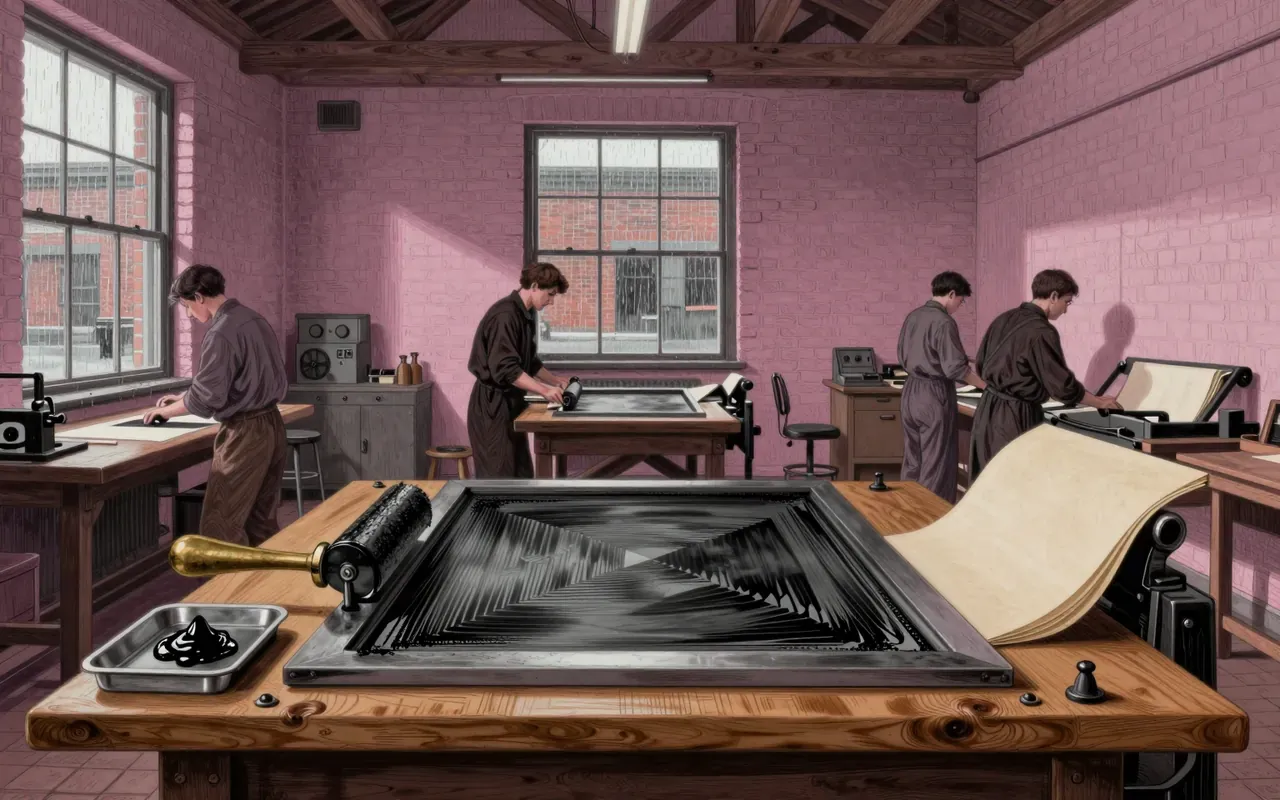
It treated art as collaborative industry. Artist, carver, printer and publisher each held distinct, non-transferable roles. Hand-printing enabled effects such as colour gradation that machines could not achieve.
The publisher financed, promoted and distributed the work, and artists rarely carved their own blocks. The expensive calendar prints that preceded full-colour nishiki-e were sent at New Year as personalised greetings and bore the patron’s name rather than the artist’s; their blocks were later reused for commercial production, with the artist’s name replacing the patron’s.
The state also shaped the trade. A law of 1790 required prints to carry a censor’s seal of approval, and from 1799 even preliminary drafts needed approval. Utamaro was imprisoned in 1804 for prints of Toyotomi Hideyoshi. The Tenpō Reforms of 1841–1843 sought to suppress displays of luxury, including pictures of courtesans and actors, and many artists turned to travel scenes and nature.
What it gets wrong
It never claimed universality. It was made by Edo chōnin for Edo chōnin—yet it is now taught as ‘Japanese art’ tout court. Its landscape prints shaped Western perception of Japanese art.
Landscape only came into its own late in the Edo period, through Hokusai and Hiroshige, and the genre now dominates Western perceptions of ukiyo-e even though the tradition had a long history before them. Before the mid-19th century Westerners paid little notice to Japanese art and rarely distinguished it from other art of the East. When the prints reached the West, woodblock printing was the most common mass medium in Japan, and the Japanese considered it of little lasting value. Prices abroad eventually passed what most collectors could pay, and the dealer Tadamasa Hayashi exported prints in such quantities that Japanese critics later accused him of siphoning off Japan’s national treasure.
Why it matters now
It shows how hand-printed media enabled precise, repeatable visual language before industrial reproduction—and how that language was later flattened into ‘Japaneseness’ for Western consumption.
The decline had specific causes. After the deaths of Hokusai and Hiroshige and the Restoration of 1868, the rapid Westernisation of the Meiji period turned woodblock printing towards journalism and brought competition from photography. Tastes turned away from a genre seen as a remnant of an obsolete era, and by the 1890s the tradition was moribund. Synthetic pigments imported from Germany had begun replacing organic ones in the mid-19th century, producing the bright red prints called aka-e. Kiyochika documented Tokyo’s modernisation, including its railways, in prints. In the 20th century shin-hanga (“new prints”) revived traditional scenes for foreign and upscale Japanese buyers, while sōsaku-hanga promoted work designed, carved and printed by a single artist.
Is it worth your time
Yes—if you want to understand how mass-produced art shaped class identity, not just aesthetics.