8:54 in production Ch. 1 · Flat, not carved / 8:54 · ceiling 15 min
Art · Ideas Lithography 1796
Lithography wasn’t art—it was a hack: an actor’s fix for expensive musical scores.
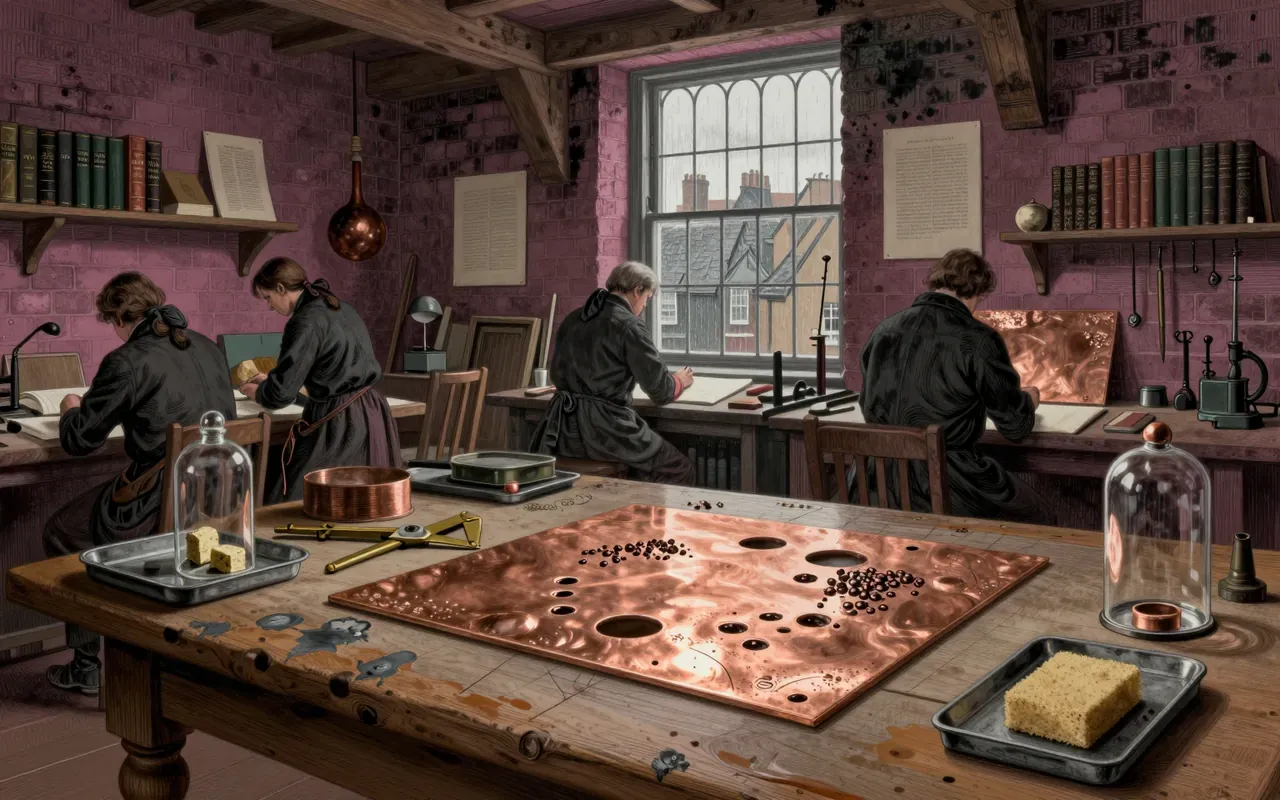
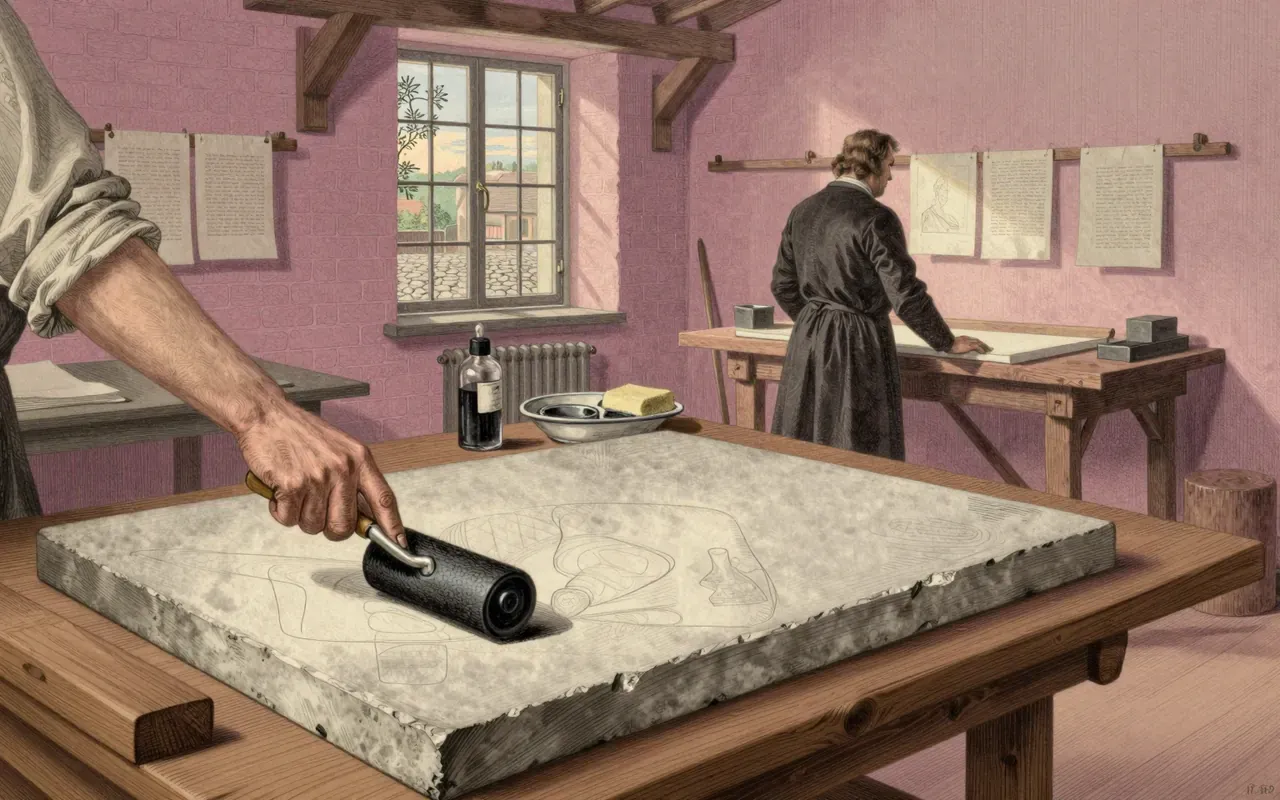
Lithography is a planographic printing method originally based on the immiscibility of oil and water. The printing is from a stone (lithographic limestone) or a metal plate with a smooth surface. It was invented in 1796 by the German author and actor Alois Senefelder and was initially used mostly for musical scores and maps. Traditionally, the image to be printed was drawn with a greasy substance, such as oil, fat, or wax onto the surface of a smooth and flat limestone plate. For printing, the stone was first moistened. The water adhered only to the etched, hydrophilic areas, making them even more oil-repellant. An oil-based ink was then applied, and would stick only to the original drawing. The ink would finally be transferred to a blank sheet of paper, producing a printed page.
Chapters & takeaways 4
0:48 Flat, not carved
Lithography prints from a flat surface using oil and water—not raised or recessed lines.
2:31 Born from necessity
Alois Senefelder invented it in 1796 to publish his own plays and musical scores cheaply.
3:42 Draw, wet, ink, print
You draw with grease on stone, wet the blank areas, then roll ink that sticks only to the drawing.
5:17 One stone, one page
Each impression transfers ink cleanly to paper—no carving, no pressure distortion.
Worth your time?
Yes. Study the whole thing. 4.5 / 5
What works offset-printing commercial-posters mass-art-reproduction What does not art-deco bauhaus impressionism modernism Study it if printmakers designers historians-of-technology Skip it if casual-readers general-audiences-unfamiliar-with-printing The written brief 1 min read
What the thing is
Lithography is a planographic printing method. It uses oil–water immiscibility to print from a smooth stone or metal plate.
Where it came from
It was invented in 1796 in the Electorate of Bavaria by Alois Senefelder, a German author and actor.
What it gets right
It exploits oil–water immiscibility cleanly. It prints from a smooth stone or metal plate. It lets artists draw directly, without engraving.
What it gets wrong
It does not scale well for text-heavy work. It requires precise chemical treatment. It was never efficient for long-run book printing.
Why it matters now
It underpins every offset press, every commercial poster, every mass-produced art print—and it started with a musician needing cheap scores.
Is it worth your time
Yes—if you care how mass visual culture began, and how a Bavarian actor solved his own publishing problem.
Same beat · Art 4 of 80
8:42
Aquatint Aquatint is a tonal printmaking method using acid-etched rosin particles. It originated in Amsterdam c.1650 but matured 1770–1830. It excels at atmospheric gradation but fails at precision. Its legacy is structural—not aesthetic—and it remains a key reference for how analogue systems encode continuous tone. 8:03
Art Deco 1910 Art Deco was a Paris-born, commercially rooted design language that treated jewellery, furniture, textiles, and architecture as interchangeable surfaces for geometric, luxurious styling. It began before WWI—not at the 1925 Exposition—and spread through department stores and fashion, not manifestos or salons. 10:37
Art Nouveau 1890 Art Nouveau was an international style of art, architecture and applied art—especially the decorative arts—that emerged in Brussels in the 1890s and was popular between 1890 and 1910. It was inspired by natural forms such as the sinuous curves of plants and flowers. It featured dynamism and movement through asymmetry and whiplash lines. It used modern materials like iron, glass, ceramics and concrete. A major objective was to break down the distinction between fine and applied arts. The first houses and interiors appeared in Brussels in the 1890s, designed by Paul Hankar, Henry van de Velde and Victor Horta—whose Hôtel Tassel was completed in 1893. By 1914, Art Nouveau was largely exhausted. 9:49
Arts and Crafts movement The Arts and Crafts movement was a British design reform effort active from the 1880s to about 1920. It opposed factory production and machine-made ornament, citing the 1851 Great Exhibition as proof of decline. It succeeded in shifting taste and establishing craft as moral category—but failed to address class, gender or colonial dimensions of production.