culturebriefs
9:50in productionCh. 1 · The Black Panels/ 9:50 · ceiling 15 min
Art · Society

Keith Haring

He didn’t bring art to the people—he treated the people as the medium.

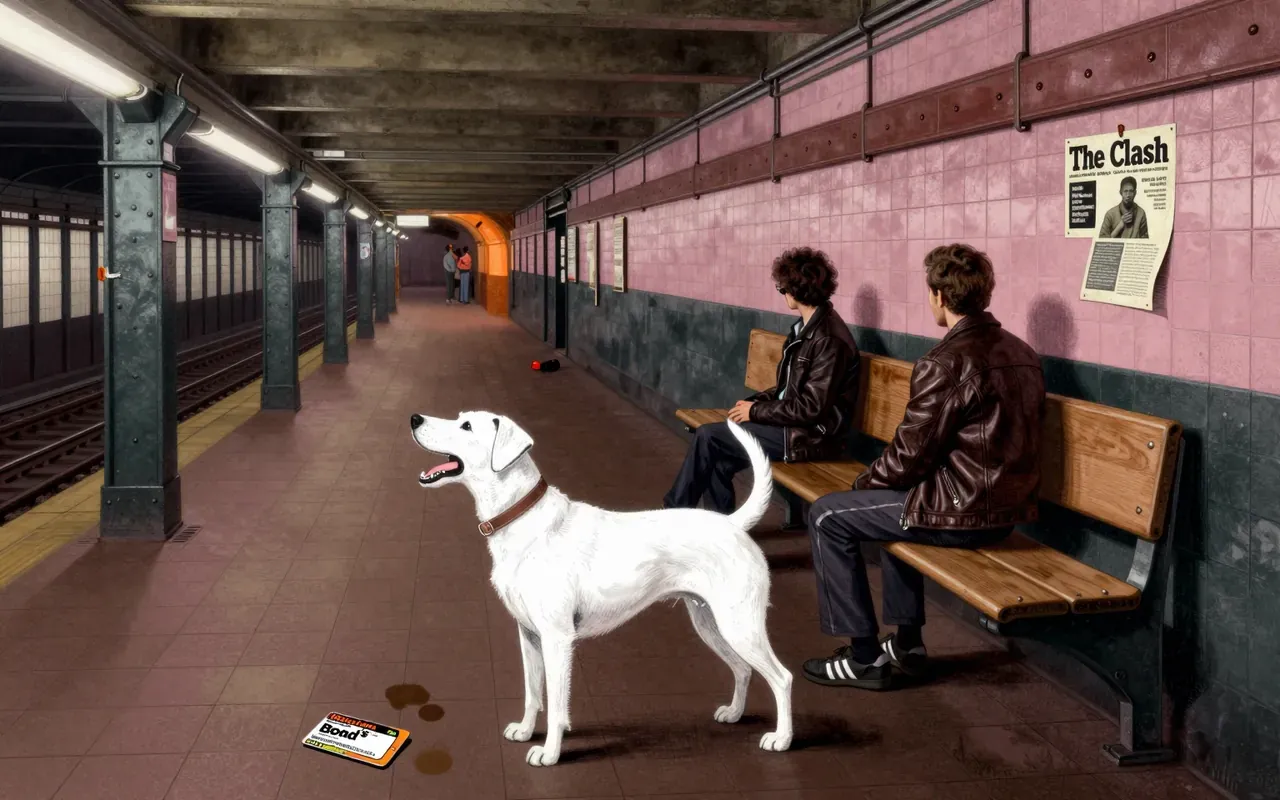
Keith Haring’s work was a direct response to the conditions of New York City’s public transport system in the early 1980s. It used minimal means—white chalk, black paper, repetition—to build recognition, urgency, and reach. It succeeded where institutional art failed: it entered daily life without invitation. But its clarity came with limits—it did not invite interpretation, only recognition. It spoke *to* people, not *with* them.

Chapters & takeaways6
  1. 0:55
    The Black Panels

    He gained attention by drawing on unused black advertising panels in New York City subway stations.

  2. 2:01
    The Laboratory

    He called the subway his 'laboratory'—a free, experimental space for public drawing.

  3. 3:15
    The Vocabulary

    The Radiant Baby, barking dogs, and dancing figures formed a repeatable, legible vocabulary.

  4. 4:15
    The Urgent Messages

    He used that vocabulary to address anti-apartheid activism, the crack epidemic, homosexuality, safe sex, and AIDS awareness.

  5. 5:22
    The Pop Shop

    In 1986, he opened the Pop Shop to distribute his imagery through affordable merchandise.

  6. 6:36
    The Last Drawings

    In his final years, he used his own iconography to speak about his illness and galvanise AIDS awareness.

Worth your time?

Yes. Study the whole thing.

4.5/ 5
What works
  • as public signage
  • as activist shorthand
  • as accessible visual language
What does not
  • influence named artists
  • define a decade
  • start a movement
  • displace other art forms
Study it if
  • commuters
  • young New Yorkers
  • LGBTQ+ communities in crisis
Skip it if
  • art collectors
  • museum curators
  • academic critics
The written brief1 min read

What the thing is

A visual language built from chalk on black paper in New York City subway stations.

Where it came from

New York City’s downtown art and graffiti scenes in the early 1980s.

What it gets right

It made urgent political messaging legible to strangers in transit. It treated the subway as civic space, not background. It turned symbols into shared language without requiring literacy in art history.

What it gets wrong

It flattened complex issues—like apartheid or AIDS—into repeatable icons. Its accessibility came at the cost of ambiguity, nuance, and room for dissent.

Why it matters now

Because public space is again contested, commercialised, and surveilled—and because clear, unlicensed visual speech is rarer, not more common.

Is it worth your time

Yes—if you want to understand how art can operate as public infrastructure, not just decoration or commodity.
Same beat · Art4 of 98
9:47
Guerrilla artGuerrilla art is a UK-born street art movement defined by inseparability from environment, psychological effect over permanence, and roots in post-graffiti practice. Its earliest documented instance was in 1978 in Wellington, New Zealand. It has no external boundary between image and environment. The surface is fundamental to meaning. It depends on urban dynamics to avoid becoming 'art for art's sake'. Production focuses on cause and effect, not the material piece. It aims to produce an effect in local residents’ minds—not necessarily meaningful art in itself.
8:10
Arte Povera1967Arte Povera was a materially specific, institutionally embedded, temporally tight Italian art movement. It used perishable matter and physical forces to stage critique—but never left the gallery circuit it claimed to dismantle.
9:01
Cubism1907Cubism is an early-20th-century avant-garde art movement that began in Paris and flourished across the 1910s and 1920s. It involved analyzing, breaking up, and reassembling subjects in abstract form, depicting them from multiple perspectives rather than a single viewpoint. A major innovation was the introduction of collage in 1912. The movement is historically divided into phases—Analytic Cubism (1910–1912) and Synthetic Cubism (1912–1914)—each marked by distinct formal strategies. It emerged from collaborative work in the studios of Picasso and Braque and rapidly expanded to include numerous artists across painting, sculpture, architecture, literature, and design.
9:18
Fauvism1904Fauvism was a short-lived French painting movement (1905–1908) that treated colour as architecture and brushwork as velocity. It fused Post-Impressionist intensity with Neo-Impressionist technique and Tahitian colour fields—and was shaped by the visual experience of driving. Its strength was its sensory immediacy; its limit was its lack of structural logic beyond intensity. It matters now because it shows how technology alters perception before theory catches up.
Up next in Culture

Kenzō

Kenzo Takada · 8:46

Kenzo didn’t bring Japan to Paris—he brought Paris to itself, via Montmartre, a flea market, and green paint.

8:46