What the thing is
Andy Warhol was an American artist and filmmaker who used silkscreen printing and experimental film to interrogate advertising, consumerism, mass media, and celebrity culture.
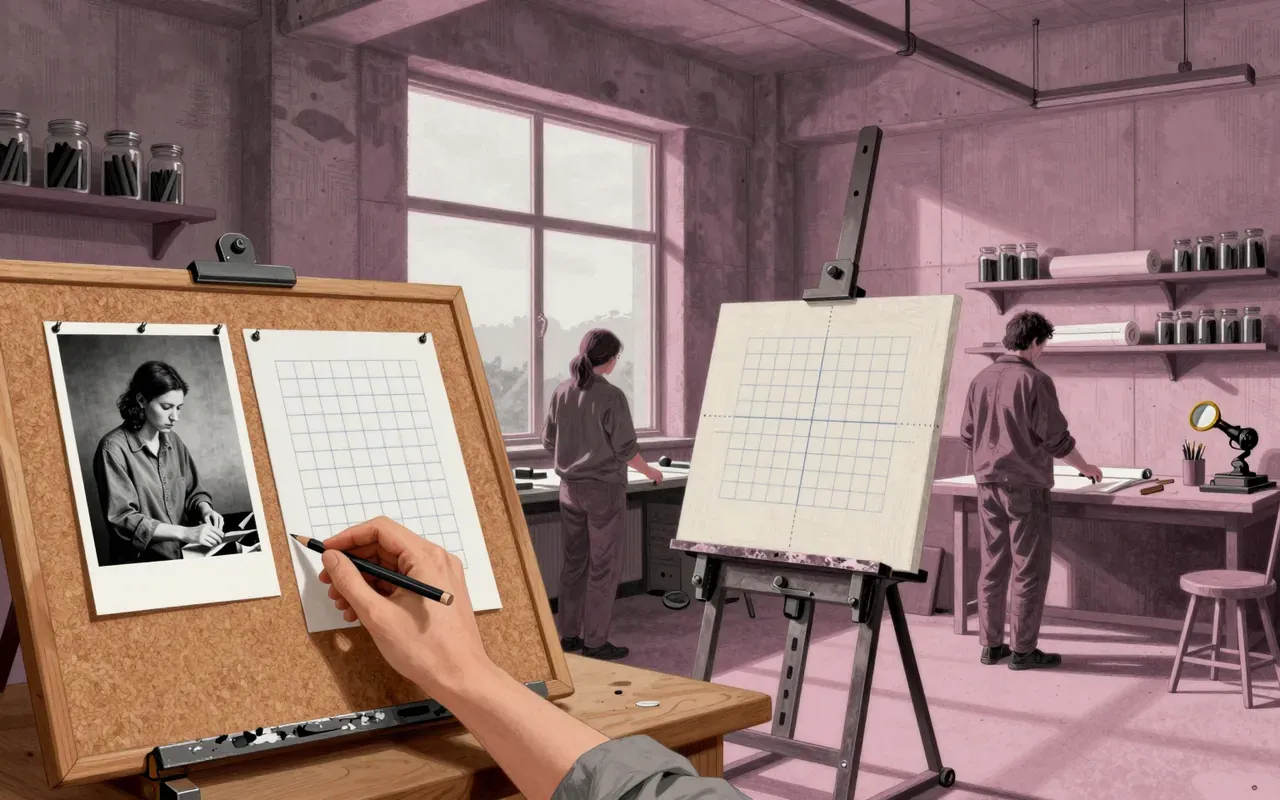
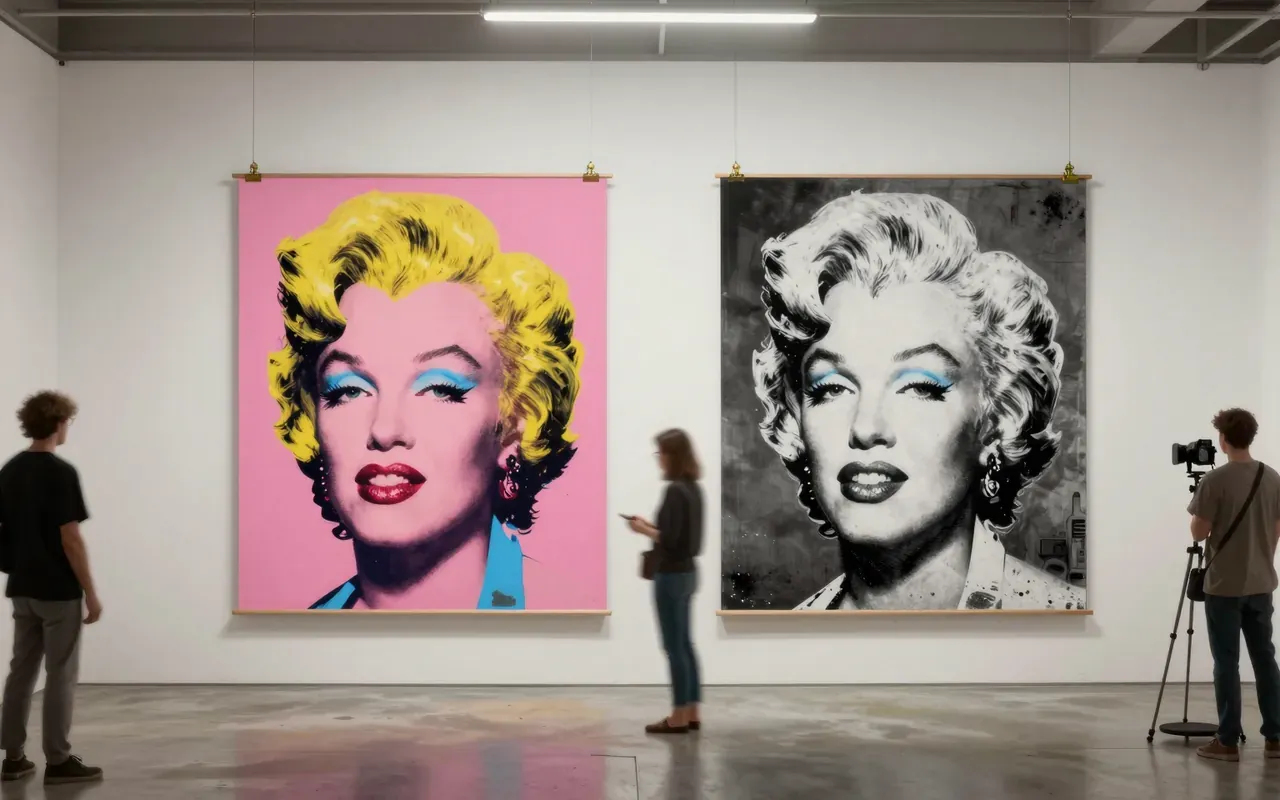
His silkscreen method began in 1962. A photograph was enlarged and transferred in glue onto a silk mesh, and ink was rolled across the screen with a squeegee so that it passed through the open areas onto the canvas. Warhol wanted the “assembly-line effect” this gave. In a 1963 Time profile he explained his attraction to mechanical processes: machines have fewer problems, and he said he would like to be one.
The films ran alongside the paintings. Between 1963 and 1968 Warhol produced more than 600 underground films, including the silent, close-up Screen Tests of Factory visitors. The early ones were studies of duration: Sleep (1964) shows the poet John Giorno sleeping for over five hours, and Empire (1965) is an eight-hour static shot of the Empire State Building. His films had no script, and he encouraged the actors to improvise. Chelsea Girls (1966) used two 16mm projections running simultaneously with alternating sound.
Where it came from
He emerged from Pittsburgh, began as a commercial illustrator in New York, and rose to prominence in the early 1960s as a leading figure in the Pop art movement.
Warhol was born Andrew Warhola Jr. in Pittsburgh in 1928 to working-class Rusyn immigrant parents. After a Bachelor of Fine Arts from the Carnegie Institute of Technology in 1949 he moved to New York, where Glamour magazine bought a drawing and commissioned shoe illustrations for its September 1949 issue. He went on to draw for Mademoiselle, Vogue and Harper’s Bazaar, and his advertisements for the shoe maker I. Miller won an Art Directors Club award in 1956. Art directors liked him because he worked quickly, met deadlines and accepted revisions.
The move into fine art was not smooth. In April 1961 five of his comic-strip and advertisement paintings appeared in a Bonwit Teller window as a backdrop for mannequins. The dealer Leo Castelli declined him, feeling the work was too close to Roy Lichtenstein’s. Irving Blum gave him a solo show at the Ferus Gallery in Los Angeles that opened on July 9, 1962, with 32 canvases, one for each variety of Campbell’s Soup. His first solo Pop show in New York opened at the Stable Gallery in November 1962.
What it gets right
Warhol correctly identified advertising and celebrity as the new religious iconography of postwar America.
His own account of consumer goods was egalitarian. Coca-Cola, he noted, was drunk by the President and by Elizabeth Taylor alike, and so could be drunk by anyone. His subjects ran from soup cans, Coke bottles and dollar bills to the gruesome images of the Death and Disaster series (1962–67) and portraits of Marilyn Monroe, Elizabeth Taylor and Jackie Kennedy. Religious themes appeared frequently in his work: he was a practising Ruthenian Catholic, and his Last Supper series (1986) is described as the largest body of religious-themed works by an American artist.
What it gets wrong
His mechanical method flattened authorship without resolving who benefits from that erasure: corporations, collectors, or the ‘superstars’ themselves.
Warhol used assistants, among them Gerard Malanga, Ronnie Cutrone, Jay Shriver and Benjamin Liu, who produced his silkscreens following his directions. In 1970 some of the acetates used for his screenprints were taken to Europe and used to make editions published as “Sunday B. Morning”. Warhol first signed and numbered one edition of 250, then distanced himself from the project after disputes with collaborators, and some prints were stamped “Fill in Your Own Signature”. After the 1968 shooting, Paul Morrissey took over the filmmaking and steered the Warhol-branded films toward narrative B-movie fare such as Flesh and Trash.
Some of the reception was hostile from the start. A Museum of Modern Art symposium in December 1962 attacked artists such as Warhol for capitulating to consumerism, and critics were appalled by his open acceptance of market culture. He advocated “Business Art”, and his turn to business was a point of criticism. In 1979 the critic Hilton Kramer wrote that Warhol’s art belongs less to the history of painting than to the history of publicity.
Why it matters now
His framing of fame as fleeting and reproducible prefigures social media’s attention economy—without its illusions of participation or control.
The expression “15 minutes of fame”, which he is credited with popularising, first appeared in a 1967 Time article and became tied to the Factory scene and its “superstars”. In 1965 large Flowers paintings sold for about $6,000 and small ones for as little as $400. In 2013 Silver Car Crash (Double Disaster) sold for $105.4 million, and in May 2022 Shot Sage Blue Marilyn sold at Christie’s for $195 million, the most expensive American artwork ever sold at auction. In 2014 alone his works brought in about $569 million at auction, more than one-sixth of the global art market that year.
His reach also extended to technology. In July 1985, at the launch of the Commodore Amiga 1000 at Lincoln Center, he made a digitally painted portrait of Debbie Harry. The Andy Warhol Museum in Pittsburgh opened in 1994 and holds the largest collection of his work in the world; his will directed that his estate found the Andy Warhol Foundation for the Visual Arts, established in 1987.
Is it worth your time
Yes—if you want to understand how mass media reshaped art’s purpose, not just its appearance.