culturebriefs
9:58in productionCh. 1 · Origin/ 9:58 · ceiling 15 min
Movements & scenes

Pop art

1950

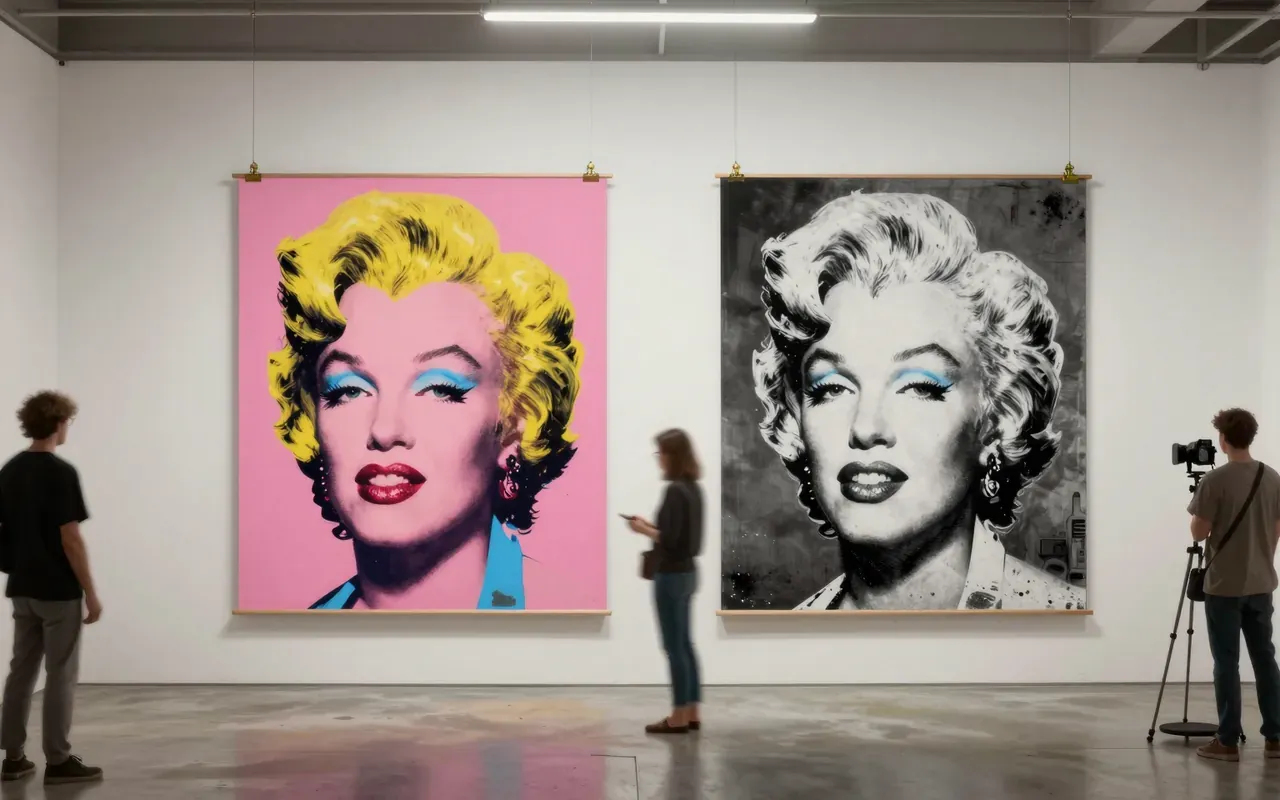
Pop art didn’t celebrate consumer culture—it weaponised its grammar to expose art’s own pretensions.

Pop art was a deliberate provocation: it took what fine art had excluded—ads, comics, packaging—and installed them as legitimate subjects. It did so in the UK and US in the mid-to-late 1950s. Its strength was formal clarity and conceptual redirection. Its weakness was ambiguity masquerading as critique. It matters now because it normalised the idea that commercial imagery isn’t just raw material—it’s the terrain.

Chapters & takeaways5
  1. 1:08
    Origin

    It began in two places at once: the UK and US, in the mid-to-late 1950s.

  2. 2:16
    Method

    It used mass imagery not as decoration but as subject—directly challenging fine art tradition.

  3. 3:33
    Tone

    It elevated the banal to high art while maintaining irony and critical awareness of consumer culture.

  4. 4:54
    Technique

    It relied on mechanical reproduction and visual displacement—removing images from context to force new readings.

  5. 6:20
    Lineage

    It linked Dada’s found-image tactics to postmodernism’s embrace of commercial aesthetics.

Worth your time?

Yes. Study the whole thing.

4/ 5
What works
  • painting
  • sculpture
  • printmaking
What does not
  • celebrity
  • fashion
  • photography
Study it if
  • art-students
  • designers
  • critics
Skip it if
  • historians-of-technology
  • literary-scholars
  • musicologists
The written brief1 min read

What the thing is

Pop art is an art movement that incorporated imagery from advertising, comics, product packaging, celebrities, and everyday consumer goods into painting, sculpture, and printmaking.

Where it came from

It emerged in the UK and US in the mid-to-late 1950s as both a reaction against and an extension of abstract expressionism.

What it gets right

It correctly identified mass imagery as a legitimate field for artistic attention. It exposed the arbitrariness of ‘high’ versus ‘low’ by recontextualising advertising, comics, and packaging as fine art objects.

What it gets wrong

It claimed neutrality through irony but offered no consistent critical framework for consumer culture—leaving its stance ambiguous, not analytical.

Why it matters now

It established the template for treating commercial aesthetics as primary material—not just reference—reshaping how visual culture is analysed, taught, and monetised today.

Is it worth your time

Yes—if you want to understand how art began treating consumer culture as its subject, not its enemy or backdrop.
Same beat · Movements & scenes4 of 96
9:54
Notting Hill Carnival1965The Notting Hill Carnival is a British Caribbean-led street festival in London, rooted in responses to racial violence and shaped by incremental community stewardship — not mythic origin stories.
10:04
Afrika BambaataaAfrika Bambaataa originated breakbeat DJing. He co-opted the Black Spades into the Universal Zulu Nation in the Bronx in 1977. He released 'Planet Rock' in 1982—a breakthrough electro-funk track that fused drum machines, synthesizers, and Kraftwerk samples to define a new genre. He played the first commercially released American single made on a computer: EBN-OZN’s 'AEIOU Sometimes Y' in 1982. He shifted live performance away from bands to exclusive reliance on technology. His leadership of the Universal Zulu Nation ended in 2016 following child sexual abuse allegations.
9:02
Anti-Apartheid Movement1959The Anti-Apartheid Movement was a British organisation founded in London in 1959. It coordinated international opposition to apartheid and supported South Africa's non-white population. It began as the Boycott Movement in response to Albert Luthuli's appeal. It attracted widespread support from students, trade unions and the Labour, Liberal and Communist parties. It launched a March Month, Boycott Action at a rally in Trafalgar Square. The Sharpeville massacre triggered an intensification of anti-apartheid action. After renaming, the AAM coordinated all anti-apartheid work and kept apartheid policy central in British politics. It campaigned for the total isolation of apartheid South Africa, including economic sanctions. The AAM scored its first major victory when South Africa was forced to leave the Commonwealth in 1961.
10:37
Art Nouveau1890Art Nouveau was an international style of art, architecture and applied art—especially the decorative arts—that emerged in Brussels in the 1890s and was popular between 1890 and 1910. It was inspired by natural forms such as the sinuous curves of plants and flowers. It featured dynamism and movement through asymmetry and whiplash lines. It used modern materials like iron, glass, ceramics and concrete. A major objective was to break down the distinction between fine and applied arts. The first houses and interiors appeared in Brussels in the 1890s, designed by Paul Hankar, Henry van de Velde and Victor Horta—whose Hôtel Tassel was completed in 1893. By 1914, Art Nouveau was largely exhausted.
Up next in Culture

Poutine

1950 · 9:44

A dish defined by three things became a battleground for who gets to define Canada.

9:44