What the thing is
Anime is a linguistic and distributional category, not a visual one. It is animation produced in Japan.
The word is a shortening of the English “animation”. Some sources say it comes from the French dessin animé, but others consider that a myth that grew out of anime’s popularity in France in the late 1970s and 1980s. Through the 1970s and 1980s the usual English term was “Japanimation”, and in the mid-1980s “anime” began to replace it. English dictionaries typically define anime as a style of Japanese animation, while other definitions simply make production in Japan a requirement.
Where it came from
It began with commercial Japanese animation in 1917. A recognisable art style emerged in the 1960s, led by Osamu Tezuka’s work.
The first professional, publicly displayed works appeared in 1917, made by animators including Ōten Shimokawa, Seitarō Kitayama and Jun’ichi Kōuchi, who are known as the “fathers of anime”. The oldest surviving film is Kōuchi’s Namakura Gatana. Many early works were lost when Shimokawa’s warehouse was destroyed in the 1923 Great Kantō earthquake. In the 1930s the government employed animators to make educational shorts and propaganda, and the first feature-length anime film, Momotaro: Sacred Sailors (1945), was sponsored by the Imperial Japanese Navy.
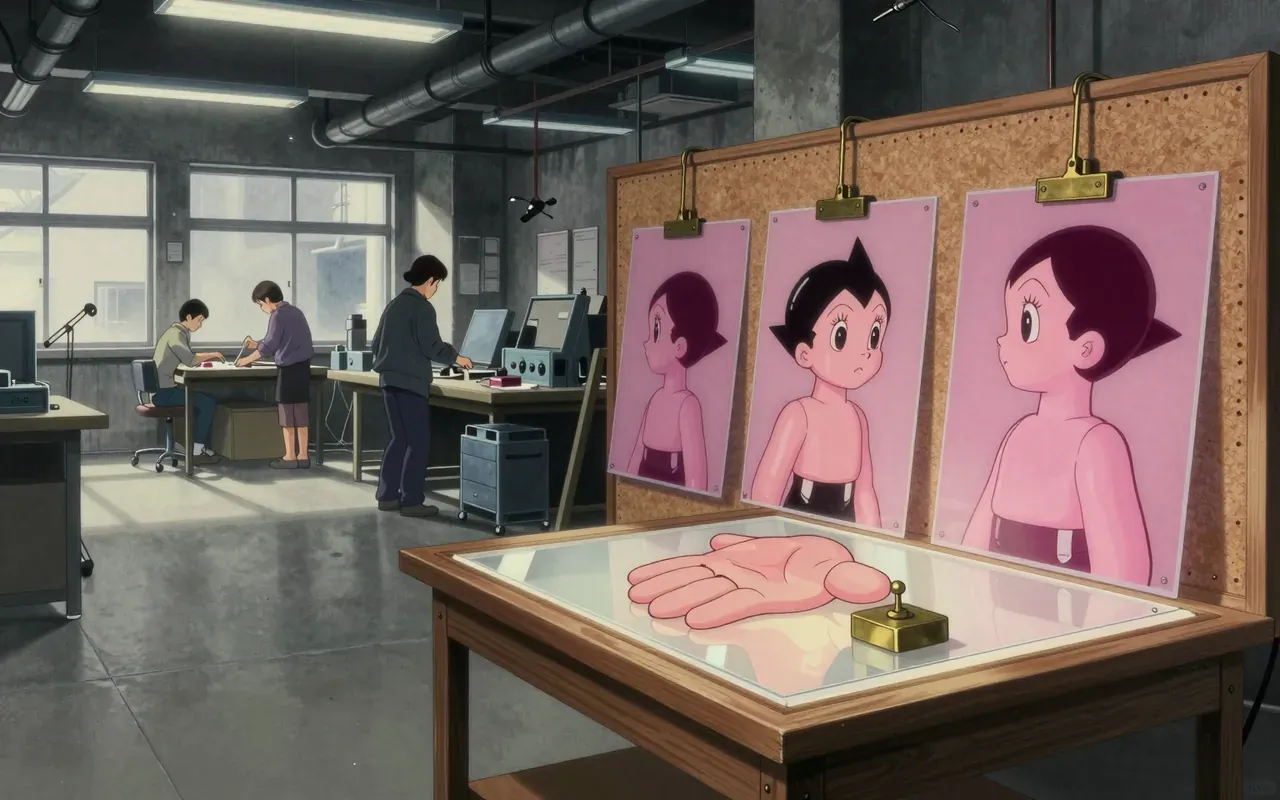
Tezuka’s contribution came from economy. In the 1960s he adapted and simplified Disney animation techniques to cut costs and limit frame counts, at first as temporary measures to meet a tight schedule with inexperienced staff. Many of those limited-animation practices came to define the medium’s style. His series Astro Boy (1963–66) was an early success, and several animators from his Mushi Production later founded major studios, including Madhouse, Sunrise and Studio Pierrot.
What it gets right
It names a medium by origin, not aesthetics. It adapts production to new technologies without abandoning broadcast or theatrical distribution.
Compared with Western animation, anime production generally puts less weight on movement and more on the detail of settings and on camera effects such as panning, zooming and angle shots. Limited animation is used both to meet deadlines and as an artistic device. The animation is almost always produced before the voice acting, the reverse of the usual American order. The works reach viewers in cinemas, on television, on direct-to-video releases and online, and are often adaptations of manga, light novels or video games. The industry has more than 430 production companies, and an episode can cost between US$100,000 and US$300,000 to produce.
What it gets wrong
It misleads outside Japan by implying stylistic uniqueness, when the term there denotes all animation—French, American, or Japanese—without distinction.
Wikipedia notes that anime is sometimes mistakenly classified as a genre, when it is a type of animation containing many genres. Its genre labels also resist simple classification: Gilles Poitras compared calling Gundam 0080, with its complex depiction of war, a “giant robot” anime to calling War and Peace a war novel. No single art style predominates across anime as a whole, and not every anime character has large eyes; Hayao Miyazaki’s works are known for realistically proportioned ones.
Why it matters now
Because global streaming platforms use ‘anime’ as a genre tag—erasing its Japanese linguistic breadth while amplifying its commercial narrowness.
Streaming figures give a sense of the audience. Netflix reported that between October 2019 and September 2020 more than 100 million member households worldwide watched at least one anime title, and that by 2025 more than 150 million households commonly watched it. In 2021 anime series were the most demanded foreign-language television shows in the United States, with a 30.5% market share. Wikipedia puts Japan’s anime industry at $24 billion a year in 2019, with 48% of that revenue coming from overseas.
The labour behind the output has drawn criticism. In recent years the industry has been accused, by Japanese and foreign media, of overworking and underpaying its animators, and in 2023 the Nippon Anime Film Culture Association was founded to address problems including working conditions.
Is it worth your time
Yes—if you need to understand how a word’s meaning fractures across borders, or how production methods outlive style.