What the thing is
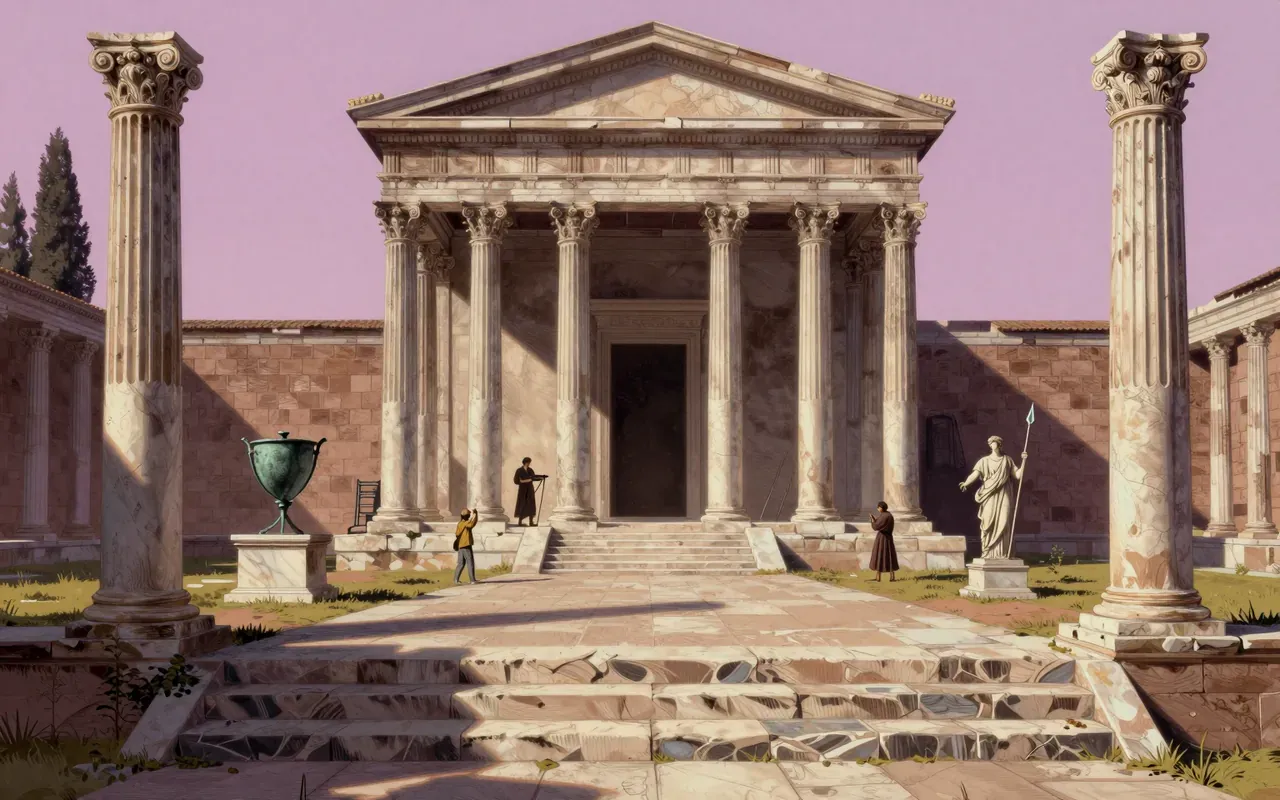
Neoclassicism is a Western cultural movement that revived forms from classical antiquity.
It reached across the decorative and visual arts, literature, theatre, music and architecture. In architecture it was built on simplicity and symmetry, where the Rococo it set itself against stressed grace, ornamentation and asymmetry. The word Neoclassical was not invented until the mid-19th century; at the time the style went by names such as “the true style”, “reformed” and “revival”.
Where it came from
It was born in Rome c. 1760, fuelled by Winckelmann’s writings and the excavations of Pompeii and Herculaneum.
The theory had a forerunner. Giovanni Pietro Bellori’s 1664 lecture on the “Ideal” in art at the Accademia di San Luca in Rome became the seminal statement of idealist art theory, and later the theoretical basis of what Winckelmann preached. Winckelmann’s books of 1755 and 1764 were the first to distinguish sharply between Greek and Roman art. He held that art should aim at “noble simplicity and calm grandeur”. The digs at Herculaneum began in the late 1740s but reached a wide audience only in the 1760s, with the first volumes of Le Antichità di Ercolano. Their spread across Europe came with the Grand Tour, as art students returned from Italy with Greco-Roman ideals.
What it gets right
It reasserted clarity, proportion and restraint against Rococo excess.
In painting it found a new direction with the success of Jacques-Louis David’s Oath of the Horatii at the Paris Salon of 1785. In interiors the Louis XVI style favoured straight lines, strict verticals and horizontals, and symmetry around a central axis, with ornament used to soften the severity rather than interfere with the basic lines. In Berlin, Karl Friedrich Schinkel gave the city a distinctly neoclassical centre, and his Bauakademie is considered a forerunner of modern architecture for its streamlined façade.
What it gets wrong
It mistook archaeological fragments for a complete aesthetic system—and imposed them as universal truth.
Each neo-classicism picks some models from the classics available to it and ignores others. Between 1765 and 1830 its proponents paid homage to the generation of Phidias, but the sculptures they embraced were more likely Roman copies of Hellenistic works, and they ignored Archaic Greek art and late antiquity. With Greece largely unexplored and regarded as dangerous Ottoman territory, Greek architecture reached them mostly through engravings that were subtly smoothed and regularised, “corrected” and “restored”, not always consciously. Greek painting was lost altogether, so painters revived it imaginatively, and much “Neoclassical” painting is more classicizing in subject matter than in anything else.
Why it matters now
It still shapes civic buildings, bank façades and national monuments—structures that claim legitimacy by echoing Rome.
The style was tied to power in specific cases. The Empire style, which took its name from Napoleon’s First French Empire, was intended to idealize his leadership and the French state. In Germany, mostly in what was then Prussia, Neoclassical architecture became widespread as a symbol of wealth and power. Elsewhere, the style’s examples include Sir John Soane’s Bank of England in London and the newly built United States Capitol in Washington, D.C. From the late 19th century it was often considered anti-modern, or even reactionary, in influential critical circles, yet the centres of Saint Petersburg and Munich came to look much like museums of Neoclassical architecture, and revivals continued into the 20th and 21st centuries, especially in the United States and Russia.
Is it worth your time
Yes—if you need to understand how classical authority was weaponised as modernity’s architectural grammar.