culturebriefs
9:03in productionCh. 1 · Marketplace, not meeting hall/ 9:03 · ceiling 15 min
Cities · Society

Forum (Roman)

The Roman forum wasn’t democratic—it was mandatory infrastructure for control.

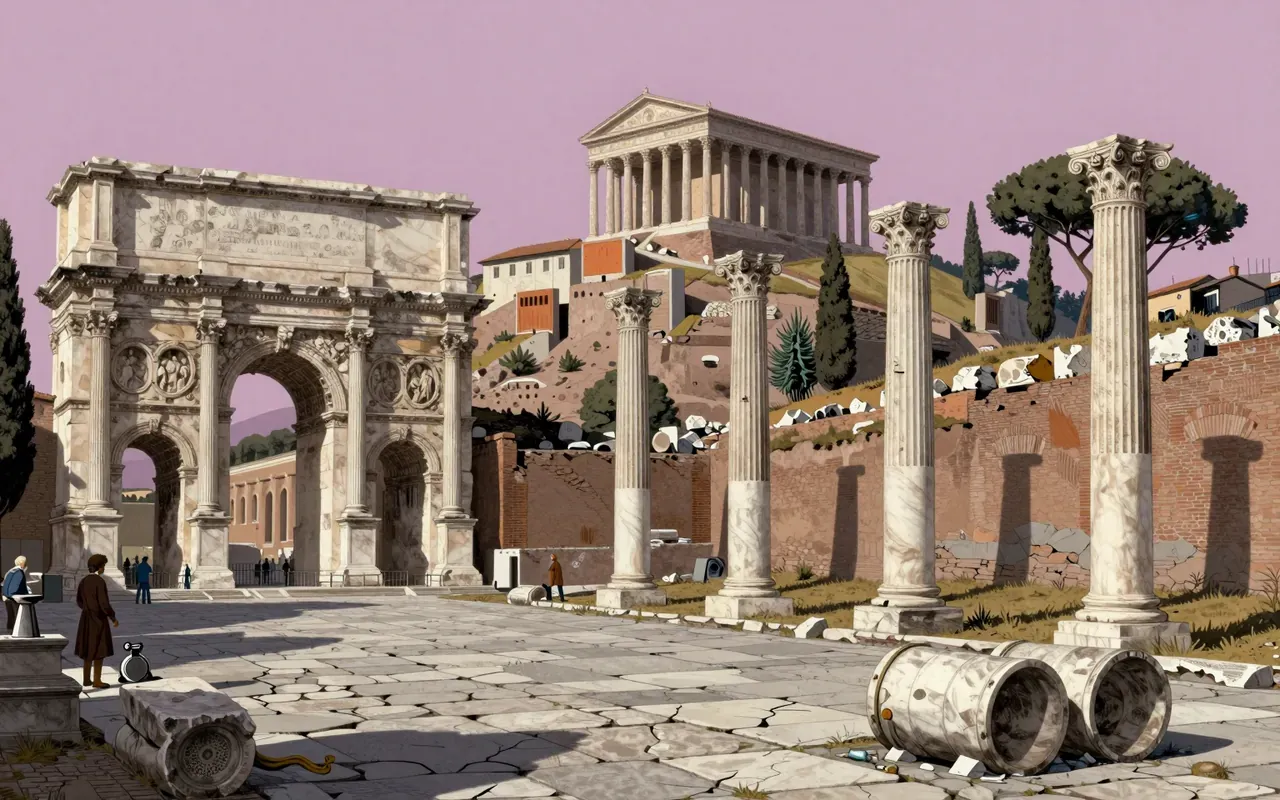
The Roman forum was a standardised civic square—marketplace first, political stage second. It appeared in every municipium, imposed a single spatial logic across culturally distinct civitates, and anchored urban planning to the cardo–decumanus grid. Its legacy is not democracy but infrastructural compulsion.

Chapters & takeaways4
  1. 0:55
    Marketplace, not meeting hall

    A forum was a marketplace first—and only secondly a place for talk.

  2. 2:34
    Mandatory in every town

    Every municipium had one—making it the first universal civic requirement across diverse cultures.

  3. 3:58
    Placed to command movement

    Its location was strategic: between villages at first, then fixed at the cardo–decumanus crossroads.

  4. 5:14
    A model that spawned monuments

    The Roman Forum in Rome set the standard—and its expansion directly inspired Pompey’s Theatre in 55 BC.

Worth your time?

Yes. Study the whole thing.

4.5/ 5
What works
  • culture/cities
  • culture/society
  • culture/ideas
What does not
  • culture/arts
  • culture/literature
  • culture/movements-and-scenes
  • culture/photography
Study it if
  • urban planners
  • historians of infrastructure
  • architects
Skip it if
  • classical philologists
  • art historians focused on aesthetics
  • literary scholars
The written brief2 min read

What the thing is

A Roman forum was a public square in a municipium or civitas—primarily a marketplace, secondarily a place for discussion.

The forum was reserved primarily for the vending of goods, with shops and stoas used for open stalls. Many were built at remote points along a road by the magistrate responsible for it, and where that happened the forum was the only settlement at the site and carried its own name, such as Forum Popili or Forum Livi.

Where it came from

The first forums were sited between independent villages. Every civitas—Latin, Italic, Etruscan, Greek, Celtic or other—synoecized around one. The Roman Forum in Rome became the architectural model after the Republic’s rise.

The earliest forums belong to a period known only through archaeology. By the late Republic, expansions and refurbishments of the forums of the city had inspired Pompey to build the Theatre of Pompey in 55 BC, with a massive forum behind its arcades known as the Portico of Pompey. That structure was the forebear of Julius Caesar’s forum and others to follow. In new Roman towns the forum usually stood at or just off the intersection of the main north–south and east–west streets, the cardo and decumanus.

What it gets right

It made commerce, politics and social exchange inseparable in one mandated civic space.

A forum typically held a Temple of Jupiter at the north end, other temples, the basilica, and a public weights and measures table so customers could check they were not being sold short measures, often with baths nearby. At election times, candidates used the temple steps to make speeches and expected their clients to come and support them. Political discussions, debates and meetings took place there alongside trade.

What it gets wrong

It assumed uniformity: every municipium got the same typology, regardless of local language, religion or settlement pattern.

Forums differ from the piazza of the modern town: piazzas are similar in use and function, but most were created in the Middle Ages, are often not part of the original city footprint, and may have come from several types of ancient civic centre or been a type of their own. Forums were a regular part of every Roman province in the Republic and the Empire, with archaeological examples at Plovdiv, Philippi, Thessaloniki, Beirut, Mérida and Tarragona.

Why it matters now

It is the earliest documented template for compulsory civic infrastructure—preceding zoning laws by two millennia.

Is it worth your time

Yes—if you care how public space is engineered to shape civic life.
Same beat · Cities4 of 35
10:05
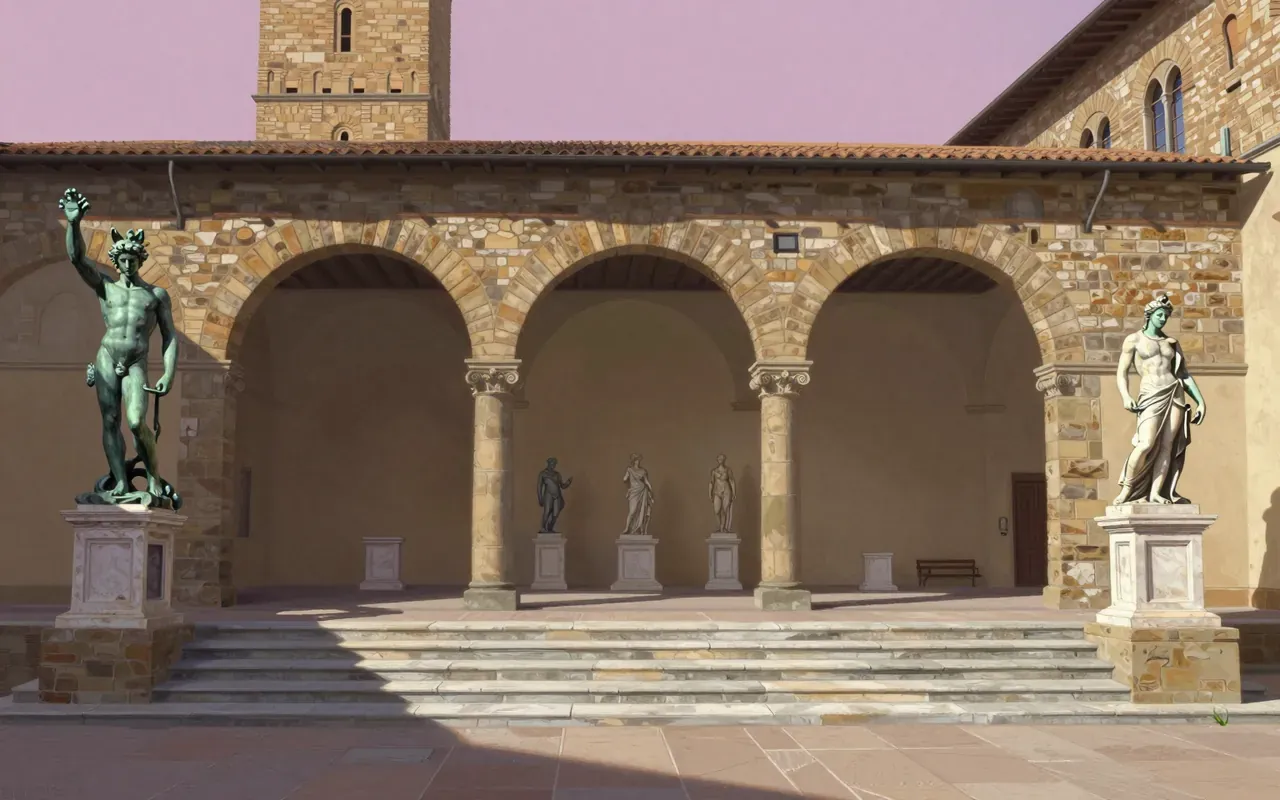
New exit for the Uffizi Gallery2012The New Exit for the Uffizi Gallery is a 1998 competition-winning architectural proposal by Arata Isozaki and Andrea Maffei. It was intended as a steel-and-stone loggia to expand the museum and activate Piazza Castellani. Though formally responsive to Florence’s Renaissance grammar and urban logic, its construction has been stalled since 2003 due to archaeological discoveries and preservation constraints. It exists only as a plan, a model, and a precedent for what cannot be built.
9:12
Pritzker Architecture Prize1979The Pritzker Architecture Prize is an annual award for living architects, founded in 1979 by Jay and Cindy Pritzker. It is judged by a rotating jury of five to nine experts. It accepts self-nomination. It claims to disregard nationality, race, creed, and ideology. Its first female winner was Zaha Hadid in 2004. Gordon Bunshaft self-nominated and won in 1988.
9:40
Hermitage Museum1764The Hermitage Museum is a state-owned art and culture museum in Saint Petersburg, Russia, founded in 1764 by Empress Catherine the Great through acquisition of a painting collection from Berlin merchant Johann Ernst Gotzkowsky. It holds the world’s largest collection of paintings and over three million items overall, housed across six historic buildings along Palace Embankment—including the Winter Palace—and several additional affiliated sites. It opened to the public in 1852 and ranked 10th among the most visited art museums globally in 2022 with over 2.8 million visitors.
9:46
MoMA PS11971MoMA PS1 began in 1971 as the Institute for Art and Urban Resources Inc., founded by Alanna Heiss in Long Island City, Queens. It opened in 1976 in a repurposed 1892 school building. A $8.5 million renovation completed in 1997 preceded its formal affiliation with MoMA in January 2000. That partnership integrated development, education, marketing, financial planning, and membership departments. Its stated aim was to promote contemporary art to a wide and growing audience.
Up next in Culture

Framing (social sciences)

· 9:56

Framing doesn’t reflect reality—it builds the lens through which reality becomes legible, actionable, and political.

9:56