culturebriefs
9:49in productionCh. 1 · Not a birth, but a naming/ 9:49 · ceiling 15 min
Movements & scenes · Art

Arts and Crafts movement

It wasn’t anti-machine—it was anti-factory conditions disguised as a love letter to oak and iron.

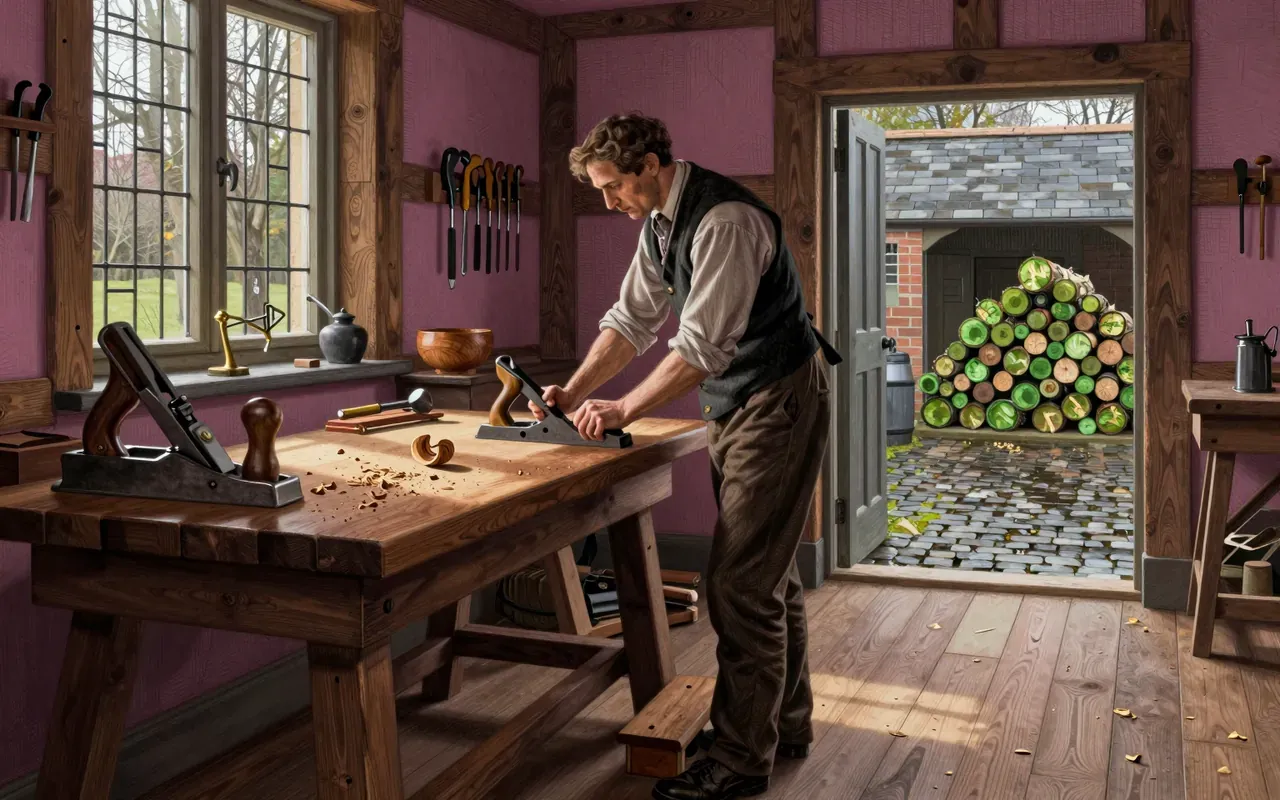
The Arts and Crafts movement was a British design reform effort active from the 1880s to about 1920. It opposed factory production and machine-made ornament, citing the 1851 Great Exhibition as proof of decline. It succeeded in shifting taste and establishing craft as moral category—but failed to address class, gender or colonial dimensions of production.

Chapters & takeaways4
  1. 0:55
    Not a birth, but a naming

    It began in the British Isles in the 1880s—not as a style, but as a label for an already-developing set of principles.

  2. 2:51
    Reform without redistribution

    It sought to reform decoration—but defined that reform as a rejection of machinery, not of exploitation or inequality.

  3. 4:32
    The spark was disgust, not delight

    The 1851 Great Exhibition didn’t inspire the movement—it provoked it, with its excesses acting as evidence, not aspiration.

  4. 6:16
    Over by 1920, not because it failed—but because it won the wrong way

    It ended in the UK by 1920—not because it succeeded, but because its language had been absorbed, diluted, and repurposed.

Worth your time?

Yes. Study the whole thing.

3.5/ 5
What works
  • established craft as ethical category
  • shifted public expectations of material honesty
  • created infrastructure for design exhibitions
What does not
  • influence William Morris’s Kelmscott Press (not mentioned in sources)
  • begin before the 1880s (sources say 1880s)
  • end globally by 1920 (sources specify UK only)
Study it if
  • middle-class patrons seeking authenticity
  • design reformers in Britain and across the Empire
Skip it if
  • factory workers
  • women designers (not named or referenced)
The written brief1 min read

What the thing is

A design reform movement focused on decorative and fine arts.

Where it came from

It originated in the British Isles in the 1880s, emerging from critiques of machinery and factory production sharpened by the 1851 Great Exhibition.

What it gets right

It correctly identified factory production as eroding material honesty and craft knowledge.

What it gets wrong

It romanticised pre-industrial labour while ignoring the poverty, drudgery and exclusion embedded in traditional workshops.

Why it matters now

It established a lasting vocabulary for critiquing mass production—yet its moral authority now obscures how much it displaced rather than reformed industrial logic.

Is it worth your time

Yes—if you care about how design choices encode values about labour, materials, and who makes things.
Same beat · Movements & scenes4 of 96
9:54
Notting Hill Carnival1965The Notting Hill Carnival is a British Caribbean-led street festival in London, rooted in responses to racial violence and shaped by incremental community stewardship — not mythic origin stories.
10:04
Afrika BambaataaAfrika Bambaataa originated breakbeat DJing. He co-opted the Black Spades into the Universal Zulu Nation in the Bronx in 1977. He released 'Planet Rock' in 1982—a breakthrough electro-funk track that fused drum machines, synthesizers, and Kraftwerk samples to define a new genre. He played the first commercially released American single made on a computer: EBN-OZN’s 'AEIOU Sometimes Y' in 1982. He shifted live performance away from bands to exclusive reliance on technology. His leadership of the Universal Zulu Nation ended in 2016 following child sexual abuse allegations.
9:02
Anti-Apartheid Movement1959The Anti-Apartheid Movement was a British organisation founded in London in 1959. It coordinated international opposition to apartheid and supported South Africa's non-white population. It began as the Boycott Movement in response to Albert Luthuli's appeal. It attracted widespread support from students, trade unions and the Labour, Liberal and Communist parties. It launched a March Month, Boycott Action at a rally in Trafalgar Square. The Sharpeville massacre triggered an intensification of anti-apartheid action. After renaming, the AAM coordinated all anti-apartheid work and kept apartheid policy central in British politics. It campaigned for the total isolation of apartheid South Africa, including economic sanctions. The AAM scored its first major victory when South Africa was forced to leave the Commonwealth in 1961.
10:37
Art Nouveau1890Art Nouveau was an international style of art, architecture and applied art—especially the decorative arts—that emerged in Brussels in the 1890s and was popular between 1890 and 1910. It was inspired by natural forms such as the sinuous curves of plants and flowers. It featured dynamism and movement through asymmetry and whiplash lines. It used modern materials like iron, glass, ceramics and concrete. A major objective was to break down the distinction between fine and applied arts. The first houses and interiors appeared in Brussels in the 1890s, designed by Paul Hankar, Henry van de Velde and Victor Horta—whose Hôtel Tassel was completed in 1893. By 1914, Art Nouveau was largely exhausted.
Up next in Culture

Audre Lorde

· 9:48

She named herself fully—not as branding, but as method.

9:48