9:40in productionCh. 1 · Not a style. A genre./ 9:40 · ceiling 15 min
Subcultures · Literature
Steampunk
Steampunk isn’t Victorian fantasy—it’s a steam valve on history’s pressure cooker.
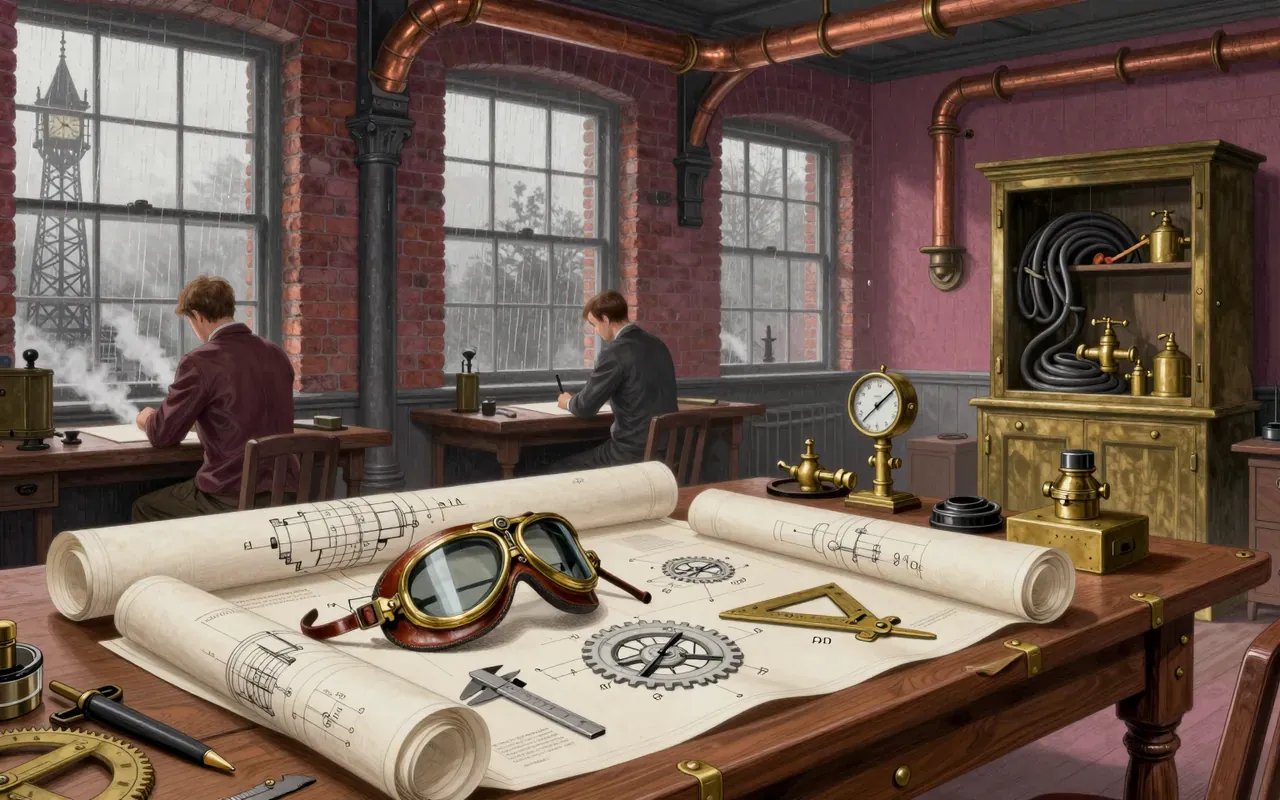
Steampunk is a science fiction subgenre defined by retro-futuristic technology and aesthetics rooted in 19th-century steam-powered machinery and design. It emerged among authors in the 1980s. K. W. Jeter coined the term in 1987. It applies retroactively to works from the 1950s onward—including Titus Alone (1959), widely regarded as the first novel in the genre proper. Steampunk often hybridises with fantasy, horror or alternate history. It is set in alternative histories of the Victorian era or American frontier where steam remains dominant. Its aesthetics reflect the 19th century’s perspective on fashion, culture, architecture and art—not just its surfaces.
Steampunk is science fiction first—not fashion, not décor, not lifestyle.
2:24
A name, not a movement.
The label was invented in 1987, not discovered in a forgotten ledger.
3:55
Perspective, not pastiche.
It roots itself in 19th-century perspectives—not just clothing or architecture, but how that era imagined possibility.
5:36
Peake came before the pun.
Titus Alone (1959) is widely regarded as the first novel in the genre proper.
Worth your time?
Yes. Study the whole thing.
3.5/ 5
What works
Titus Alone (1959)
Morlock Night (1979)
The Anubis Gates (1983)
Homunculus (1986)
What does not
influence
define
launch
inspire
Study it if
readers who track how genres formalise historical assumptions
Skip it if
those seeking political clarity or narrative cohesion
The written brief1 min read
What the thing is
Steampunk is a science fiction subgenre. It uses retro-futuristic technology and aesthetics inspired by 19th-century steam-powered machinery and design.
Where it came from
It emerged among science fiction authors in the 1980s. K. W. Jeter coined the term in 1987. He applied it retroactively to works like Titus Alone (1959) and his own Morlock Night (1979).
What it gets right
It treats technology as cultural artefact, not neutral tool. It shows how 19th-century design logic—gears, brass, visible mechanics—carries assumptions about labour, hierarchy and progress.
What it gets wrong
It flattens Victorian-era complexity into costume. It displaces colonial violence with clockwork romance. It mistakes aesthetic recycling for historical interrogation.
Why it matters now
It reveals how nostalgia functions as infrastructure: repackaging industrial-era control systems as charming, legible, and safe—while real-world automation accelerates without such ornament.
Is it worth your time
Yes—if you care about how speculative fiction reworks historical power structures through aesthetics. No—if you expect coherent worldbuilding or political critique.