culturebriefs
8:58in productionCh. 1 · Gold is glue/ 8:58 · ceiling 15 min
Art · Ideas

Kintsugi

1450

Kintsugi was never about healing—it was about making brokenness visible, precious, and ceremonial.

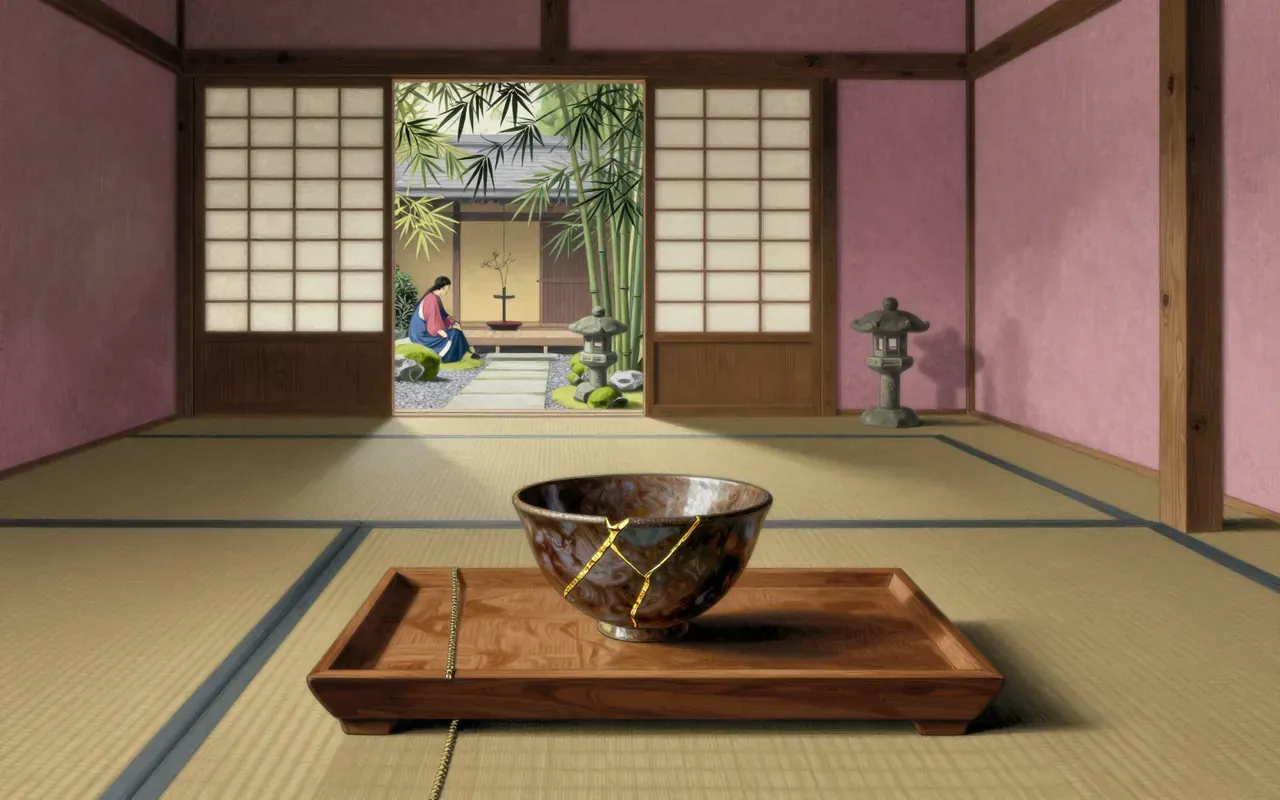
Kintsugi is a late-15th-century Japanese repair practice rooted in the tea ceremony. It uses urushi lacquer and precious metals to visibly mend broken ceramics—not to hide damage, but to integrate it into an object’s history. Its origin ties to Ashikaga Yoshimasa’s rejection of Chinese metal-staple repair. Though later associated with wabi-sabi and mono no aware, the sources do not attribute those philosophies to its invention—only to its resonance. Some collectors deliberately broke pottery to enable kintsugi, revealing its early status as a marker of connoisseurship, not consolation.

Chapters & takeaways4
  1. 0:50
    Gold is glue

    Kintsugi is a repair method that refuses disguise—it makes breaks luminous.

  2. 2:15
    A shōgun’s complaint

    It began not in quiet contemplation but in elite tea culture’s dissatisfaction with foreign repair.

  3. 3:38
    Staples that inspired gold

    Metal staples were ugly—but their ugliness sparked the search for something more intentional.

  4. 4:50
    Deliberate breakage

    Some collectors smashed pottery just to make it kintsugi-worthy—proving its status was performative, not spiritual.

Worth your time?

Yes. Study the whole thing.

4/ 5
What works
  • kintsugi-as-material-practice
  • kintsugi-as-tea-ceremony-tool
What does not
  • buddhism
  • zen
  • wabi-sabi
  • mono-no-aware
Study it if
  • tea-masters
  • collectors
  • lacquer-artisans
Skip it if
  • general-audience
  • self-help-readers
  • therapy-clients
The written brief1 min read

What the thing is

Kintsugi is a Japanese ceramic repair method using urushi lacquer and powdered gold, silver, or platinum. It is also a philosophy: breakage and repair belong in an object’s story.

Where it came from

It emerged in the late 15th century, linked to Ashikaga Yoshimasa and a damaged Chinese tea bowl returned from China with crude metal staples.

What it gets right

It treats breakage as history, not flaw. It embeds repair in ritual context—the tea ceremony—and insists on visibility, not erasure.

What it gets wrong

It is routinely misread as universal Zen wisdom. The sources show it was a narrow, elite craft response to one shōgun’s dissatisfaction with Chinese metal-staple repair.

Why it matters now

Because its contemporary misuse—as a vague symbol of resilience—obscures its real discipline: precise material knowledge, humidity-controlled curing (furo), and deliberate aesthetic choice within chanoyu.

Is it worth your time

Yes—if you care about material philosophy, not metaphor. Kintsugi is a specific repair practice, not a life-hack slogan.

Same beat · Art4 of 80
8:42
AquatintAquatint is a tonal printmaking method using acid-etched rosin particles. It originated in Amsterdam c.1650 but matured 1770–1830. It excels at atmospheric gradation but fails at precision. Its legacy is structural—not aesthetic—and it remains a key reference for how analogue systems encode continuous tone.
8:03
Art Deco1910Art Deco was a Paris-born, commercially rooted design language that treated jewellery, furniture, textiles, and architecture as interchangeable surfaces for geometric, luxurious styling. It began before WWI—not at the 1925 Exposition—and spread through department stores and fashion, not manifestos or salons.
10:37
Art Nouveau1890Art Nouveau was an international style of art, architecture and applied art—especially the decorative arts—that emerged in Brussels in the 1890s and was popular between 1890 and 1910. It was inspired by natural forms such as the sinuous curves of plants and flowers. It featured dynamism and movement through asymmetry and whiplash lines. It used modern materials like iron, glass, ceramics and concrete. A major objective was to break down the distinction between fine and applied arts. The first houses and interiors appeared in Brussels in the 1890s, designed by Paul Hankar, Henry van de Velde and Victor Horta—whose Hôtel Tassel was completed in 1893. By 1914, Art Nouveau was largely exhausted.
9:49
Arts and Crafts movementThe Arts and Crafts movement was a British design reform effort active from the 1880s to about 1920. It opposed factory production and machine-made ornament, citing the 1851 Great Exhibition as proof of decline. It succeeded in shifting taste and establishing craft as moral category—but failed to address class, gender or colonial dimensions of production.
Up next in Culture

Knafeh

· 10:36

Knafeh is not ancient—it’s a 19th-century invention dressed in caliph-era folklore.

10:36