9:08in productionCh. 1 · Built from ashes and altar stones/ 9:08 · ceiling 15 min
The arts · Cities
La Scala
1778
La Scala was never about art for art’s sake—it was opera as municipal utility.
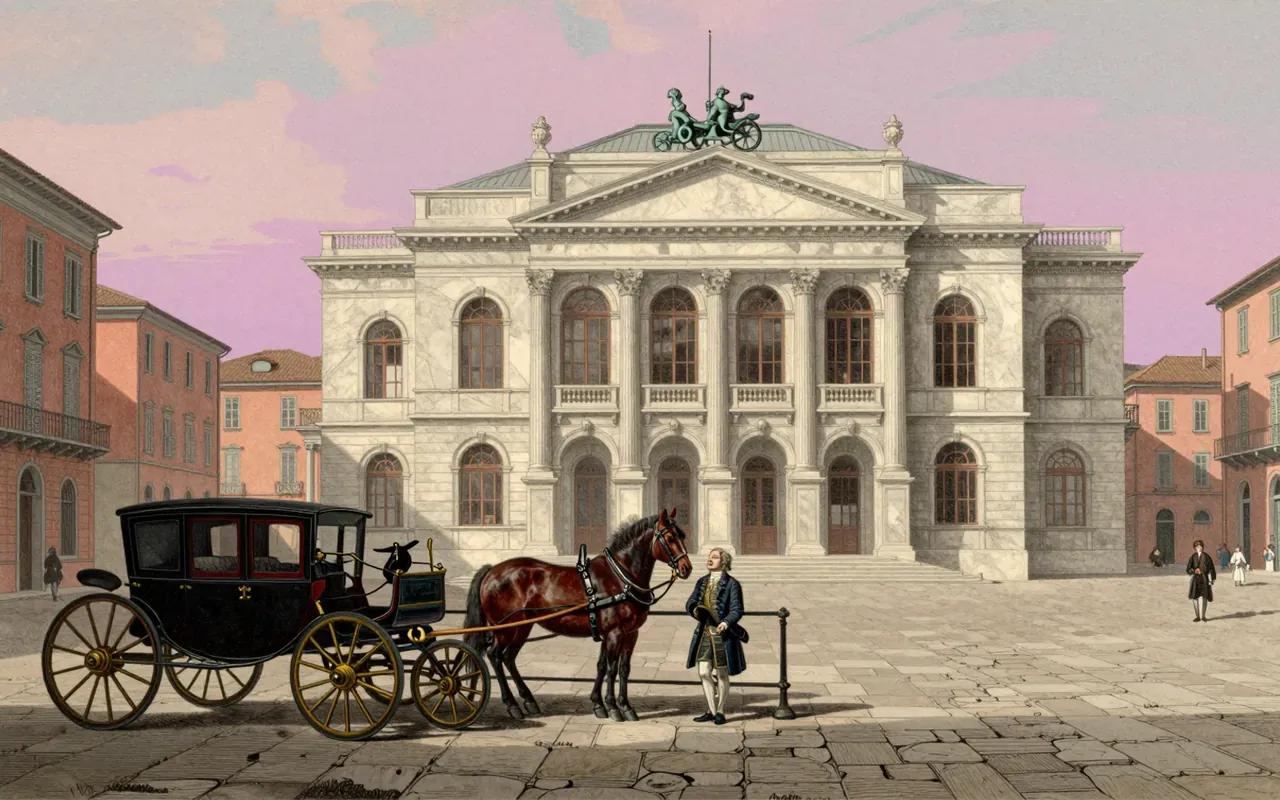
La Scala is an opera house in Milan, Italy, inaugurated on 3 August 1778 on the site of the deconsecrated church of Santa Maria della Scala, following the 1776 fire that destroyed its predecessor, the Teatro Regio Ducale. Built over two years by Pietro Marliani, Pietro Nosetti, and Antonio and Giuseppe Fe, it originally held ~3,000 seats and was illuminated by oil lamps—later replaced by gas and then electric lights in 1883. Renovated in 1907 (to 1,987 seats), damaged in WWII (1943) and rebuilt by 1946, and extensively modernized from 2002–2004, La Scala remains a leading global institution for opera and ballet, housing resident ensembles and an academy, and maintaining traditions such as opening its season on 7 December, Saint Ambrose’s Day.
It replaced a royal theatre destroyed by fire with a new civic institution on sacred ground.
2:45
A theatre engineered for order
Three architects built a 3,000-seat machine for hierarchy, visibility and control.
4:19
Light as infrastructure
Oil lamps gave way to gas, then electric light in 1883—each upgrade changed who could see, and be seen.
5:51
The shape that stuck
The 1907 renovation cut capacity to 1,987 seats—but locked in La Scala’s modern layout and ritual.
Worth your time?
Yes. Study the whole thing.
4.5/ 5
What works
opera
ballet
classical music
What does not
culture/literature
culture/photography
culture/subcultures
Study it if
audiences
architects
musicologists
Skip it if
casual tourists
first-time opera-goers
The written brief1 min read
What the thing is
La Scala is an opera house in Milan, Italy, built in 1778 as a purpose-built, publicly accessible theatre for opera and ballet.
Where it came from
It rose from the ashes of the Teatro Regio Ducale, destroyed by fire on 25 February 1776, on the site of the deconsecrated church of Santa Maria della Scala.
What it gets right
It established a permanent home for opera as civic infrastructure, not courtly entertainment. Its scale, seating hierarchy and fixed seasonal calendar codified opera’s social function in Enlightenment-era Milan.
What it gets wrong
Its original design prioritised spectacle over acoustics: oil lamps created heat and smoke; the loggione’s height compromised sound projection; the pit-stalls placed elite patrons closest to noise, not music.
Why it matters now
It remains a working institution—not a monument—still housing resident ensembles, training performers at its academy, and opening each season on 7 December, a tradition uninterrupted since the 19th century.
Is it worth your time
Yes—if you care about how institutions endure, not just how they begin.