10:25in productionCh. 1 · The Bubble/ 10:25 · ceiling 15 min
Art · The arts
Glassblowing
Glassblowing didn’t just make glass cheaper—it rewrote what glass could be, and who could hold it.
Glassblowing is a technique—not an art form, not a tradition, but a precise physical method. It turns glass’s disordered atomic structure into a controllable medium. It was invented once, in one place, at one time: the middle of the 1st century BC, by Phoenician and Syrian craftsmen. It spread rapidly because it worked: it enabled uniform thickness, prevented blow-through, and scaled from luxury vessels to everyday wares. It persists because nothing else does what it does.
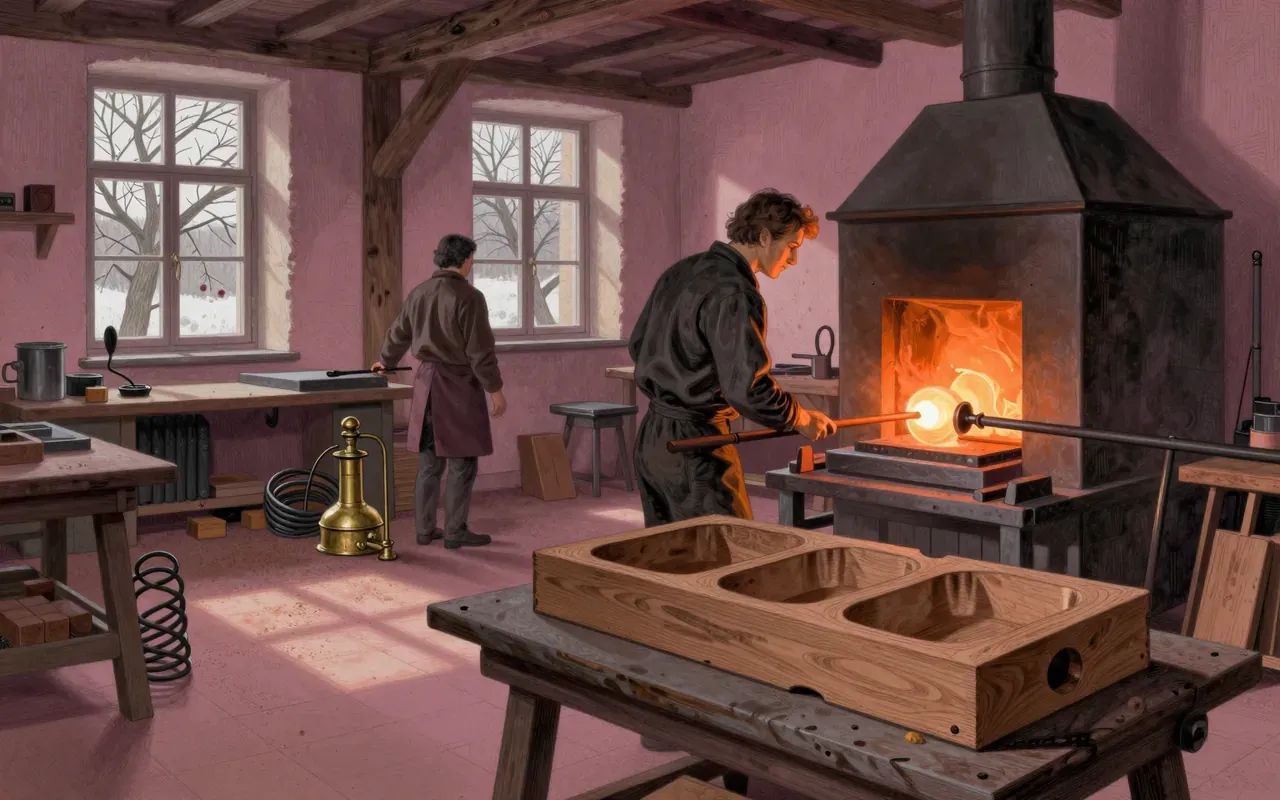
Glassblowing is defined by one action: inflating molten glass with air through a blowpipe.
2:06
The Invention
It was invented in the middle of the 1st century BC—and introduced inflation as a working property of glass for the first time.
3:30
The Physics
Thinner layers cool faster, becoming more viscous—so differential cooling prevents blow-through and ensures uniform thickness.
4:48
The Chemistry
A subtle compositional shift—slightly less natron—increased stiffness and made blowing possible.
5:50
The Scale
Free-blowing and mold-blowing were both fully developed within decades of its invention.
7:01
The Structure
Glass’s disordered atomic network gives it the viscosity needed to hold shape while hot—and harden gradually on cooling.
Worth your time?
Yes. Study the whole thing.
4.5/ 5
What works
culture/art
culture/arts
culture/ideas
culture/society
What does not
culture/cities
culture/generations
culture/literature
culture/photography
Study it if
designers
historians of technology
material scientists
Skip it if
casual viewers
general history readers
The written brief1 min read
What the thing is
Glassblowing is a method of forming glass by inflating molten glass into a bubble using a blowpipe.
Where it came from
It was invented in the middle of the 1st century BC by Phoenician and Syrian craftsmen.
What it gets right
It exploits glass’s disordered atomic structure to turn viscosity into control. It uses differential cooling to prevent blow-through. It enabled mass production of diverse forms within decades.
What it gets wrong
Nothing is claimed to be wrong in the sources. The technique itself has no moral or functional failure stated—only physical and compositional requirements.
Why it matters now
It underpins the modern studio glass movement, which began in 1962—and remains the primary method for making hollow, shaped glass objects at any scale.
Is it worth your time
Yes—if you care how material constraints shape culture, or how a single technical insight can scale across empires.