culturebriefs
8:44in productionCh. 1 · Method First/ 8:44 · ceiling 15 min
Art

Sandpainting

A healing tool disguised as art—where every grain is diagnostic, and sitting on it is part of the cure.

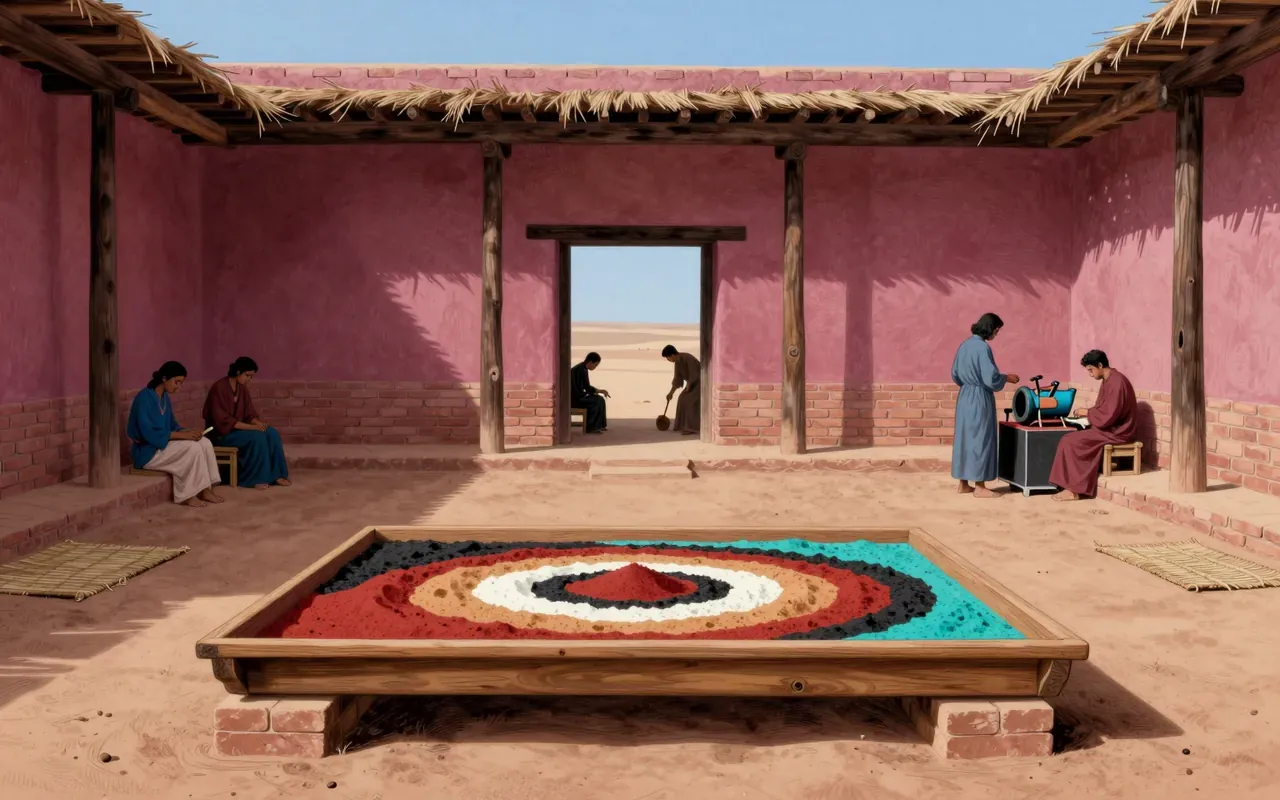
Sandpainting is a globally dispersed ritual practice grounded in controlled material application, intentional impermanence, and functional accuracy—not aesthetic novelty. Its Navajo iteration is medically specific: a diagnostic and therapeutic interface where symmetry restores harmony, accuracy enables efficacy, and physical contact transfers spiritual power. But the document explicitly lists non-healing uses across multiple traditions—commemorative, aesthetic, performative—making the claim of exclusive healing purpose inaccurate and reductive. It matters now because it offers a rigorous counterpoint to digital permanence, authorial ego, and disengaged spectatorship: here, making is healing, seeing is participating, and dissolution is part of the function.

Chapters & takeaways4
  1. 0:37
    Method First

    It is defined by method—not medium, not meaning—by pouring, not painting.

  2. 2:06
    Precision Is Power

    Accuracy isn’t symbolic—it determines whether the ritual works.

  3. 3:40
    The Body Is the Circuit

    The painting is a functional interface: a portal for spirits, a seat for absorption, a surface for exchange.

  4. 4:56
    Healing Is Not the Whole Story

    Claiming exclusive healing purpose erases its commemorative, aesthetic, and performative roles across cultures.

Worth your time?

Yes. Study the whole thing.

4/ 5
What works
  • culture/art
  • culture/society
  • culture/ideas
What does not
  • culture/arts
  • culture/cities
  • culture/fashion
  • culture/food
Study it if
  • practitioners
  • anthropologists
  • ritual studies scholars
Skip it if
  • casual art viewers
  • design students seeking inspiration
  • collectors
The written brief1 min read

What the thing is

Sandpainting is the controlled application of colored sands and powdered pigments onto a surface to make fixed or unfixed paintings. It is methodologically defined by manual control, ritual framing, and intentional ephemerality or fixation.

Where it came from

It is globally dispersed—not rooted in one origin. Documented traditions include Navajo, Tibetan Buddhist, Indigenous Australian, Japanese bonseki, European table decking, Georgian, Victorian Isle of Wight, Senegalese, sand bottle, sand carpet, and contemporary performance forms.

What it gets right

It treats accuracy as functional, not decorative. Every line, colour, and symmetry serves a diagnostic and therapeutic logic. The patient sits on it. Spirits move through it. Illness is absorbed and removed—not symbolically, but ritually.

What it gets wrong

It claims the paintings serve exclusively healing purposes. This contradicts the document’s own list of uses: commemorative, aesthetic, and ritual beyond healing—including Tibetan Buddhist, Japanese bonseki, Georgian, Victorian Isle of Wight, Senegalese, sand bottle, sand carpet, and contemporary performance forms.

Why it matters now

Because it models a non-instrumental relationship to time, material, and agency: where making is inseparable from unmaking, where efficacy depends on fidelity—not expression—and where spiritual power is transferred physically, not metaphorically.

Is it worth your time

Yes—if you need to understand how ritual precision, material impermanence, and embodied participation coalesce in a healing practice. No—if you expect aesthetic innovation, narrative, or individual authorship.
Same beat · Art4 of 98
9:47
Guerrilla artGuerrilla art is a UK-born street art movement defined by inseparability from environment, psychological effect over permanence, and roots in post-graffiti practice. Its earliest documented instance was in 1978 in Wellington, New Zealand. It has no external boundary between image and environment. The surface is fundamental to meaning. It depends on urban dynamics to avoid becoming 'art for art's sake'. Production focuses on cause and effect, not the material piece. It aims to produce an effect in local residents’ minds—not necessarily meaningful art in itself.
8:10
Arte Povera1967Arte Povera was a materially specific, institutionally embedded, temporally tight Italian art movement. It used perishable matter and physical forces to stage critique—but never left the gallery circuit it claimed to dismantle.
9:01
Cubism1907Cubism is an early-20th-century avant-garde art movement that began in Paris and flourished across the 1910s and 1920s. It involved analyzing, breaking up, and reassembling subjects in abstract form, depicting them from multiple perspectives rather than a single viewpoint. A major innovation was the introduction of collage in 1912. The movement is historically divided into phases—Analytic Cubism (1910–1912) and Synthetic Cubism (1912–1914)—each marked by distinct formal strategies. It emerged from collaborative work in the studios of Picasso and Braque and rapidly expanded to include numerous artists across painting, sculpture, architecture, literature, and design.
9:18
Fauvism1904Fauvism was a short-lived French painting movement (1905–1908) that treated colour as architecture and brushwork as velocity. It fused Post-Impressionist intensity with Neo-Impressionist technique and Tahitian colour fields—and was shaped by the visual experience of driving. Its strength was its sensory immediacy; its limit was its lack of structural logic beyond intensity. It matters now because it shows how technology alters perception before theory catches up.
Up next in Culture

Secular humanism

· 9:59

Secular humanism isn’t a philosophy—it’s a rhetorical target dressed as one.

9:59