10:11in productionCh. 1 · A word invented in 1925/ 10:11 · ceiling 15 min
Movements & scenes · Ideas
Mingei
Mingei wasn’t about folk art — it was a nationalist doctrine disguised as aesthetics.
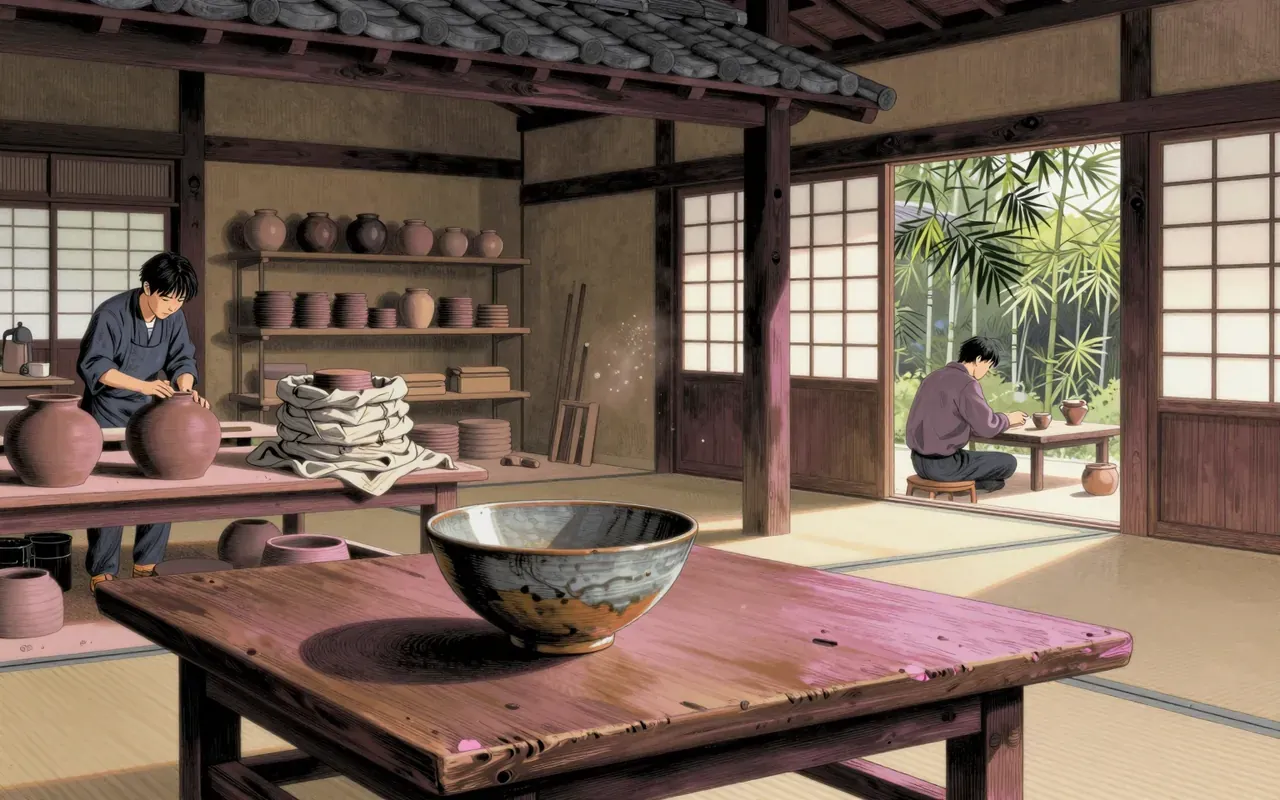
Mingei is a Japanese folk craft movement founded in the mid-1920s by Yanagi Sōetsu, Hamada Shōji and Kawai Kanjirō. They coined the term in 1925. It defines beauty in utilitarian, hand-made objects made by anonymous artisans using natural materials and traditional methods. Yanagi translated it as 'folk craft' — not 'folk art' — to distinguish it from individually inspired 'high' art. He prescribed eight criteria: natural materials, hand production, tradition, simplicity, functionality, plurality, inexpensiveness, anonymity, and healthy attitude. He argued beauty arises from 'direct perception' by the viewer and 'self surrender' by the maker. The movement institutionalised itself through the Japan Folk Crafts Museum (1936), the Folk Craft Association (1931), and magazines Kōgei (1931) and Mingei (1939). It extended a culturally nationalist 'criterion of beauty' to colonised regions like Korea — drawing criticism for colonialist appropriation. Post-war, mingei surged as a consumer 'boom' (1960s–mid-70s), but mechanisation, commercialisation, and the rise of named artist-craftsmen undermined Yanagi’s original ideals.
Mingei began as a deliberate coinage — not a rediscovery of tradition, but a new category forged by three men in the mid-1920s.
2:25
Beauty by subtraction
It defined beauty by exclusion: no named artists, no individual expression, no expense — only utility, plurality, and anonymity.
3:14
Chokkan and tarikidō
Appreciation required 'direct perception'; creation demanded 'self surrender' — aesthetic ideals rooted in Buddhist metaphysics, not craft practice.
4:09
Eight rules for true mingei
Its eight criteria were prescriptive, not descriptive — a checklist for legitimacy, not a record of existing practice.
5:24
Institutionalised anonymity
It built institutions — a museum in 1936, an association in 1931, two magazines — to enforce its definition of craft.
6:37
The boom that broke the doctrine
Post-war commercialisation betrayed its core tenets: anonymity dissolved, locality was flattened, and handmade gave way to mechanisation.
Worth your time?
Yes. Study the whole thing.
4/ 5
What works
Yanagi's 1928 book on mingei
What does not
art-deco
avant-garde
bauhaus
minimalism
Study it if
designers
curators
historians of empire
Skip it if
collectors seeking investment-grade ceramics
practising potters looking for technique manuals
The written brief1 min read
What the thing is
Mingei is a Japanese folk craft movement. It defines beauty in utilitarian, hand-made objects made by anonymous artisans using natural materials and traditional methods.
Where it came from
It emerged in the mid-1920s in Japan through discussions between philosopher Yanagi Sōetsu and potters Hamada Shōji and Kawai Kanjirō. They coined the term in 1925.
What it gets right
It locates beauty in utility, repetition, and collective making. It insists on natural materials, hand production, and regional specificity. It rejects the cult of the named artist.
What it gets wrong
It imposes a nationalist ‘criterion of beauty’ onto colonised regions like Korea. It romanticises poverty and anonymity while institutionalising its own hierarchy through museums and magazines.
Why it matters now
It prefigures today’s debates about craft commodification, algorithmic curation of ‘authenticity’, and the erasure of maker identity in mass-market design.
Is it worth your time
Yes — if you want to understand how beauty was weaponised as cultural policy, or how anonymity became a criterion for value in craft.