What the thing is
Osamu Tezuka was a manga author, editor, and pedagogue who systematised manga as a learnable craft and narrative medium.
Tezuka was born on 3 November 1928 in Toyonaka, Osaka, and died of stomach cancer on 9 February 1989. His output runs to over 700 volumes and more than 150,000 pages. Calling him the Japanese equivalent of Walt Disney praises his early children’s manga and animation, but blurs the influence of his later, more literary gekiga work.
Where it came from
He launched the manga revolution in 1947 with New Treasure Island, inspired by the Chinese animated film Princess Iron Fan.
He was studying medicine at Osaka University when his first professional work, Diary of Ma-chan, was serialized in a children’s newspaper in early 1946, at age 17. New Treasure Island came from a pitch by fellow manga creator Shichima Sakai, who suggested a story based on Stevenson’s Treasure Island; Tezuka based it only loosely on the novel. The 200-page akahon became an overnight success. Tezuka later said that the strongest influence on his wish to be an animator was not Disney, whose Bambi he had seen more than 80 times, but watching Princess Iron Fan as a child.
What it gets right
Tezuka treated manga as cinematic storytelling. He used motion, pacing, and emotional rhythm drawn from film. Kimba the White Lion proved manga could carry moral weight and sustained character arcs.
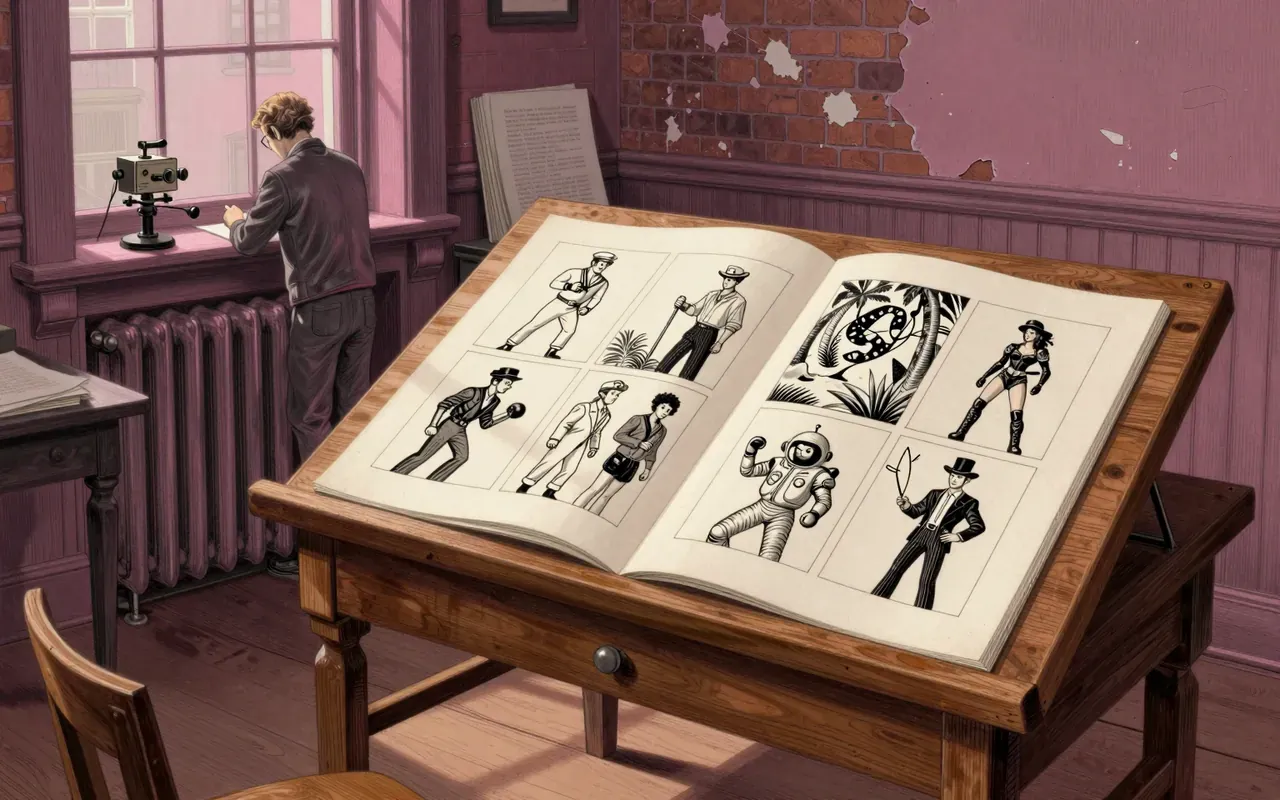
Kimba was the most popular feature of the magazine Manga Shōnen, where Tezuka also wrote the Manga Classroom column. His cinematic page layouts were influenced by Milt Gross’s early graphic novel He Done Her Wrong, and he put several depths into one frame, mirroring deep-focus cinematography in Hollywood film. His Star System cast recurring characters in different roles across his comics, the way actors play different parts.
On television, Astro Boy first aired on New Year’s Day 1963 and created the first successful model for animation production in Japan. Tezuka cut costs to 2.5 million yen per episode with techniques such as shooting on threes, stop images and repetition, none of which he invented but which his studio refined.
What it gets wrong
He ceded control of his own stories at Toei. His vision was diluted by studio constraints. The large eyes style he invented became reductive shorthand, not expressive nuance.
At Toei he did not enjoy the work on Saiyuki, released as Alakazam the Great in 1960, and disliked feeling he had no control over the story or its ending. His 500-page storyboard arrived late, and the crew found it unpractical for a 90-minute film. The large eyes he drew came from the performers of the Takarazuka Revue and from Western cartoon characters such as Betty Boop, Mickey Mouse and Bambi. His own studio was not a clean success either. Mushi Productions fell deep into debt, two adult animated films failed to rescue it, and it collapsed financially in 1973. Selling Astro Boy to the American market meant accepting rules, including no arc lasting more than an episode and no indication the show was made in Japan.
Why it matters now
His instructional work Manga Classroom (1952–1954) reframed comics as teachable technique—not innate talent—shaping generations of creators who still inherit that framework.
In 1967, responding to the magazine Garo and the gekiga movement, he founded the magazine COM and moved from a cartoony, Disney-esque style toward realistic drawing and adult themes. Phoenix, which he called his life’s work, ran from 1954 to 1988 and was unfinished when he died. The fallout from Mushi Productions’ collapse produced several influential animation studios, including Sunrise.
Is it worth your time
Yes—if you want to understand how manga became a narrative form, not just entertainment.