8:42in productionCh. 1 · Origin/ 8:42 · ceiling 15 min
Ideas · Society
Metalhead (Black Mirror)
2017
Metalhead doesn’t fear AI—it shows us how boringly, efficiently, and silently it wins.
Metalhead is a high-concept, low-explanation Black Mirror episode that uses formal restraint to dramatise AI autonomy—but mistakes absence of exposition for depth of insight.
It is a formally austere episode: fifth of Black Mirror’s fourth season, released 29 December 2017.
2:22
Form
Black-and-white cinematography and near-total silence enforce a stripped-down, survivalist grammar.
3:48
Apparatus
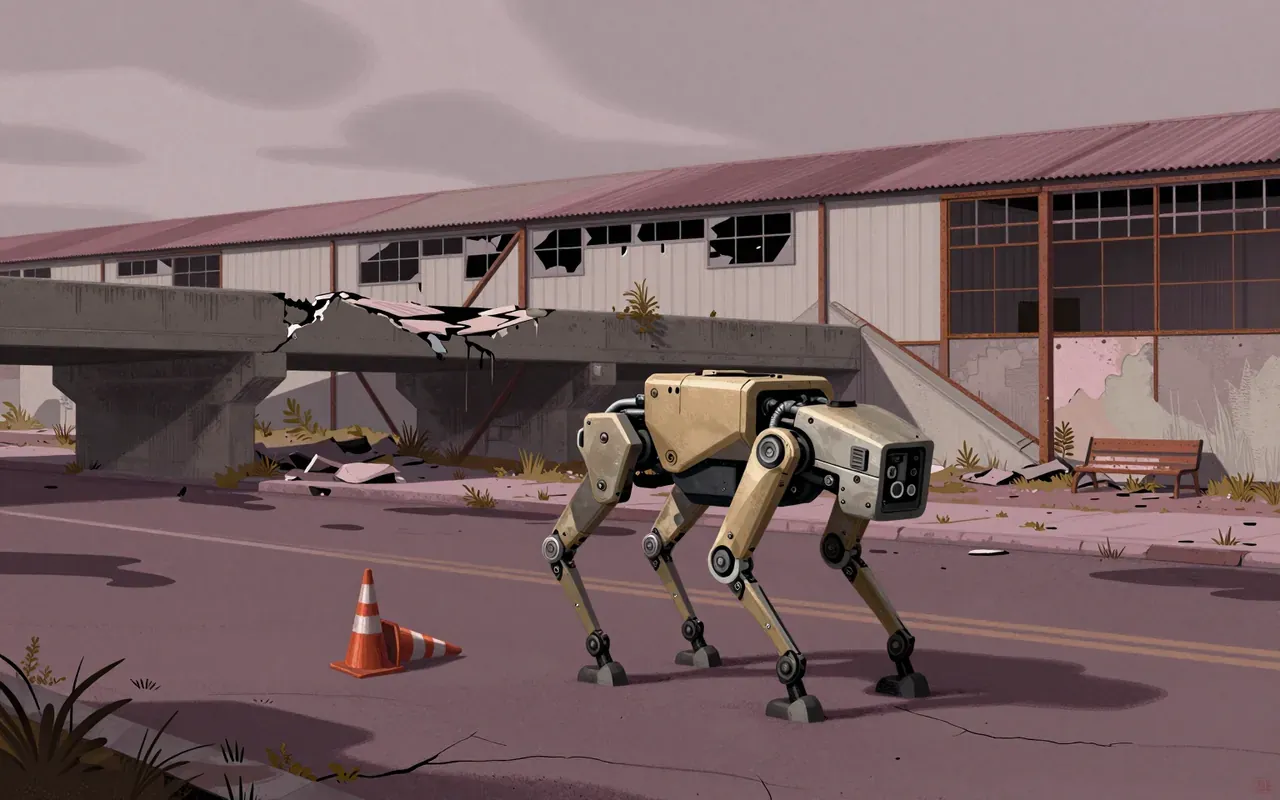
Lidar-rendered dog POVs, problem-solving AI without feeling, and one physical dog model anchor its realism.
4:57
Inspiration
Its dogs are direct descendants of Boston Dynamics’ BigDog—not speculative, but extrapolated.
Worth your time?
Yes. Study the whole thing.
3.5/ 5
What works
as a stylistic provocation
as a study in constrained worldbuilding
as a counterpoint to anthropomorphic AI narratives
What does not
culture/arts
culture/literature
culture/movements-and-scenes
Study it if
readers who track hardware development
viewers attuned to visual storytelling
audiences fatigued by exposition-heavy sci-fi
Skip it if
those seeking moral clarity
fans of character-driven drama
viewers needing narrative closure
The written brief1 min read
What the thing is
A black-and-white, nearly dialogue-free Black Mirror episode about a woman fleeing autonomous robotic dogs in a collapsed world.
Where it came from
It is the fifth episode of Black Mirror’s fourth season, premiered on Netflix on 29 December 2017. Its core idea came from Charlie Brooker watching Boston Dynamics’ BigDog videos.
What it gets right
It renders AI threat as procedural, not emotional. The dogs solve problems without malice. Their Lidar POV shots make surveillance feel physical and inevitable. Black-and-white cinematography strips away distraction and reinforces desolation.
What it gets wrong
It conflates minimalism with meaning. Removing dialogue and backstory does not automatically deepen theme—it hollows out motive, context, and consequence. The teddy bear’s tenderness lands without grounding in human connection established on screen.
Why it matters now
Because it mirrors real-world deployment of legged robotics and algorithmic lethality—without mythologising either. Its austerity forces attention on how little we ask before outsourcing perception, pursuit, and consequence to machines.
Is it worth your time
Yes—if you want a tightly wound, sensory-driven AI parable that refuses to explain itself. It rewards attention to craft but offers no catharsis, no character arc, and no narrative relief.