What the thing is
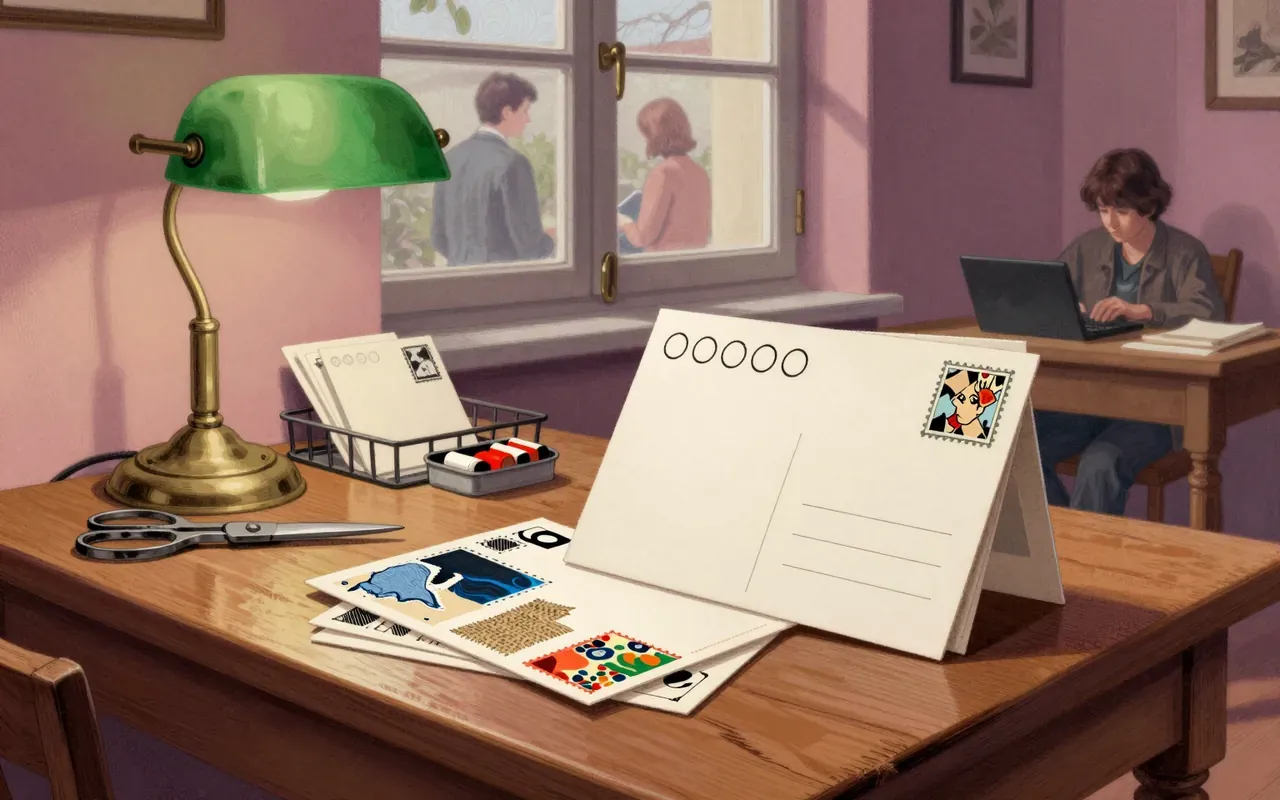
Mail art is an artistic movement centred on sending small-scale works through the postal service.
It is also called postal art and correspondence art. Common media include postcards, collage, rubber stamps and artist-made stamps called artistamps, but anything that fits in an envelope can be sent, including music, sound art and poetry. A mail artwork is considered art once it is dispatched.
Where it came from
It developed out of Ray Johnson’s New York Correspondance School and the Fluxus movements of the 1960s. Ray Johnson is considered the first mail artist. His mailing of ‘moticos’ in the mid-1950s provided a blueprint for the free exchange of art via post.
Johnson’s experiments with art in the mail date to 1943. In 1962 Edward M. Plunkett coined the name “New York Correspondence School” for Johnson’s activities, and Johnson adopted it while sometimes deliberately misspelling it “correspondance,” a playful habit typical of the school. Most of its members are fairly obscure. Its letters often featured simple drawings or stickers and asked the recipient to do something simple, such as calling a meeting of a fan club, one of which was devoted to the actress Anna May Wong. Many of Johnson’s mailings carried a hand-drawn bunny head that became a personal logo.
In a 1968 interview Johnson said he valued mailed correspondence because it removes the confrontation of two people talking, and delivers an object opened in privacy. The Fluxus artist Robert Filliou coined the term “Eternal Network,” which became synonymous with mail art, and many Fluxus members were among the network’s earliest participants. In 1970 Johnson and Marcia Tucker organised the New York Correspondence School Exhibition at the Whitney Museum, the first significant public exhibition of the genre.
What it gets right
It established a global, non-hierarchical network for artistic exchange. It treated the postal service as infrastructure, not a delivery system.
Its open-call rules were explicit. A mail art show has no jury, no entry fee and no censorship, and all works are exhibited. Original contributions are not returned, but a catalogue or documentation goes free to every participant. These rules were sometimes stretched but generally held for four decades. The practice also circumvented the art market, museums and galleries, and in the 1970s it grew considerably as a cheap and flexible channel for cultural outsiders. It was particularly widespread where state censorship limited the circulation of alternative ideas, as in certain countries behind the Iron Curtain and in South America.
What it gets wrong
It claimed universality while relying on functioning national post systems, stable addresses and literacy in dominant languages—conditions not evenly distributed in 1982.
The network also had limits of its own. English has been the de facto language because the movement began in America, though a growing number of artists now write in Breton, French, Italian, German, Spanish and Russian. In 1984 curator Ronny Cohen edited the works sent to the Franklin Furnace exhibition “Mail Art Then and Now,” breaking the custom that every submission is shown. Mail artists read this as censorship. The ensuing panel ended with Cohen leaving after being asked to give up moderating, and the debate documented how far the network was dominated by a small, mostly male circle. Johnson, who was not a panelist, commented on the event’s reverse-censorship and sexism in a letter to Mark Bloch.
Why it matters now
It prefigured peer-to-peer distribution, open participation and anti-curatorial practice—not as ideals, but as daily logistical acts.
Is it worth your time
Yes—if you care about art that bypassed galleries, institutions and gatekeepers before the internet made it easy.
Mail art’s peak in global postal activity was reached by the 1990s. Aware of rising postal rates, mail artists began gradually moving collective projects to the web and cheaper digital communication, and the Internet speeded up calls for work and brought in newcomers.