culturebriefs
9:06in productionCh. 1 · Departure/ 9:06 · ceiling 15 min
Movements & scenes · Literature

Merry Pranksters

They didn’t change America — they staged a perceptual intervention and called it a revolution.

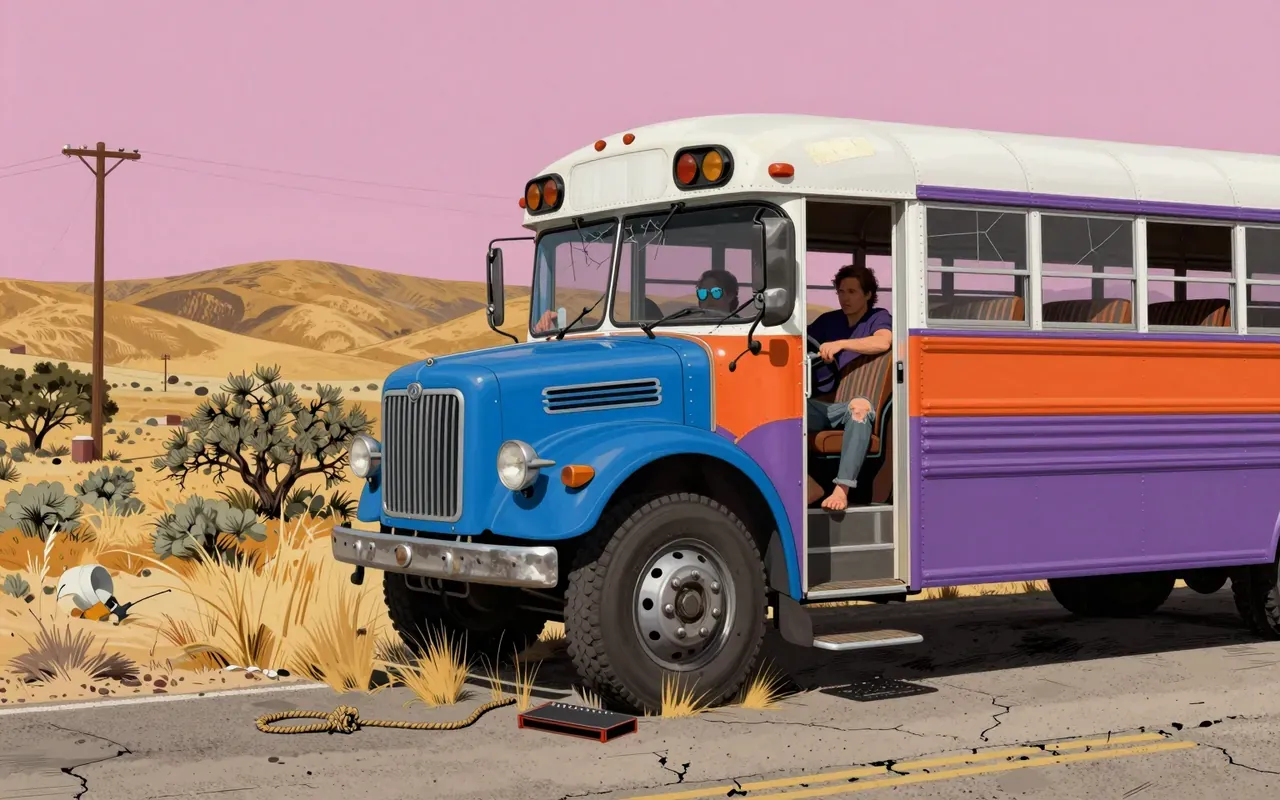
The Merry Pranksters were Ken Kesey’s followers. They travelled cross-country in a psychedelic bus in summer 1964. They gave out LSD and held parties. They aimed to confront American conformity with hallucinogen-fuelled spontaneity. They departed La Honda, California on June 17, 1964 with 13 members aboard Furthur. The trip celebrated Sometimes a Great Notion and targeted the 1964 World's Fair. They framed it as a reversal of westward expansion.

Chapters & takeaways4
  1. 0:55
    Departure

    Thirteen people left La Honda on June 17, 1964 — not as pilgrims, but as agents of deliberate disorientation.

  2. 2:20
    Method

    The bus wasn’t transport — it was a stage. Parties and LSD were tools to rupture routine, not ends in themselves.

  3. 3:58
    Confrontation

    They tested hallucinogenic spontaneity against conformity — and mistook reaction for resistance.

  4. 5:15
    Direction

    Reversing westward expansion was a rhetorical frame — not a geographic correction or a political programme.

Worth your time?

Yes. Study the whole thing.

3.5/ 5
What works
  • as a case study in self-mythologising
  • as evidence of how literary fame enables behavioural licence
  • as a precursor to immersive storytelling formats
What does not
  • define a decade
  • start a movement
  • influence named artists
  • displace mainstream culture
Study it if
  • readers of Kesey
  • students of 1960s media performance
  • critics of psychedelic exceptionalism
Skip it if
  • those seeking political strategy
  • historians of institutional change
  • fans of retrospective consensus
The written brief1 min read

What the thing is

A deliberately chaotic collective action led by Ken Kesey. Thirteen people in a painted school bus. LSD-distributed parties. A mobile theatre of disruption.

Where it came from

Ken Kesey’s ranch in La Honda, California. June 17, 1964. A communal base in Oregon preceded it. The group formed around Kesey’s authority and literary output.

What it gets right

They exposed the rigidity of mid-century American social scripting. Their bus trip forced unplanned encounters with mainstream norms. They treated perception as political terrain.

What it gets wrong

They assumed spontaneity was inherently liberating. They conflated chemical provocation with structural critique. Their reversal of westward expansion was symbolic, not material.

Why it matters now

It prefigures today’s attention economies: performative authenticity, branded collectives, and the conversion of lived experience into shareable narrative units.

Is it worth your time

Yes — if you want to understand how a small, self-aware stunt became a template for countercultural performance.
Same beat · Movements & scenes4 of 139
9:24
Adbusters1989Adbusters is a Canadian anti-capitalist activist foundation founded in 1989 in Vancouver by Kalle Lasn and Bill Schmalz. It uses culture jamming—especially subvertisements and campaigns like Buy Nothing Day and Occupy Wall Street—to challenge consumerism and corporate control of information flows. It publishes the reader-supported, advertising-free Adbusters magazine. Its founding premise is that citizens lack equal access to information flows compared to corporations.
8:14
Crypto-anarchyCrypto-anarchy is a movement, not a prophecy. It uses cryptography to enable anonymity, free speech and trade. It emerged from Timothy C. May’s 1988 manifesto and the 1992 cypherpunk founding. It gets right that code can constrain power—but wrong that it will collapse the state. A 2022 study confirms its political irrelevance—yet its architecture remains vital for Internet-native dissent.
8:35
Culture jammingCulture jamming is anti-consumerist protest that uses détournement to subvert corporate media forms. It began in the 1950s, was named in 1984 by Don Joyce of Negativland, and draws directly from the Letterist and Situationist Internationals. It correctly identifies media as a tool of perception-shaping and conformity-enforcement. But it wrongly assumes irony alone can resist power—and ignores how quickly its tactics are absorbed into branding. It matters now because corporate language has colonised every channel of attention, yet its methods remain stuck in the logic of the 1980s media landscape. It is worth your time if you want to understand why resistance so often looks like the thing it opposes.
8:55
Free software movementThe free software movement is a precise, principled refusal of proprietary control over software. It began in 1983 with GNU and institutionalised in 1985 with the FSF. It gets right that software freedom must be guaranteed—not merely permitted. It gets wrong that licence compliance alone secures user agency. Its relevance has grown as software becomes infrastructural—but its methods remain rooted in individual refusal and collective development.
Up next in Culture

Noble savage

· 9:59

The noble savage was never noble, never savage, and never real — just a rhetorical tool wielded across five centuries to justify, protest, or parody power.

9:59