9:49in productionCh. 1 · Origins: art, not austerity/ 9:49 · ceiling 15 min
Movements & scenes · Society
Tiny-house movement
A lifestyle trend masquerading as housing policy—visible, viral, and legally stranded.
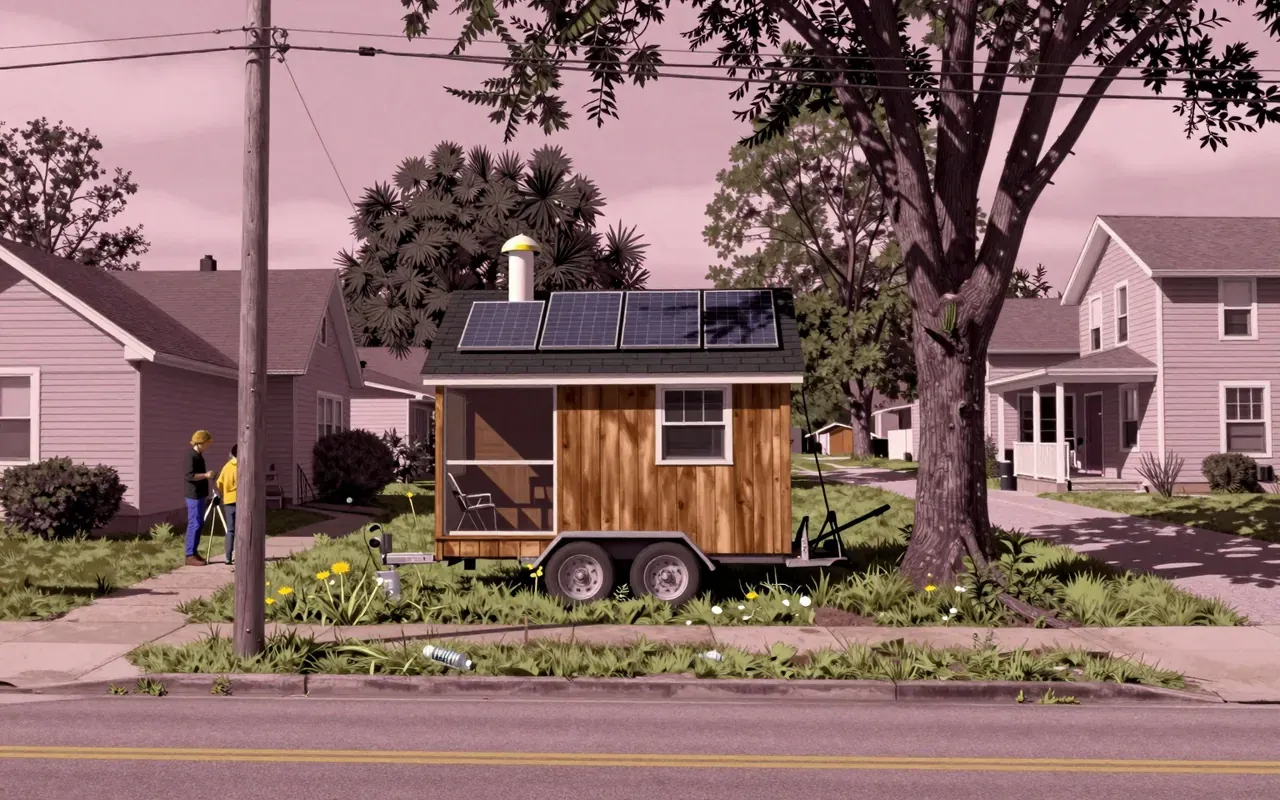
The tiny-house movement is an architectural and social movement promoting reduction and simplification of living spaces. Its core is full-time residence in very small floor-space buildings—often under 400–600 ft². It began in the 1970s with artists like Allan Wexler investigating compact living. It coalesced in the late 1990s when Jay Shafer built a 90-square-foot mobile home in 1999 and founded Tumbleweed Tiny House Company. The Small House Society formed in 2002 to advocate for it. Tiny homes have been promoted for lower cost, eco-friendliness, and as housing for homeless individuals. In the 2010s and 2020s, television shows and Instagram social media trends popularized them. The movement remains niche, facing legal, zoning, and scalability challenges. It grew through the 2020s—but growth was cultural, not infrastructural, and remains legally unanchored.
The movement did not emerge from necessity—it began with artists testing compactness, then hardened into a mobile, marketable unit.
2:08
Core: living, not building
Its definition is behavioural: full-time residence in very small floor space—not size alone, but commitment to constraint.
3:14
Amplification: screen over statute
It gained traction not through policy wins but through television and Instagram—turning housing into aspirational content.
5:31
Growth: viral, not viable
It grew through the 2020s—but growth was cultural, not infrastructural, and remains legally unanchored.
Worth your time?
Yes. Study the whole thing.
3.5/ 5
What works
as a provocation
as a design constraint test
as a lens on housing precarity
What does not
solve housing shortages
reform zoning law
scale beyond individual choice
Study it if
people seeking intentional, low-footprint residence
local governments piloting emergency shelter models
audiences consuming aspirational domestic content
Skip it if
most unhoused populations
municipal planners needing replicable infrastructure
developers seeking market-rate density
The written brief1 min read
What the thing is
An architectural and social movement promoting reduction and simplification of living spaces. Its core is full-time residence in very small floor-space buildings—often under 400–600 ft².
Where it came from
It began in the 1970s with artists like Allan Wexler investigating compact living. It coalesced in the late 1990s when Jay Shafer built a 90-square-foot mobile home in 1999 and founded Tumbleweed Tiny House Company. The Small House Society formed in 2002 to advocate for it.
What it gets right
It demonstrates that full-time residence in under 400 ft² is viable for some people. It highlights affordability and ecological constraints as urgent design drivers. It re-centres dwelling as intentional practice, not passive consumption.
What it gets wrong
It treats a niche architectural experiment as a systemic housing fix. It displaces structural critiques of land use, zoning, and capital with lifestyle minimalism. It offers no path past legal exclusion or scalability limits.
Why it matters now
Because tiny homes are promoted for homelessness response and disaster relief—and because TV and Instagram have amplified them since the 2010s, widening their cultural footprint while deepening the gap between visibility and viability.
Is it worth your time
Yes—if you care about housing policy, climate adaptation, or how cultural trends collide with legal reality. No—if you expect scalable solutions or widespread adoption.