9:46in productionCh. 1 · Origins: Congress and continuity/ 9:46 · ceiling 15 min
Movements & scenes · Society
Indian independence movement
It wasn’t one movement. It was a contested, evolving set of political efforts — some non-violent, some violent, all aimed at ending British rule.
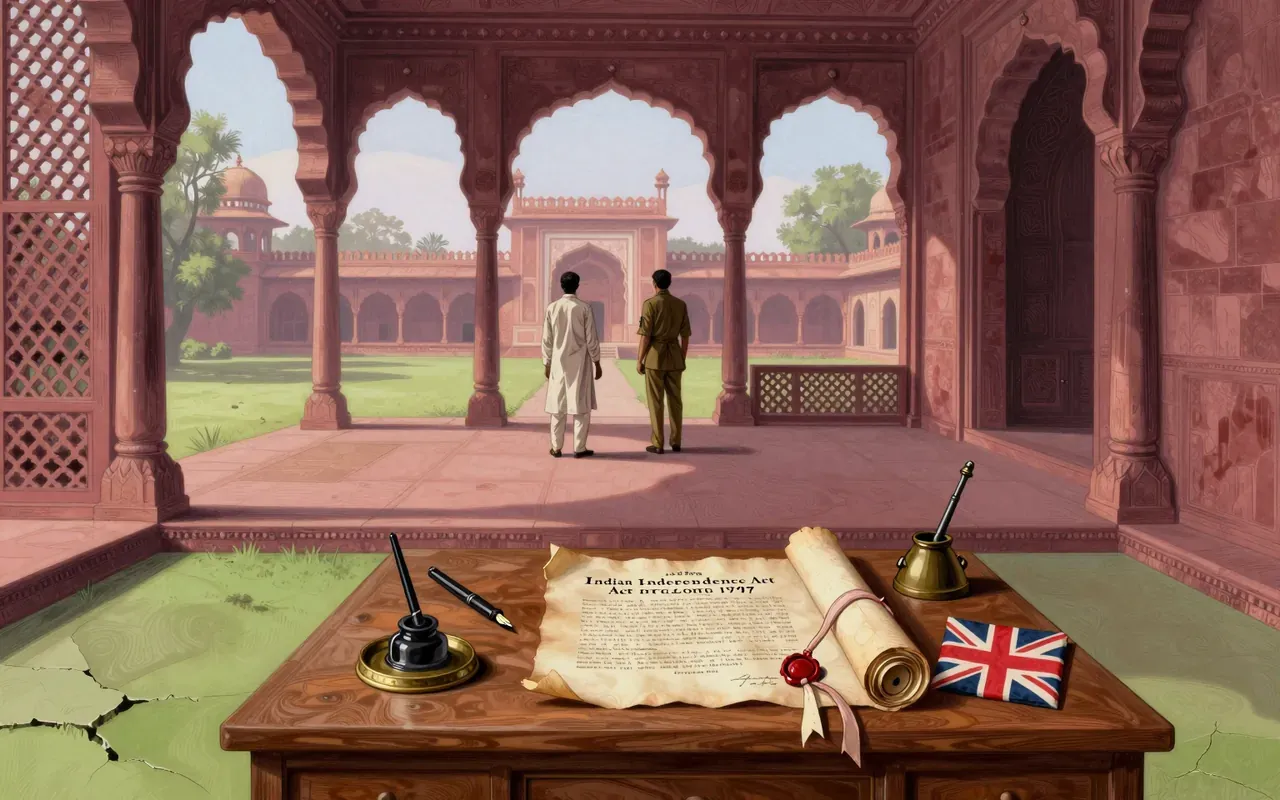
The Indian independence movement was a series of political efforts from the mid-1880s to 1947 aimed at ending British colonial rule in the Indian subcontinent. It began with the formation of the Indian National Congress in 1885. It progressed through successive mass campaigns — protests against the Partition of Bengal (1905), the Non-cooperation Movement (1919–1922), the Civil Disobedience Movement (1929–1931), and the Quit India Movement (1942). In the 1920s, it was characterised by Gandhi’s leadership and Congress’s adoption of non-violence and civil disobedience. A violent strand emerged after the Rowlatt Act enabled indefinite detention without trial. Ideologically, it evolved constantly: anti-colonial at its core, later incorporating secular, democratic, republican, civil-libertarian, and, after the 1930s, socialist orientations. It culminated in the Indian Independence Act 1947, ending Crown suzerainty and partitioning British India.
It started as a Congress-led reformist project in 1885 — not a spontaneous uprising.
2:06
Campaigns: From Bengal to Quit India
Its rhythm was defined by four named mass campaigns — each escalating in demand and scale.
3:27
Tactics: Non-violence and its rupture
Non-violence and violence coexisted — Gandhi’s strategy dominated the 1920s, but armed resistance gained ground after the Rowlatt Act.
4:54
Ideology: Constant evolution, not fixed doctrine
Its ideology was never settled — anti-colonial core, then layered with secular, democratic, republican, civil-libertarian, and later socialist aims.
6:29
Outcome: Sovereignty and division
It ended not in unity but in partition — the Indian Independence Act 1947 transferred power and divided British India.
Worth your time?
Yes. Study the whole thing.
4.5/ 5
What works
as a corrective to mythologised accounts
as a scaffold for understanding post-1947 political fractures
What does not
iconic
groundbreaking
seminal
timeless
Study it if
students of anti-colonial politics
readers tracking the roots of modern Indian statehood
Skip it if
those seeking a unified narrative of liberation
readers expecting cultural or artistic analysis
The written brief1 min read
What the thing is
A series of political efforts from the mid-1880s to 1947 aimed at ending British colonial rule in the Indian subcontinent.
Where it came from
It began with the formation of the Indian National Congress in 1885.
What it gets right
It correctly identifies the movement as a series of political efforts — not a monolith — spanning from 1885 to 1947, anchored by Congress, defined by successive campaigns, and shaped by Gandhi’s non-violence alongside violent strands triggered by repression like the Rowlatt Act.
What it gets wrong
It implies ideological coherence where there was contestation: socialist orientation only emerged after the 1930s, secular-democratic-republican-civil-libertarian aims were aspirational supplements, not consensus positions.
Why it matters now
It matters now because its unresolved tensions — between non-violence and armed resistance, secularism and partition, democracy and elite leadership — continue to shape Indian politics, law, and public memory.
Is it worth your time
Yes — if you need to understand how anti-colonial politics evolved through mass mobilisation, ideological adaptation, and tactical fracture in British India.