8:20 in production Ch. 1 · Feeling First / 8:20 · ceiling 15 min
Movements & scenes · Art Suprematism 1913
Suprematism didn’t invent abstraction—it declared war on meaning itself.
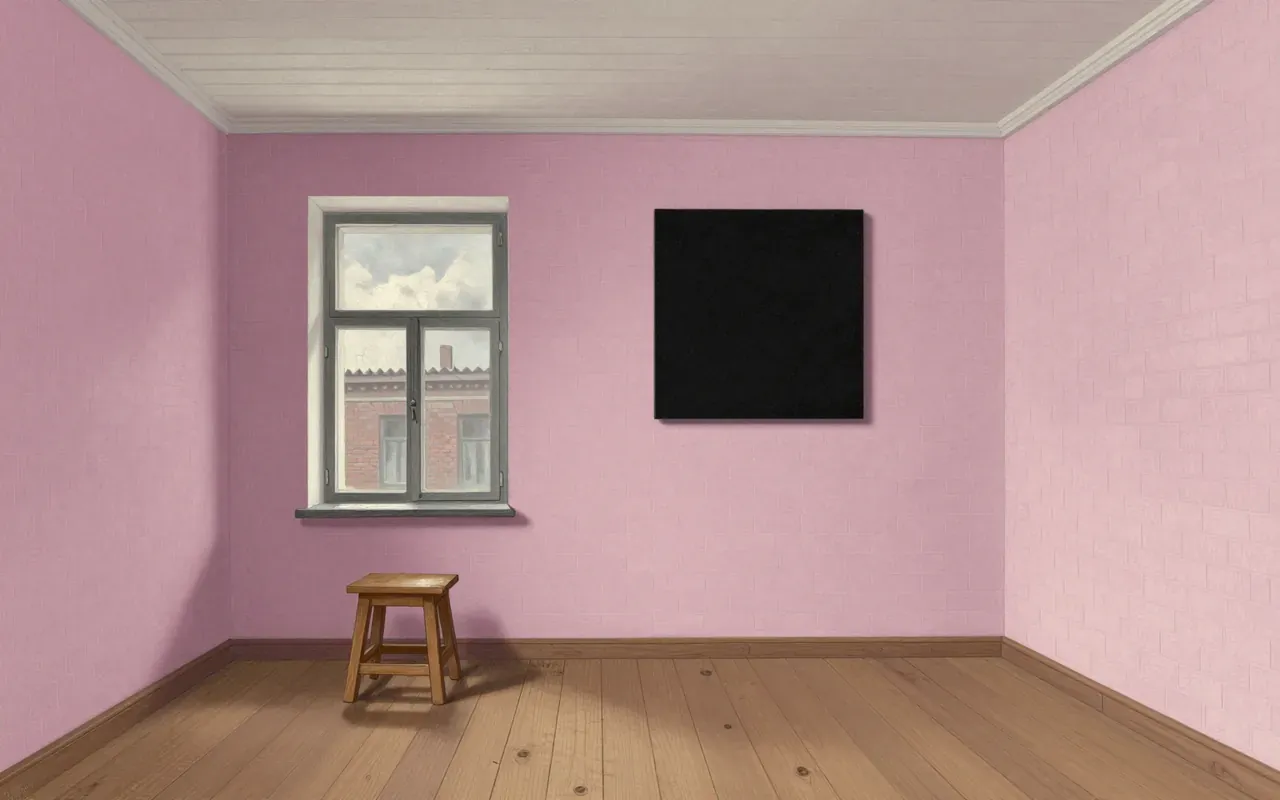
Suprematism is an early 20th-century Russian art movement founded by Kazimir Malevich in 1913, centred on pure feeling expressed through fundamental geometric forms—especially the square and circle—in a limited colour range. It rejected figurative depiction and objective reality, asserting that visual phenomena are meaningless in themselves and that only pure feeling matters. Its foundational public declaration occurred at the 1915 0.10 Exhibition in Petrograd, where Malevich presented Black Square as a breakthrough. White on White later marked a shift to monochrome. The movement opposed Constructivism’s materialism and utilitarianism, embracing instead anti-materialist, non-objective philosophy. Though the Supremus journal was planned from 1915 onward, its first issue was never distributed due to the Russian Revolution. Key figures included Malevich, El Lissitzky, Lazar Khidekel, and others in the Supremus group.
Chapters & takeaways 5
0:55 Feeling First
Feeling is not expressed through form—it replaces form.
2:20 A Grammar of Zero
The square and circle are not motifs—they are grammar.
2:55 The Red Corner
Black Square was placed like an icon—not to worship, but to dethrone.
4:06 Monochrome Shift
White on White isn’t minimalism—it’s erasure made visible.
5:12 No Structure, Only Supremacy
Liberation from predetermination leaves no map—only blank space.
Worth your time?
Yes. Study the whole thing. 4.5 / 5
What works it names the moment feeling becomes sovereign it exposes the violence of declaring anything 'supreme' What does not suprematism started a movement suprematism defined a decade suprematism influenced el lissitzky's later work suprematism displaced realism Study it if readers who treat abstraction as political act, not aesthetic choice Skip it if readers who need narrative, figuration or historical consensus The written brief 1 min read
What the thing is
Suprematism is an art movement built on squares, circles and rectangles in a limited colour range. It asserts pure feeling as supreme over depiction.
Where it came from
It emerged from Kazimir Malevich’s work in Russia in 1913. Its public launch was the 1915 0.10 Exhibition in Petrograd.
What it gets right
It establishes that feeling can be primary, not derivative. It strips art of mimesis and material utility in one gesture.
What it gets wrong
It mistakes the evacuation of meaning for the creation of meaning. Its anti-materialism offers no alternative structure—only negation.
Why it matters now
It clarifies the stakes of non-representation today—not as style or decor, but as a refusal of legibility as obligation.
Is it worth your time
Yes—if you want to understand how abstraction became a weapon against representation, not just its stylistic cousin.
Same beat · Movements & scenes 4 of 166
8:40
Expressionism Expressionism is a modernist movement originating in Northern Europe around 1900, defined by subjective perspective and radical distortion for emotional effect. It developed as an avant-garde style before the First World War and became predominant in Germany between 1910 and 1930—especially in painting, poetry and theatre. Though mainly German in its peak, its precursors were not. The term did not firmly establish itself until 1913. Die Brücke, founded in Dresden in 1905, was arguably its founding organisation—even if its members never used the word. 8:17
Neo-expressionism Neo-expressionism is a late 1970s painting and sculpture movement that reacted against conceptual and minimal art. It revived figurative representation with emotional intensity and vivid colour. It drew direct inspiration from German Expressionism. It dominated the art market until the mid-1980s. 9:34
Bloomsbury Group The Bloomsbury Group was a loose, friendship-based collective of British writers, intellectuals, philosophers and artists active in the early 20th century. It formed among Cambridge-educated men and their London-based female associates—including those from King’s College London—and cohered around regular gatherings (the Friday Club and Thursday Evenings), shared ethical commitments drawn from G. E. Moore, and pre-fame personal ties. Its members came largely from upper-middle-class professional families and saw themselves as part of an ‘intellectual aristocracy’ with roots in the Clapham Sect. It had no formal membership, no doctrine, and no institutional structure—only overlapping loyalties, mutual promotion, and a consistent emphasis on love, aesthetic experience and knowledge. 9:01
Cubism 1907 Cubism is an early-20th-century avant-garde art movement that began in Paris and flourished across the 1910s and 1920s. It involved analyzing, breaking up, and reassembling subjects in abstract form, depicting them from multiple perspectives rather than a single viewpoint. A major innovation was the introduction of collage in 1912. The movement is historically divided into phases—Analytic Cubism (1910–1912) and Synthetic Cubism (1912–1914)—each marked by distinct formal strategies. It emerged from collaborative work in the studios of Picasso and Braque and rapidly expanded to include numerous artists across painting, sculpture, architecture, literature, and design.