9:28 in production Ch. 1 · The Diplomat Who Got Fired / 9:28 · ceiling 15 min
He didn’t invent realpolitik—he documented its machinery, then got fired for it.
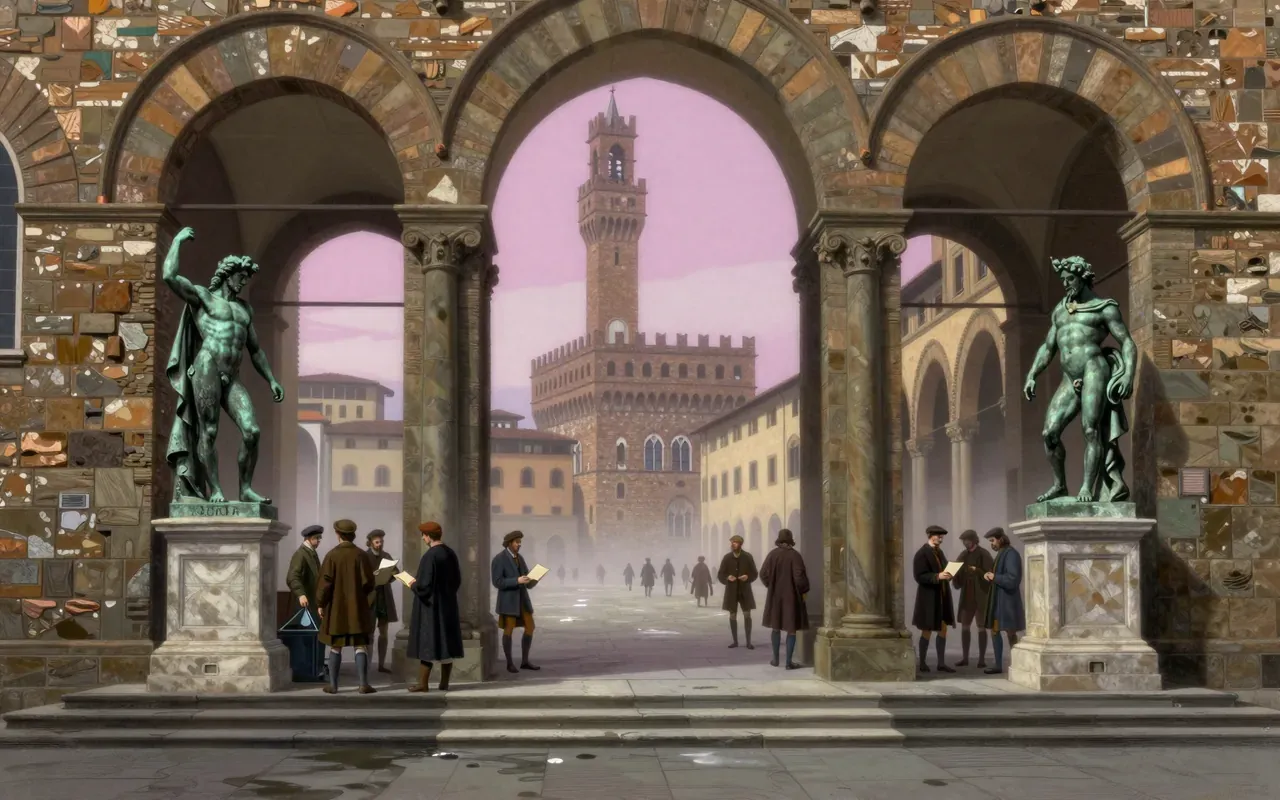
Machiavelli’s The Prince is a functional guide to power maintenance, written by a deposed official who knew how diplomacy and force intersected in Renaissance Florence. It does not glorify tyranny—it isolates the tools required when moral frameworks collapse. Its endurance lies in its refusal to conflate legitimacy with virtue. It matters now because it is still misread as cynical advice rather than diagnostic clarity.
Chapters & takeaways 4
1:01 The Diplomat Who Got Fired
His authority came from years inside Florence’s government—not from theory, but from negotiation, espionage, and troop deployment.
2:27 The Exile’s Handbook
The Prince was written in exile, not in office—a manual drafted after access to power was revoked.
3:58 Unsavory Policies, Not Evil Ones
It rejects classical ethics not to celebrate cruelty—but to isolate what sustains rule when ethics fail.
5:24 A Title Assigned Later
The 'father of modern political philosophy' label reflects later academic framing—not contemporary reception.
Worth your time?
Yes. Study the whole thing. 4.5 / 5
What does not celebrate justify romanticise Study it if students of politics practitioners of statecraft readers suspicious of moral simplification Skip it if those seeking ethical instruction devotees of classical virtue theory readers who require narrative or character The written brief 1 min read
What the thing is
The Prince is a short political treatise advising rulers on acquiring and holding power.
Where it came from
Machiavelli wrote it in 1513 after losing his diplomatic post in Florence and being exiled by the returning Medici.
What it gets right
It names the gap between moral theory and political practice. It treats rulership as a craft requiring observation, not virtue.
What it gets wrong
It assumes all political societies rest on coercion alone. It offers no mechanism for accountability or legitimacy beyond survival.
Why it matters now
It remains a reference point whenever leaders justify harsh measures as necessary—without naming the trade-offs those measures entail.
Is it worth your time
Yes—if you want a concise, unsentimental account of how power operates when ideals are set aside.
Same beat · Ideas 4 of 111
9:06
Ai Weiwei Ai Weiwei’s work is investigative, not expressive. It names, documents, and endures. It does not persuade authorities—it exposes their refusal to be persuaded. 9:10
Al-Ghazali Al-Ghazali is a Persian Shafi'i Sunni Muslim scholar born in Tus. He studied fiqh locally and under al-Juwayni in Nishapur. After al-Juwayni's death in 1085, he joined the court of Nizam al-Mulk in Isfahan. In July 1091, he was appointed head of the Nizamiyya of Baghdad. In 1095, he underwent a spiritual crisis and left Baghdad on the pretext of pilgrimage to Mecca. 8:32
Alliance française The Alliance française is a state-aligned language network whose colonial purpose is masked by its current framing as cultural exchange. 8:23
Aristotle Aristotle is the earliest surviving architect of Western intellectual infrastructure. His work is not a set of answers but a toolkit—still embedded in how we classify, argue and teach. It was built in Athens, rooted in Classical Greece, and designed for students—not the public, not rulers, not posterity.