culturebriefs
9:30in productionCh. 1 · The Readymade as Refusal/ 9:30 · ceiling 15 min
Art

Marcel Duchamp

Duchamp didn’t kill painting—he made authorship optional.

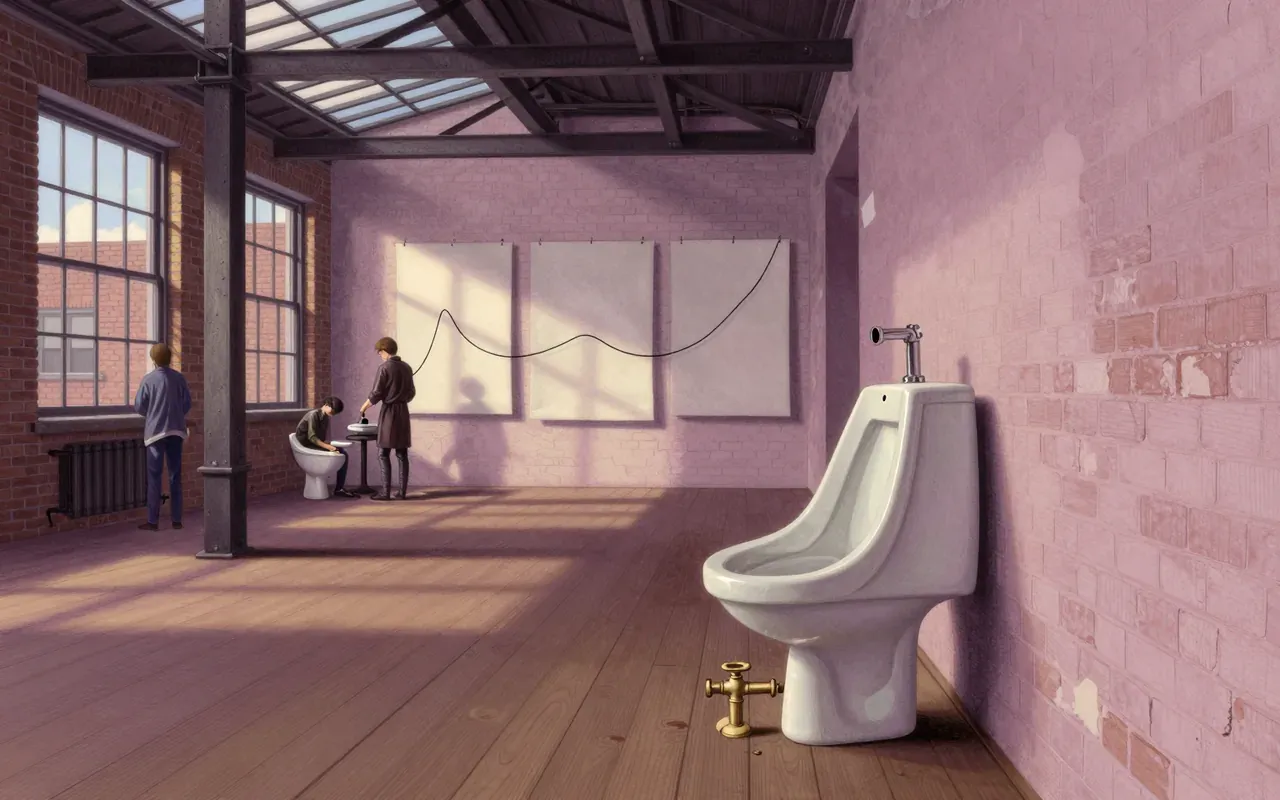
Duchamp’s work is not about irony or provocation. It is a set of repeatable protocols—indifference, chance, spectator-as-medium, anti-retinal framing—that redefined art’s operating conditions. It displaced painting not through opposition but through obsolescence. It reached avant-garde artists and institutional gatekeepers in Paris and New York before 1920. It displaced craft-based authorship, narrative legibility, and aesthetic consensus. It did not start Dada—but it provided its grammar.

Chapters & takeaways4
  1. 0:58
    The Readymade as Refusal

    He chose objects not for beauty or ugliness—but for indifference.

  2. 2:34
    The Spectator as Co-Author

    He gave the spectator equal creative agency—and called it the 'art coefficient'.

  3. 4:12
    Chance as Measurement

    He used gravity, weather, and randomness to unmake Euclidean certainty.

  4. 5:52
    The First Institutional Fracture

    He was rejected by Cubists for being too literal—and too mythic.

Worth your time?

Yes. Study the whole thing.

4.5/ 5
What works
  • readymades
  • 3-Standard-Stoppages
  • Nude-Descending-a-Staircase-No-2
What does not
  • dada
  • surrealism
  • pop-art
Study it if
  • artists
  • curators
  • philosophers-of-perception
Skip it if
  • art-history-survey-students
  • aesthetic-consumers
The written brief1 min read

What the thing is

A sustained, procedural critique of art’s conventions—using readymades, chance operations, anonymity, chess, and language play to displace intention, skill, and visual appeal.

Where it came from

Early 20th-century Paris and New York, amid Cubist orthodoxy, pre-Dada institutional resistance, and emerging scientific ideas about uncertainty, geometry, and perception.

What it gets right

It treats authorship as contingent, not sovereign. It replaces retinal pleasure with conceptual friction. It makes indifference a method, not a mood.

What it gets wrong

It assumes the spectator’s interpretation is always generative. It offers no mechanism for distinguishing between meaningful misreading and mere noise.

Why it matters now

Because algorithms now generate, curate, and valorise images without authorial presence—and Duchamp built the first operating system for that condition.

Is it worth your time

Yes—if you want to understand how art became a question rather than an object.
Same beat · Art4 of 98
9:47
Guerrilla artGuerrilla art is a UK-born street art movement defined by inseparability from environment, psychological effect over permanence, and roots in post-graffiti practice. Its earliest documented instance was in 1978 in Wellington, New Zealand. It has no external boundary between image and environment. The surface is fundamental to meaning. It depends on urban dynamics to avoid becoming 'art for art's sake'. Production focuses on cause and effect, not the material piece. It aims to produce an effect in local residents’ minds—not necessarily meaningful art in itself.
8:10
Arte Povera1967Arte Povera was a materially specific, institutionally embedded, temporally tight Italian art movement. It used perishable matter and physical forces to stage critique—but never left the gallery circuit it claimed to dismantle.
9:01
Cubism1907Cubism is an early-20th-century avant-garde art movement that began in Paris and flourished across the 1910s and 1920s. It involved analyzing, breaking up, and reassembling subjects in abstract form, depicting them from multiple perspectives rather than a single viewpoint. A major innovation was the introduction of collage in 1912. The movement is historically divided into phases—Analytic Cubism (1910–1912) and Synthetic Cubism (1912–1914)—each marked by distinct formal strategies. It emerged from collaborative work in the studios of Picasso and Braque and rapidly expanded to include numerous artists across painting, sculpture, architecture, literature, and design.
9:18
Fauvism1904Fauvism was a short-lived French painting movement (1905–1908) that treated colour as architecture and brushwork as velocity. It fused Post-Impressionist intensity with Neo-Impressionist technique and Tahitian colour fields—and was shaped by the visual experience of driving. Its strength was its sensory immediacy; its limit was its lack of structural logic beyond intensity. It matters now because it shows how technology alters perception before theory catches up.
Up next in Culture

Marimekko

Armi Ratia · 1951 · 9:33

Marimekko didn’t liberate fashion—it industrialised pattern-making, then sold the result as freedom.

9:33