culturebriefs
7:52in productionCh. 1 · Born in the tag/ 7:52 · ceiling 15 min
Subcultures · Generations

Light academia

Light academia isn’t hopeful—it’s hope made wearable, then sold.

Light academia is a Tumblr-born aesthetic subculture from 2019. It emphasises light visuals and positive emotions: optimism, joy, friendship. It positions itself as the lighter counterpart to dark academia. It ranked seventh among Tumblr’s top ten aesthetics by end-2020, and third by end-2021. It uses a neutral-earthy palette and draws clothing cues from early-to-mid-20th-century college wear.

Chapters & takeaways4
  1. 0:46
    Born in the tag

    The term was coined on Tumblr in 2019—not in a lecture hall or a design studio, but in a tag field.

  2. 1:56
    Defined by absence

    It defines itself only by contrast: lighter than dark academia, visually and emotionally.

  3. 3:09
    Ranked, not revered

    Its rise was measurable: from seventh to third on Tumblr’s aesthetic rankings in twelve months.

  4. 4:22
    Emotion as aesthetic

    It trades in optimism, joy, and friendship—not critique, rigour, or contradiction.

Worth your time?

Yes. Study the whole thing.

3.5/ 5
What works
  • as visual shorthand
  • as mood packaging
  • as commercial signal
What does not
  • history
  • politics
  • literature
Study it if
  • Gen Z
  • social media users
  • retail buyers
Skip it if
  • historians
  • educators
  • archivists
The written brief1 min read

What the thing is

Light academia is an internet-born aesthetic subculture. It is defined by light visuals and positive emotional themes: optimism, joy, friendship.

Where it came from

It was coined on Tumblr in 2019. It rose rapidly across Tumblr, Pinterest, and Depop between 2020 and 2022. By end-2020 it ranked seventh among Tumblr’s top ten aesthetics; by end-2021 it was third.

What it gets right

It delivers a legible, emotionally warm counterpoint to dark academia’s gothic austerity. Its palette and clothing cues—cream, beige, oat, tweed, oxford cloth, loafers—signal aspiration without menace. It names a mood: studious joy.

What it gets wrong

It flattens early-to-mid-20th-century college dress into costume, ignoring class, gender, and racial exclusions baked into those institutions. It treats ‘academia’ as décor, not practice.

Why it matters now

It reveals how Gen Z repackages institutional nostalgia as self-care. It shows the demand for benign, non-ironic idealism in digital spaces—and how quickly that idealism becomes commercially extractable.

Is it worth your time

Yes—if you need a visual shorthand for collegiate optimism in 2020–2022. No—if you’re looking for historical accuracy, ideological coherence, or sustained cultural infrastructure.
Same beat · Subcultures4 of 96
8:48
Image macroImage macros are a digital interface—not an art form. They standardised how millions expressed irony, frustration and affiliation before platforms automated tone and stripped away authorship. Their rigidity enabled scale. Their simplicity enabled theft. Their legacy isn’t humour—it’s the template as infrastructure.
10:01
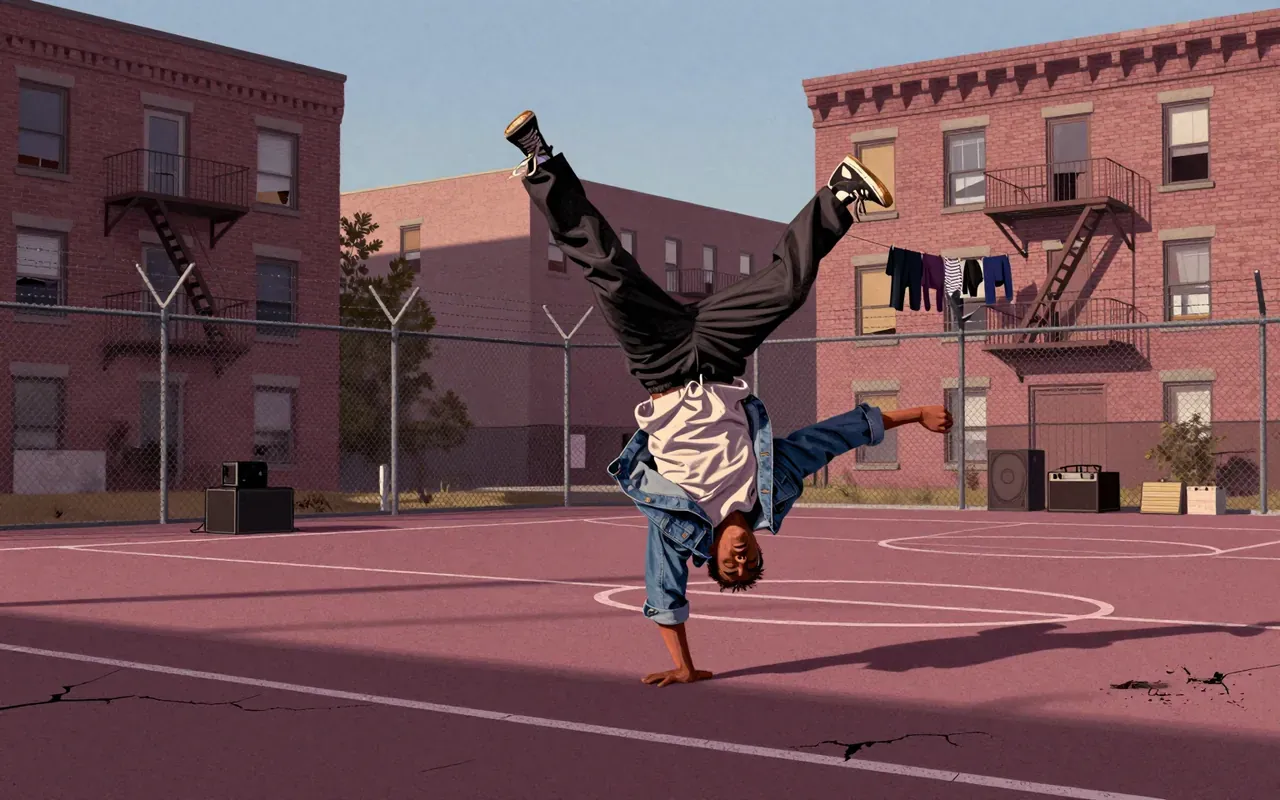
BreakdancingBreakdancing is a street dance style developed by African Americans and Puerto Ricans in the Bronx during the 1970s and early 1980s. It consists of four core movement types — toprock, footwork, power moves, and freezes — performed to music featuring drum breaks. Its Olympic debut in Paris 2024 formalised a global practice that began as an act of cultural assertion in marginalised communities.
9:42
BanksyBanksy is a pseudonymous England-based street artist whose practice centres on stencilled, satirical interventions placed on publicly visible surfaces. He emerged from the Bristol underground scene in the 1990s. His first known large-scale mural was The Mild Mild West in 1997 on Stokes Croft. Banksy makes satire legible on city walls. His stencils deliver punchlines fast. They occupy surfaces people pass daily. They force confrontation without requiring attention. The method relies on evasion—but that evasion obscures authorship, dilutes accountability, and turns political gesture into branded ambiguity. His work established a template for art that operates outside institutions but trades on their validation—exposing the friction between subversion and market absorption.
9:46
BeatnikBeatnik was a media slur—not a self-chosen identity. It erased Kerouac’s spiritually grounded 'beat' in favour of a consumable caricature. Its legacy is not influence, but warning: how fast serious ideas become costumes.
Up next in Culture

Lowbrow (art movement)

· 9:28

Lowbrow didn’t break the art world’s rules—it spat on the rulebook and built a new one from spray paint and ink.

9:28