culturebriefs
9:26in productionCh. 1 · Monotypic and pulmonary/ 9:26 · ceiling 15 min
Art · Society

Escargot de Quimper

A snail named for a Breton town—not for taste, but for taxonomy.

A taxonomic entry, not a culinary one. Precise. Local. Unromantic.

Chapters & takeaways4
  1. 1:03
    Monotypic and pulmonary

    It is the only species in its genus—and it breathes air.

  2. 2:36
    Named for place, not plate

    Quimper is not a brand—it’s the type locality, recorded in 1821.

  3. 4:31
    Shell geometry, not symbolism

    Its shell is umbilicate, planorboid, and precisely sized: 20–30 mm wide, 10–12 mm tall.

  4. 5:51
    Feeds on fungi, not folklore

    It lives on mycelia from rotten oak stumps—not in garlic butter.

Worth your time?

Yes. Study the whole thing.

4.5/ 5
What works
  • taxonomy
  • field biology
  • Habitats Directive compliance
What does not
  • culture/food
  • culture/arts
Study it if
  • malacologists
  • conservationists
  • regional biologists
Skip it if
  • gourmands
  • culinary historians
  • general readers seeking narrative
The written brief1 min read

What the thing is

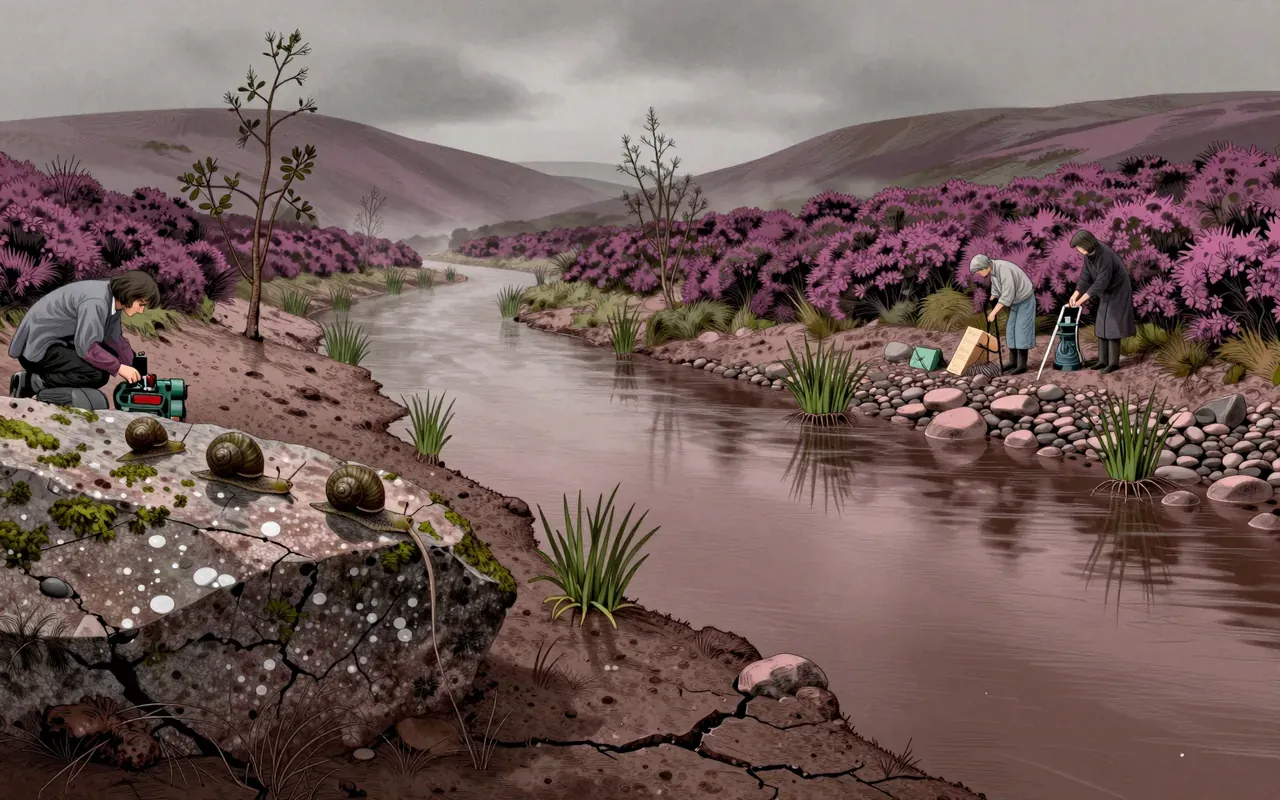
Escargot de Quimper is Elona quimperiana: a terrestrial pulmonate gastropod, sole species in the monotypic genus Elona, native to temperate humid deciduous forests in northwestern France and northwestern Spain.

Where it came from

It was first found at the margin of Briec-de-l’Odet near Quimper in Brittany by De Kermovan and Bonnemaison, and formally described as Helix quimperiana by Férussac in 1821.

What it gets right

It names and locates a real organism with taxonomic rigour. It records morphology, life cycle, habitat, and distribution without embellishment.

What it gets wrong

Nothing is claimed to be wrong in the source material. The document makes no value claims, so there is no misrepresentation to correct.

Why it matters now

It matters as a fixed point in European malacology—a species defined by place, anatomy, and ecology, not culinary use or cultural myth—and as a marker of biodiversity under the Habitats Directive.

Is it worth your time

Yes—if you care about precise biological description, regional endemism, or the quiet specificity of a snail named for a Breton town.
Same beat · Art4 of 98
9:47
Guerrilla artGuerrilla art is a UK-born street art movement defined by inseparability from environment, psychological effect over permanence, and roots in post-graffiti practice. Its earliest documented instance was in 1978 in Wellington, New Zealand. It has no external boundary between image and environment. The surface is fundamental to meaning. It depends on urban dynamics to avoid becoming 'art for art's sake'. Production focuses on cause and effect, not the material piece. It aims to produce an effect in local residents’ minds—not necessarily meaningful art in itself.
8:10
Arte Povera1967Arte Povera was a materially specific, institutionally embedded, temporally tight Italian art movement. It used perishable matter and physical forces to stage critique—but never left the gallery circuit it claimed to dismantle.
9:01
Cubism1907Cubism is an early-20th-century avant-garde art movement that began in Paris and flourished across the 1910s and 1920s. It involved analyzing, breaking up, and reassembling subjects in abstract form, depicting them from multiple perspectives rather than a single viewpoint. A major innovation was the introduction of collage in 1912. The movement is historically divided into phases—Analytic Cubism (1910–1912) and Synthetic Cubism (1912–1914)—each marked by distinct formal strategies. It emerged from collaborative work in the studios of Picasso and Braque and rapidly expanded to include numerous artists across painting, sculpture, architecture, literature, and design.
9:18
Fauvism1904Fauvism was a short-lived French painting movement (1905–1908) that treated colour as architecture and brushwork as velocity. It fused Post-Impressionist intensity with Neo-Impressionist technique and Tahitian colour fields—and was shaped by the visual experience of driving. Its strength was its sensory immediacy; its limit was its lack of structural logic beyond intensity. It matters now because it shows how technology alters perception before theory catches up.
Up next in Culture

Etching

· 8:14

Etching isn’t about precision—it’s about surrendering control to acid, metal, and time.

8:14