culturebriefs
9:48in productionCh. 1 · A performer, not a musician/ 9:48 · ceiling 15 min
Art

David Bowie

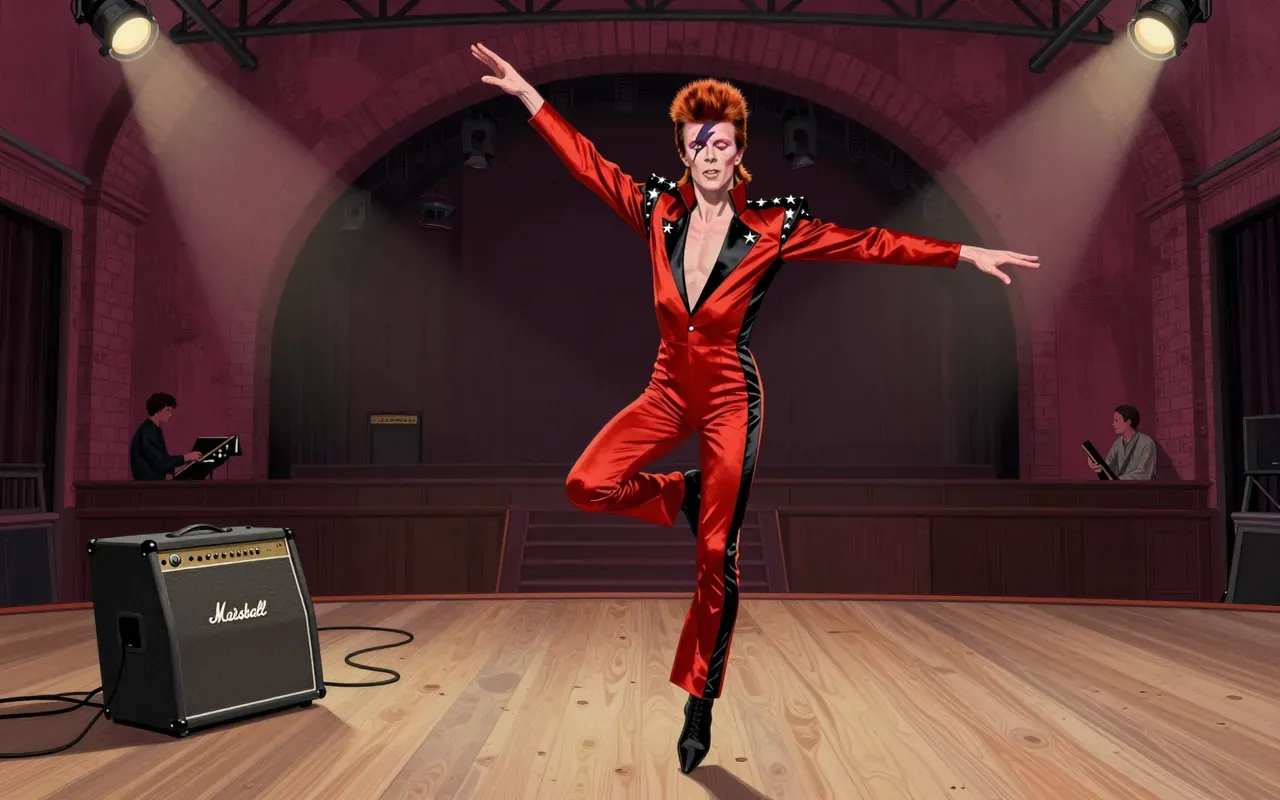
Bowie didn’t sing songs—he launched characters. And he made the pop star into a vessel for ideas, not just feelings.

Bowie’s significance lies in his consistent use of persona as a compositional element—not decoration, not marketing, but structure. His 1972 breakthrough with Ziggy Stardust proved that a pop record could be a character-driven narrative. Later shifts—from Halloween Jack to the Thin White Duke—were not rebranding exercises but formal decisions that redirected his sound, subject matter and ethical register. He treated pop stardom as a medium, not a platform.

Chapters & takeaways4
  1. 0:53
    A performer, not a musician

    Bowie was an English singer, songwriter and actor—not a 'musician' first, but a multi-disciplinary performer.

  2. 2:16
    Art school logic, pop format

    His training in art, music and design shaped a career where image, sound and concept were inseparable.

  3. 3:46
    Ziggy: the first pop opera

    Ziggy Stardust (1972) wasn’t just a hit—it was the first time a pop album functioned as a self-contained character study.

  4. 5:52
    Personas as pivot points

    Halloween Jack and the Thin White Duke weren’t gimmicks—they were deliberate shifts in musical direction, genre and moral tone.

Worth your time?

Yes. Study the whole thing.

4.5/ 5
What works
  • Ziggy Stardust (1972)
  • Diamond Dogs (1974)
  • Station to Station (1976)
What does not
  • influence
  • define
  • launch
  • start
Study it if
  • audiences seeking conceptual rigour in pop
  • students of performance and media
Skip it if
  • listeners who value lyrical consistency over stylistic rupture
  • those looking for a stable artistic ‘voice’
The written brief1 min read

What the thing is

David Bowie was an English singer, songwriter and actor whose career was built on serial reinvention through character-based personae.

Where it came from

He studied art, music and design before embarking on a music career in 1962.

What it gets right

It treats identity as mutable material. Ziggy Stardust (1972) established that a pop star could be a narrative device, not just a voice or face.

What it gets wrong

It displaces the work of earlier British performers who used theatricality and costume—like Marc Bolan or The Who—without crediting their precedent.

Why it matters now

His method—adopting personas like Halloween Jack (1974) and the Thin White Duke (1976)—prefigures how digital identity is curated, fragmented and performed today.

Is it worth your time

Yes—if you want to understand how persona, not just songwriting, became a structural tool in popular music.
Same beat · Art4 of 98
9:47
Guerrilla artGuerrilla art is a UK-born street art movement defined by inseparability from environment, psychological effect over permanence, and roots in post-graffiti practice. Its earliest documented instance was in 1978 in Wellington, New Zealand. It has no external boundary between image and environment. The surface is fundamental to meaning. It depends on urban dynamics to avoid becoming 'art for art's sake'. Production focuses on cause and effect, not the material piece. It aims to produce an effect in local residents’ minds—not necessarily meaningful art in itself.
8:10
Arte Povera1967Arte Povera was a materially specific, institutionally embedded, temporally tight Italian art movement. It used perishable matter and physical forces to stage critique—but never left the gallery circuit it claimed to dismantle.
9:01
Cubism1907Cubism is an early-20th-century avant-garde art movement that began in Paris and flourished across the 1910s and 1920s. It involved analyzing, breaking up, and reassembling subjects in abstract form, depicting them from multiple perspectives rather than a single viewpoint. A major innovation was the introduction of collage in 1912. The movement is historically divided into phases—Analytic Cubism (1910–1912) and Synthetic Cubism (1912–1914)—each marked by distinct formal strategies. It emerged from collaborative work in the studios of Picasso and Braque and rapidly expanded to include numerous artists across painting, sculpture, architecture, literature, and design.
9:18
Fauvism1904Fauvism was a short-lived French painting movement (1905–1908) that treated colour as architecture and brushwork as velocity. It fused Post-Impressionist intensity with Neo-Impressionist technique and Tahitian colour fields—and was shaped by the visual experience of driving. Its strength was its sensory immediacy; its limit was its lack of structural logic beyond intensity. It matters now because it shows how technology alters perception before theory catches up.
Up next in Culture

Denim

· 8:30

Denim isn’t rebellious—it’s bureaucratic. It was issued by railways and air forces long before it was adopted by teenagers.

8:30