9:10in productionCh. 1 · What it is/ 9:10 · ceiling 15 min
Society · Cities
Coffee culture
Coffee culture never made space democratic—it just moved the gate.
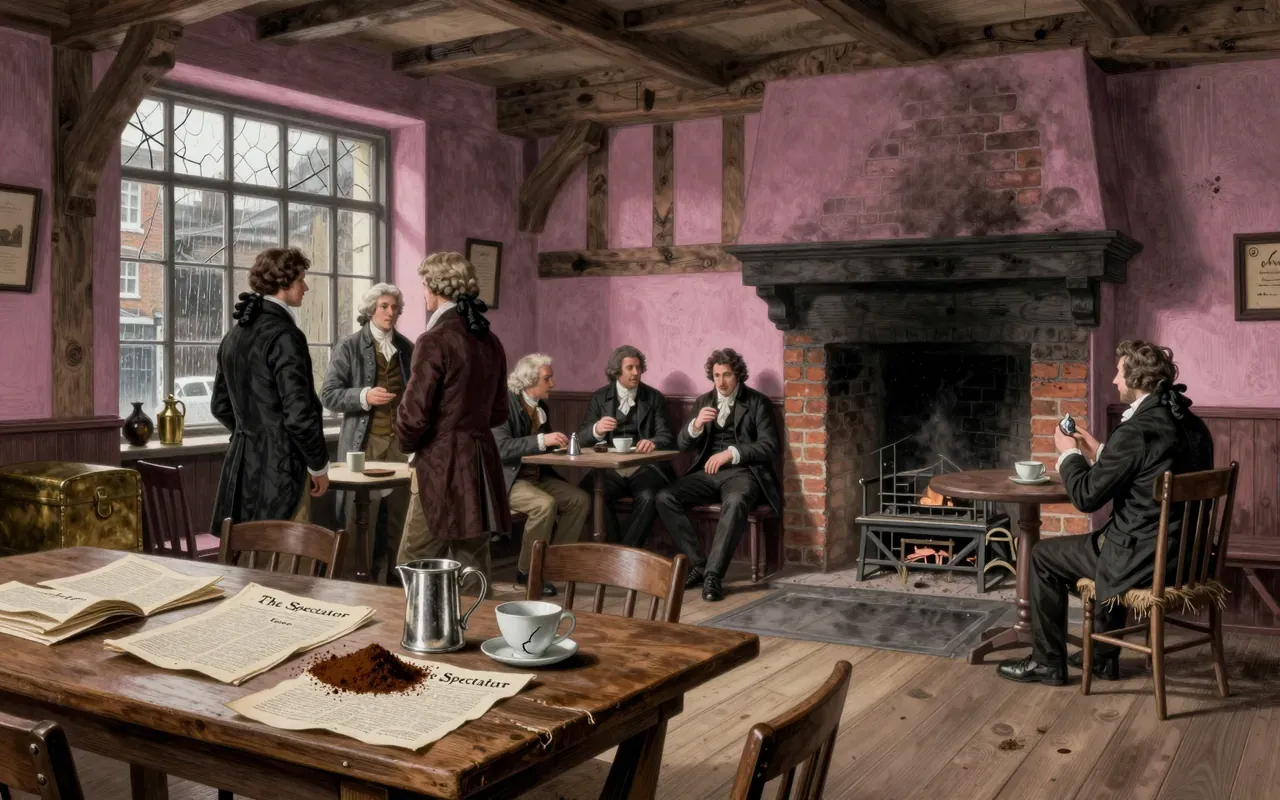
Coffee culture is the set of traditions and social behaviours around coffee consumption—especially as a social lubricant—and the cultural diffusion of coffee as a widely consumed stimulant. It originated in 16th-century Ottoman Turkey and evolved through distinct regional developments: London coffeehouses as political and intellectual hubs in the late 17th–18th centuries; Viennese coffee houses in the 19th century spreading across Central Europe; and modern forms including espresso dominance (late 20th century), mobile carts and pop-ups (early 21st century), and digitally enabled spaces like Wi-Fi cafés. The earliest-grown coffee traces to Ethiopia, with documented use by Yemeni Sufis in the late 15th century and spread via trade routes across the Middle East, Europe, and the Americas.
Coffee culture is not about beans or brewing—it's about behaviour and diffusion.
2:23
Where it came from
It began in Ottoman Turkey, then anchored itself in London’s politics and Vienna’s intellect.
3:24
What it got right
It worked when it hosted dissent, commerce, and art—but only for those allowed in.
4:34
What it got wrong
Calling coffee a 'social lubricant' hides whose friction it smoothed—and whose it ignored.
6:01
Why it matters now
Espresso dominance and pop-ups didn’t democratise coffee—they relocated its exclusions.
Worth your time?
Yes. Study the whole thing.
3.5/ 5
What works
it explains how stimulants structure assembly
it maps exclusion into infrastructure
What does not
iconic
groundbreaking
seminal
timeless
Study it if
urban historians
designers of public space
policy makers on informal economy
Skip it if
coffee connoisseurs seeking tasting notes
baristas seeking technique
The written brief1 min read
What the thing is
Coffee culture is the set of traditions and social behaviours around coffee consumption—especially as a social lubricant—and the cultural diffusion of coffee as a widely consumed stimulant.
Where it came from
It originated in 16th-century Ottoman Turkey. It spread via trade routes across the Middle East, Europe, and the Americas. Documented use began with Yemeni Sufis in the late 15th century.
What it gets right
It treats coffee as a social technology. It built spaces for political debate in London. It sustained intellectual exchange in Vienna. It enabled mobile, temporary gathering in early-21st-century markets and festivals.
What it gets wrong
It conflates diffusion with democracy. Ottoman, Viennese, and London coffeehouses were exclusive—by gender, class, religion, or profession. The term ‘social lubricant’ obscures who was lubricated and who was excluded.
Why it matters now
Because digitally enabled coffee spaces—Wi-Fi cafés, pop-ups, carts—reproduce old tensions: access, surveillance, commercialisation, and the illusion of neutral ground.
Is it worth your time
Yes—if you care how stimulants shape public life. Coffee culture is not about taste or craft. It is about where people gather, who gets to speak, and what infrastructure enables it.