8:08in productionCh. 1 · Origin: Parish business, not studio experiment/ 8:08 · ceiling 15 min
Subcultures
Sound system (Jamaican)
Sound systems didn’t just play music—they built an economy where bass was currency and exclusivity was policy.
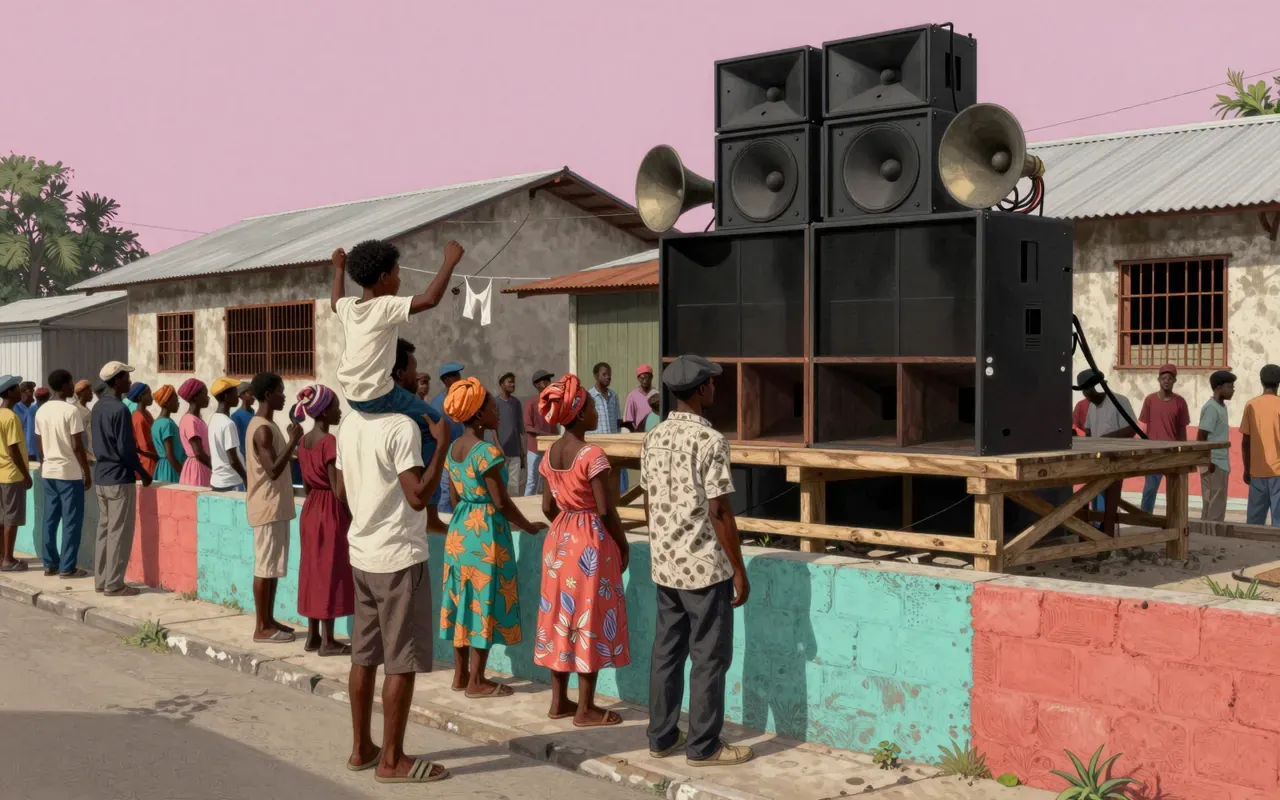
The Jamaican sound system is a mobile, high-wattage audio apparatus that began in Kingston parish in the 1940s. It evolved from playing American R&B into a locally rooted, commercially driven institution—producing exclusive dubplates, pioneering ska and reggae, and fostering participatory, bass-heavy street parties. Its method relied on custom-built loudspeaker systems, crowd interaction, political satire, and independent record production. It generated revenue through admission, food, and alcohol sales—not record royalties—and its scale grew from wardrobe-sized cabinets in the 1950s to 30,000+ watt systems. It displaced live musicians by the mid-1950s and became central to cultural dominance in Jamaica and its diaspora.
It started not as art but as enterprise—in Kingston parish, with Tom Wong’s Tom the Great Sebastian.
1:58
Imitation bred invention
Copying American R&B forced local musicians to invent ska—and then reggae—on the fly.
3:15
Hardware scaled to street volume
By the late 1950s, speaker cabinets were wardrobe-sized; by the 1970s, systems hit 30,000 watts—engineering for crowd immersion, not fidelity.
4:12
Exclusives served commerce, not curation
Revenue came from admission, food and alcohol—not record sales—so dubplates were tools of control, not collectibles.
Worth your time?
Yes. Study the whole thing.
4.5/ 5
What works
culture/subcultures
culture/movements-and-scenes
culture/society
What does not
culture/arts
culture/literature
culture/photography
Study it if
music-business
sound-design
urban-planning
Skip it if
film-music
painting
sculpture
The written brief1 min read
What the thing is
A mobile, high-wattage audio apparatus for street parties in Kingston parish.
Where it came from
It began in the 1940s in Kingston parish, launched by Tom the Great Sebastian—the first commercially successful sound system—playing American R&B before pivoting to local music.
What it gets right
It built a self-sustaining ecosystem: custom hardware, local production, live crowd feedback, and political satire—all funded by admission, food and alcohol sales.
What it gets wrong
It never resolved the tension between commercial dominance and grassroots participation. As wattage and exclusivity rose, access narrowed to those who could afford dubplates or attend high-stakes clashes.
Why it matters now
It remains the original blueprint for independent music infrastructure: crate-digging, dubplate scarcity, speaker-as-instrument, and the DJ as producer, promoter and political voice—all operating beyond label gatekeeping.
Is it worth your time
Yes—if you care about how music economies operate outside corporate control, or how bass, exclusivity and street-level politics shape culture.