culturebriefs
9:24in productionCh. 1 · From Emo to Scene/ 9:24 · ceiling 15 min
Subcultures

Scene (subculture)

Scene wasn’t a music scene—it was a MySpace interface dressed in skinny jeans.

Scene was a US adolescent subculture born in the early 2000s from emo, defined by skinny jeans, bright clothing, vividly dyed straight hair with long bangs, and MySpace as its central platform. It peaked mid-2000s to early 2010s. Its revival since 2019 has fed into e-girl/e-boy aesthetics and hyperpop—but its real legacy is proving how deeply platform constraints shape youth identity.

Chapters & takeaways5
  1. 1:06
    From Emo to Scene

    Scene began as a splinter of emo—not a reaction against it, but an extension of its emotional vocabulary into visual code.

  2. 2:16
    Hair as Interface

    The haircut wasn’t just style—it was infrastructure: long bangs framed the face for profile pictures, dyed hair read at thumbnail scale.

  3. 3:31
    Built on MySpace

    MySpace wasn’t where Scene lived—it’s where Scene was built: custom layouts, top-eight lists, and band pages were its native architecture.

  4. 4:38
    Adolescent Infrastructure

    It was adolescent by design—neither children nor adults, but a cohort fluent in platform logic before they could vote.

  5. 5:42
    A Haircut With a Name

    The quintessential haircut had an author: Javier Van Huss of Eighteen Visions—not a trend, but a named invention.

Worth your time?

Yes. Study the whole thing.

3.5/ 5
What works
  • platform-design
  • visual-identity
  • youth-aesthetics
What does not
  • music-business
  • record-labels
  • songwriting
Study it if
  • digital-designers
  • youth-culture-researchers
  • fashion-historians
Skip it if
  • musicologists
  • sociologists-of-religion
  • urban-planners
The written brief1 min read

What the thing is

Scene was a US adolescent subculture defined by coordinated fashion, stylised hair, and MySpace-mediated self-branding.

Where it came from

It emerged in the early 2000s United States from the emo subculture, coalescing around terms like ‘scene queen’ by 2002.

What it gets right

It made adolescence legible through hyper-stylised self-presentation. The haircut, the MySpace profile, the band page—each was a low-barrier tool for claiming visibility on one’s own terms.

What it gets wrong

It conflated musical genre with moral posture. Metalcore and pop punk were treated as ideological signifiers, not sonic choices—and that flattened both the music and its listeners.

Why it matters now

Its visual grammar resurfaced in e-girl/e-boy aesthetics and hyperpop—not as revival, but as repurposed syntax for digital performance.

Is it worth your time

Yes—if you’re tracking how internet-native youth aesthetics migrate into mainstream fashion and pop music. It’s a case study in platform-driven identity formation, not a nostalgia trip.
Same beat · Subcultures4 of 96
8:48
Image macroImage macros are a digital interface—not an art form. They standardised how millions expressed irony, frustration and affiliation before platforms automated tone and stripped away authorship. Their rigidity enabled scale. Their simplicity enabled theft. Their legacy isn’t humour—it’s the template as infrastructure.
10:01
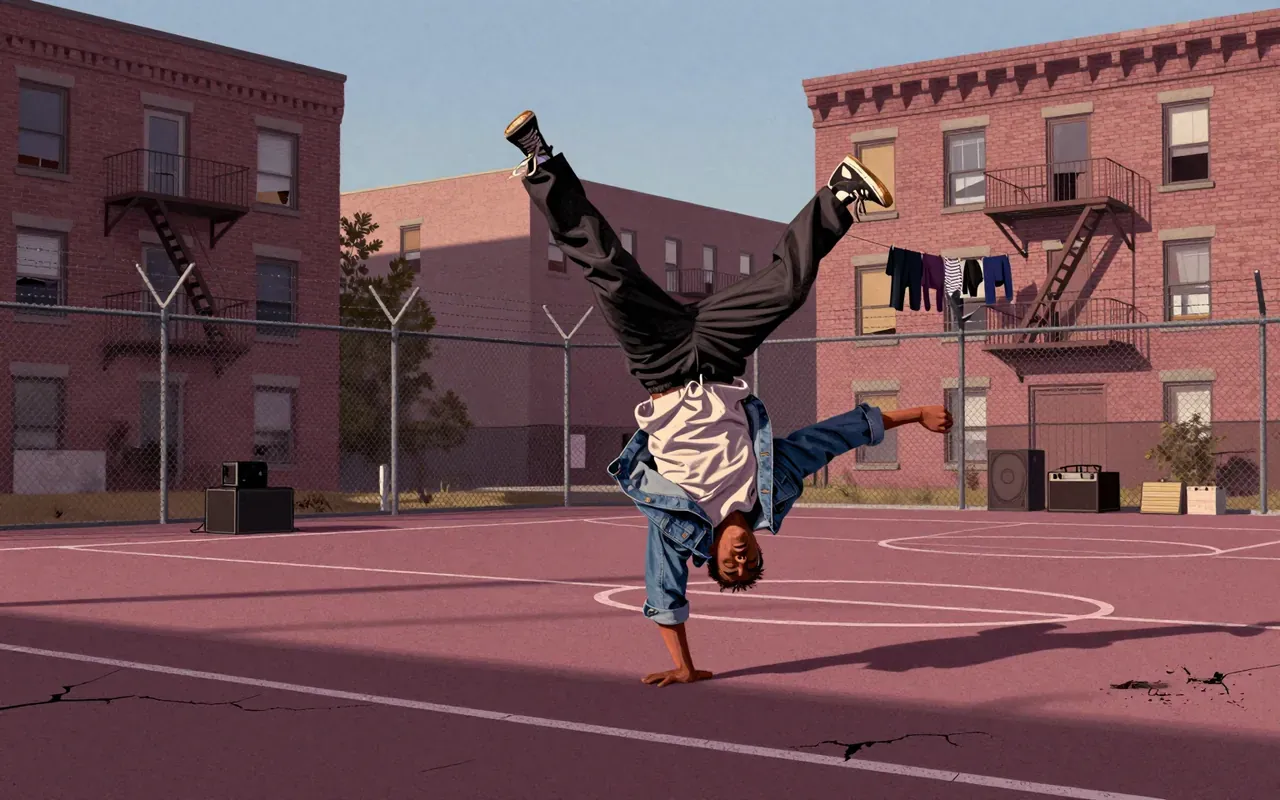
BreakdancingBreakdancing is a street dance style developed by African Americans and Puerto Ricans in the Bronx during the 1970s and early 1980s. It consists of four core movement types — toprock, footwork, power moves, and freezes — performed to music featuring drum breaks. Its Olympic debut in Paris 2024 formalised a global practice that began as an act of cultural assertion in marginalised communities.
9:42
BanksyBanksy is a pseudonymous England-based street artist whose practice centres on stencilled, satirical interventions placed on publicly visible surfaces. He emerged from the Bristol underground scene in the 1990s. His first known large-scale mural was The Mild Mild West in 1997 on Stokes Croft. Banksy makes satire legible on city walls. His stencils deliver punchlines fast. They occupy surfaces people pass daily. They force confrontation without requiring attention. The method relies on evasion—but that evasion obscures authorship, dilutes accountability, and turns political gesture into branded ambiguity. His work established a template for art that operates outside institutions but trades on their validation—exposing the friction between subversion and market absorption.
9:46
BeatnikBeatnik was a media slur—not a self-chosen identity. It erased Kerouac’s spiritually grounded 'beat' in favour of a consumable caricature. Its legacy is not influence, but warning: how fast serious ideas become costumes.
Up next in Culture

Self-care

· 9:32

Self-care is not wellness—it is the daily work of staying well, staying alive, and staying connected.

9:32