culturebriefs
8:44in productionCh. 1 · Not Clickbait. Ragebait./ 8:44 · ceiling 15 min
Society · Ideas

Rage-baiting

Rage-baiting isn’t bad faith—it’s good maths with bad consequences.

Rage-baiting is not an aberration. It is a documented, named, algorithmically rewarded tactic that turns moral outrage into metrics. It began as clickbait’s darker sibling. It now shapes what reaches millions—and what does not.

Chapters & takeaways4
  1. 0:58
    Not Clickbait. Ragebait.

    Rage-baiting is clickbait’s evil twin—engineered not for clicks, but for fury.

  2. 2:16
    Trolling Is Chaos. Rage-Farming Is Calculus.

    Unlike trolling, rage-farming has a strategy: provoke opponents to amplify your message while holding your base.

  3. 3:36
    The Algorithm Doesn’t Care What You’re Angry About

    Algorithms don’t distinguish between rage and reason—they reward reaction, full stop.

  4. 5:04
    When Outrage Is the Editorial Brief

    A news organisation can post something expressly designed to outrage as many people as possible—and call it journalism.

Worth your time?

Yes. Study the whole thing.

4.5/ 5
What works
  • news-organisations
  • platform-engineers
  • political-strategists
What does not
  • culture/arts
  • culture/literature
  • culture/photography
Study it if
  • digital-publishers
  • social-media-users
  • journalists
Skip it if
  • historians-of-antiquity
  • classical-musicians
  • print-designers
The written brief1 min read

What the thing is

Rage-baiting is a manipulative tactic designed to elicit outrage to increase traffic, engagement, revenue, and audience growth.

Where it came from

It evolved from clickbait. A 2016 article called it ‘clickbait’s evil twin’. It was documented since at least 2009 and named Oxford University Press’s Word of the Year for 2025.

What it gets right

Rage-baiting correctly identifies that outrage drives engagement more reliably than joy or curiosity. It exploits confirmed cognitive biases: negativity bias, confirmation bias, and moral outrage. Algorithms treat rage as resonance.

What it gets wrong

It treats outrage as neutral fuel. It ignores how sustained exposure reshapes perception, erodes trust in shared reality, and displaces slower, evidence-based discourse—not just in politics, but in health, science, and education.

Why it matters now

Because platforms reward both positive and negative engagement—and political actors now deploy rage-farming deliberately to polarise opponents while consolidating a like-minded base.

Is it worth your time

Yes—if you use social media, consume news online, or work in digital publishing. It is not a fringe tactic. It is the operating system of much current attention economy infrastructure.

Same beat · Society4 of 286
8:48
Image macroImage macros are a digital interface—not an art form. They standardised how millions expressed irony, frustration and affiliation before platforms automated tone and stripped away authorship. Their rigidity enabled scale. Their simplicity enabled theft. Their legacy isn’t humour—it’s the template as infrastructure.
9:10
Self-managed social centerSelf-managed social centers are anti-authoritarian, volunteer-run spaces that operate as infoshops, free schools, bicycle workshops and concert venues. They began in Italy in the 1980s and spread to the US and UK in the 1990s. They oppose gentrification and megaprojects. They create and practice the commons. They are transient, precarious, and politically active—but do not survive long enough to institutionalise what they prefigure.
10:00
Home recordingHome recording is sound captured in private homes—not studios. It began with isolated pioneers in the US, UK, Australia, and Jamaica in the 1950s–1970s. The 1979 Portastudio enabled consumer multitrack recording. Digital recorders and DAWs replaced analog in the 1990s. Lockdowns in 2020 caused a global surge in home-based artists and microgenres. Untreated rooms produce misleading acoustics that compromise mixing. Professional studios have been heavily impacted over the last two decades.
10:02
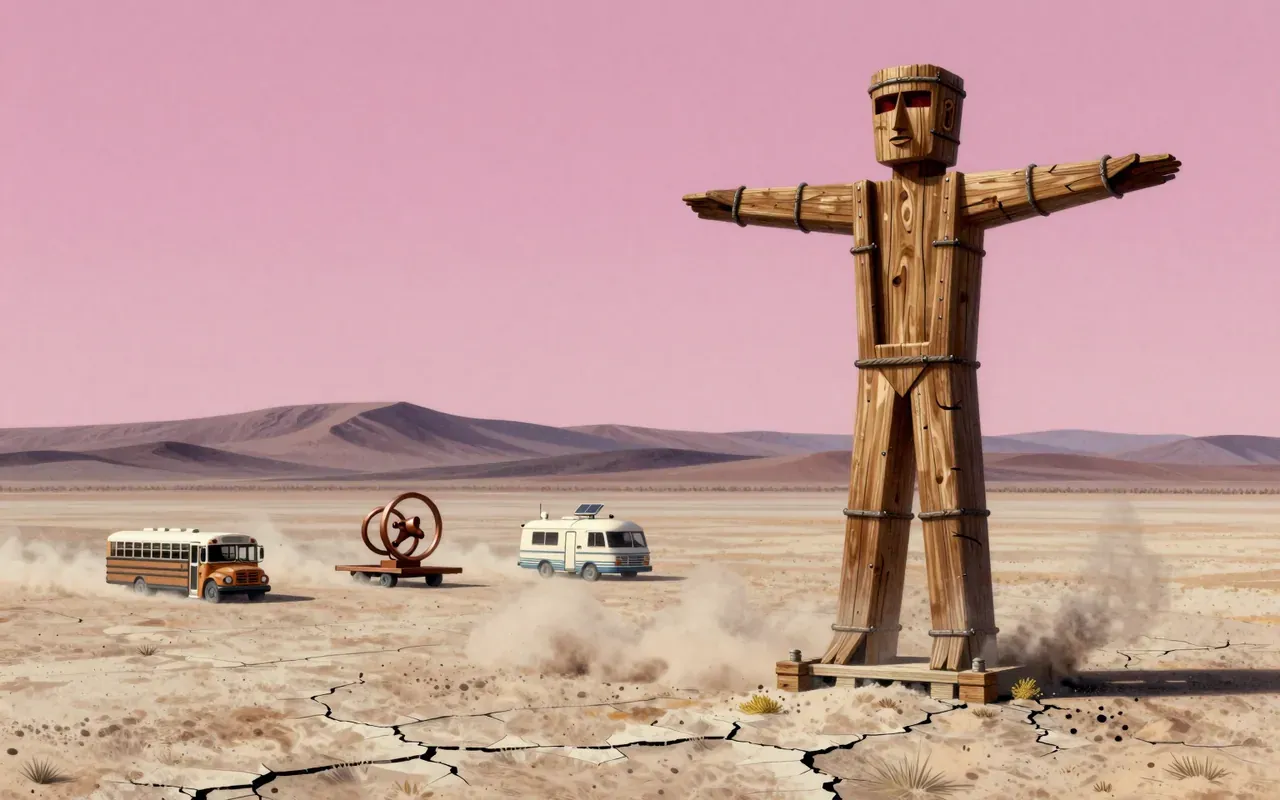
Burning Man1986Burning Man is a participant-built desert gathering named for the ceremonial burning of a wooden effigy—the Man—on the Saturday before Labor Day. It began on Baker Beach in 1986, moved to the Black Rock Desert in 1990, and operates on radical self-reliance, communal effort, and theme-driven art made solely by attendees. Its ten principles were codified in 2004—not at origin—and its model has since been replicated, commercialised, and contested. It is neither pure counterculture nor corporate spectacle, but a documented instance of how ritual, place, and principle diverge over time.
Up next in Culture

Rangoli

· 10:14

Rangoli is not decoration. It is a threshold discipline: ritual, hygiene, spinal exercise and deity invitation—all in one morning gesture.

10:14