8:56in productionCh. 1 · A Word Before the Dish/ 8:56 · ceiling 15 min
Food
Pizza
Pizza is not a dish—it’s a thousand-year-old linguistic container for flatbread, tomato, and myth.
Pizza is a linguistic artefact first, a food second. Its name survived centuries without a fixed recipe. Its modern form is local, recent, and contingent—not ancient, universal, or inevitable.
The word 'pizza' predates the tomato by 500 years—and the modern dish by nearly 1,000.
1:57
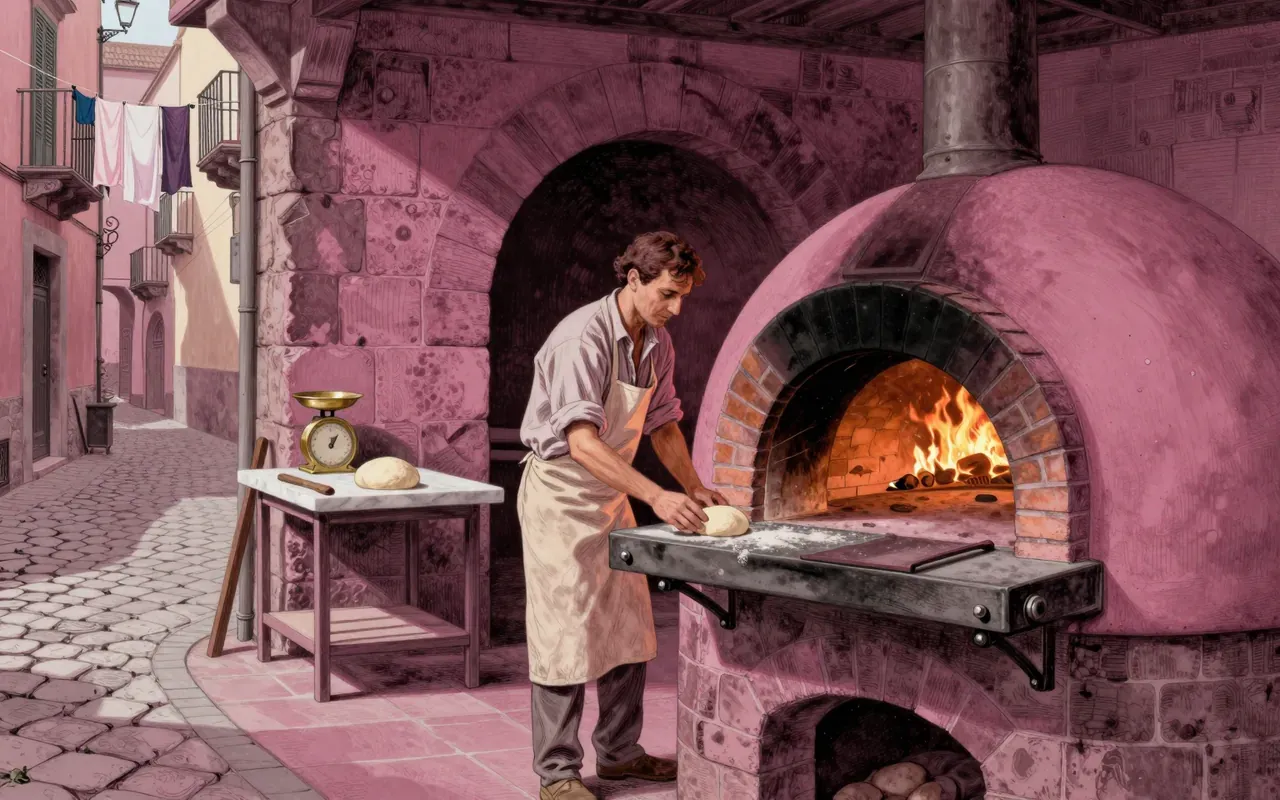
Naples Was the Lab, Not the Origin
Naples did not invent pizza. It standardised it—late, locally, and under royal patronage.
3:24
No Tomato, No Pizza (as We Know It)
Tomatoes were impossible on pizza before the Columbian Exchange—so every pre-16th-century 'pizza' was tomato-free.
4:35
Ancient Echoes, Not Ancestors
Pizza-like food appears across two millennia—but none of those versions share ingredients, technique, or intent with today’s version.
5:47
What Makes It Pizza Now
Modern pizza is defined by its ingredients—not its history: leavened wheat dough, tomato, cheese, high-heat baking.
Worth your time?
Yes. Study the whole thing.
4/ 5
What works
as a case study in semantic drift
as evidence of culinary non-linearity
as proof that naming precedes standardisation
What does not
define a movement
influence named chefs beyond Esposito
displace other flatbreads globally in its own time
represent consensus in 19th-century Naples
Study it if
linguists
archaeologists
food historians
Skip it if
casual eaters seeking origin myths
marketing teams building 'authenticity'
The written brief1 min read
What the thing is
Pizza is a word with layered meanings. It names a modern Italian dish, an ancient Roman food object, and many flatbreads between.
Where it came from
The word ‘pizza’ originated in Gaeta in AD 997. The modern dish evolved in Naples in the 18th or early 19th century. Tomatoes arrived no earlier than the 16th century. A 2023 Pompeii fresco shows a pizza-like item from antiquity.
What it gets right
It anchors food in place and time. Naples gave it form. Gaeta gave it a name. Pompeii gave it precedent.
What it gets wrong
It pretends to be one dish. It is not. The AD 997 ‘pizza’ was flatbread. The 18th-century Neapolitan version added tomato only after 1500. The 2023 Pompeii fresco shows no tomato, no cheese, no oven—just a round food on a platter.
Why it matters now
It reveals how cultural continuity is linguistic, not culinary: the same word holds together Roman grain, Byzantine scribes, Neapolitan street vendors, and 21st-century archaeology.
Is it worth your time
Yes—if you care how a word survives 1,000 years while the thing it names keeps changing shape.