Laura Ashley didn’t sell nostalgia—she manufactured it, one £10 screen frame at a time.
Laura Ashley built a fashion empire not from runway ambition, but from noticing a missing patch. Her method was craft-based, low-capital, and rooted in specific institutions—the Women’s Institute, the V&A—and a precise historical reference: the 19th-century rural. She sold Romanticism as reliability. She reached middle-class British women who wanted gentility without grandeur. She did not invent nostalgia—but she standardised it, scaled it, and shipped it via mail order before it had a name.
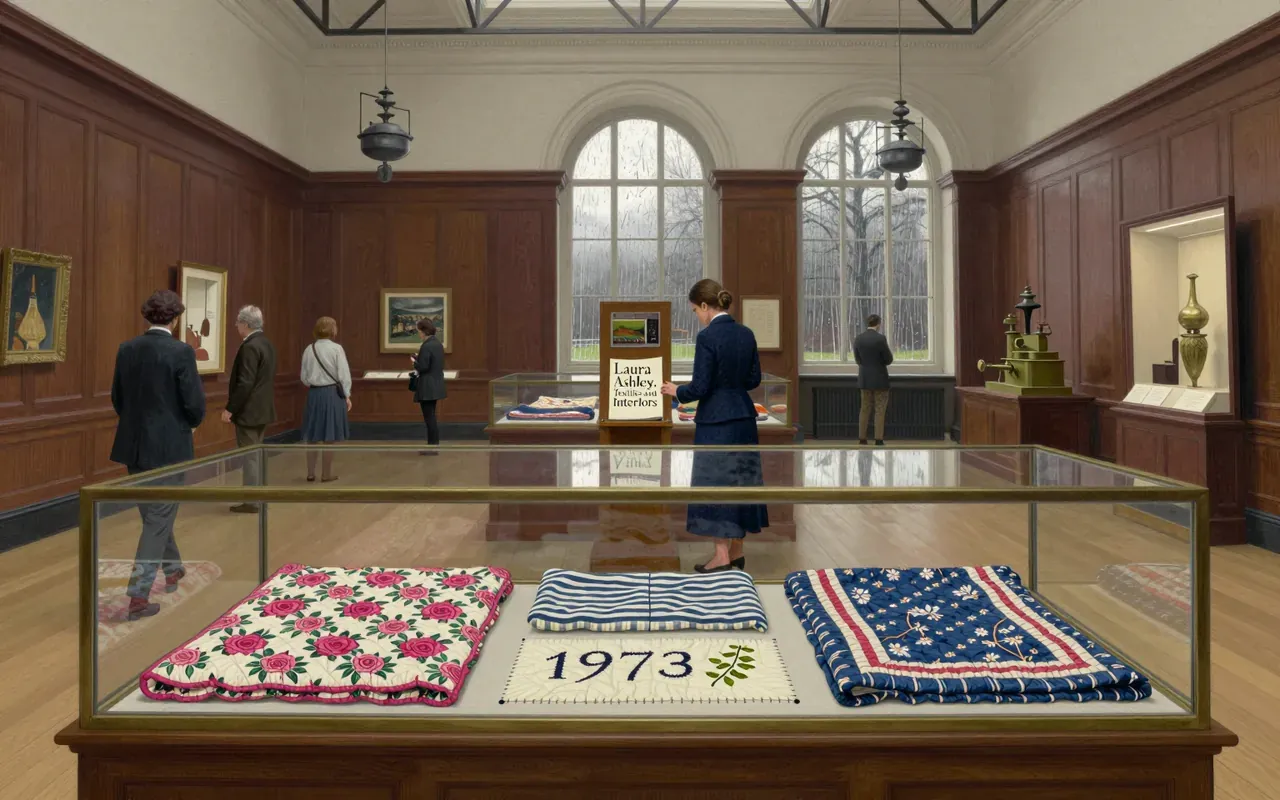
A Women’s Institute display at the V&A gave her the idea—and her quilting work for them gave her the skill.
2:37
The £10 launch
She started with £10, an attic, and a self-built machine—then printed Victorian headscarves because no one else made them.
4:01
From napkins to John Lewis
Romantic rural motifs on natural fabrics moved from tea-towels to high street chains like John Lewis—fast.
5:40
The unbroken line
Furnishings came first. Clothing followed. The style never changed: 19th-century rural, always.
Worth your time?
Yes. Study the whole thing.
4/ 5
What works
as a case study in aesthetic arbitrage
as evidence of how domestic labour entered commerce
as a counterpoint to modernist design orthodoxy
What does not
influence
define
start
pioneer
Study it if
design historians
retail analysts
students of postwar British consumer culture
Skip it if
those seeking avant-garde rupture
fans of minimalism
anyone expecting subversion
The written brief1 min read
What the thing is
Laura Ashley is a British textile and clothing brand founded by Laura Ashley in the 1950s. It began with printed headscarves and expanded into furnishing fabrics and clothing.
Where it came from
It emerged from an attic flat at 83 Cambridge Street, Pimlico, London. Its method came from quilting work for the Women’s Institute and a V&A display of traditional handicrafts.
What it gets right
It identified a real gap: no commercially available Victorian-style patches in 1953. It filled it with handmade-looking textiles printed on a machine built in an attic flat.
What it gets wrong
It displaced modernist simplicity with Romantic clutter. It turned rural fantasy into mass-market uniformity—without acknowledging the class distance between its Welsh origins and its aspirational English clientele.
Why it matters now
It shows how retro aesthetics can be industrialised—not as irony, but as earnest commercial infrastructure—long before ‘vintage’ became algorithmic.
Is it worth your time
Yes—if you want to understand how domestic craft became a retail empire, and how nostalgia was systematised before it was digitised.