culturebriefs
9:53in productionCh. 1 · 1920: The First Export Strategy/ 9:53 · ceiling 15 min
Art

Japanese popular culture

Japanese popular culture is not folklore—it’s foreign policy with a soundtrack.

Japanese popular culture is a deliberate, state-adjacent system of image-making and export. It began in the 1920s, scaled through postwar material constraint and broadcast diplomacy, and now delivers over ¥5 trillion in overseas revenue. It distinguishes Japan internationally—not by accident, but by design.

Chapters & takeaways5
  1. 1:06
    1920: The First Export Strategy

    Culture was weaponised for diplomacy before WWII—not after.

  2. 2:02
    Cans, Not Steel

    Postwar reconstruction ran on ingenuity, not aid: toys from cans, identity from entertainment.

  3. 3:19
    Oshin and the Odourless Myth

    Oshin didn’t just air—it dissolved a regional stereotype and built shared feeling across borders.

  4. 4:52
    2023: The Export Number

    ¥5,776.9 billion isn’t influence—it’s balance-sheet proof of cultural industry scale.

  5. 5:46
    Old Forms, New Function

    Tradition isn’t preserved—it’s repurposed as a signature, distinguishing Japan from the rest of the modern world.

Worth your time?

Yes. Study the whole thing.

4.5/ 5
What works
  • as infrastructure
  • as economic data
  • as diplomatic record
What does not
  • soft power
  • pop culture
  • national branding
Study it if
  • policy analysts
  • media historians
  • export strategists
Skip it if
  • casual fans
  • anime newcomers
  • nostalgia seekers
The written brief1 min read

What the thing is

Japanese popular culture is a set of export-oriented media and consumer practices—anime, manga, video games, purikura, kaiju films, doujinshi, television dramas—that retain traditional artistic motifs while serving diplomatic and economic ends.

Where it came from

It began as a state-adjacent strategy in the 1920s to shape international perception. It intensified after WWII, when toy makers used old cans instead of banned metal, and broadcasters deployed Oshin and Godzilla to reposition Japan in Asia and globally.

What it gets right

It uses entertainment to build national distinction. It embeds tradition in new forms. It turned postwar scarcity into creative substitution.

What it gets wrong

It treats ‘cultural odorlessness’ as a pre-Oshin condition without specifying whose perception that was or how widely held.

Why it matters now

Because ¥5,776.9 billion in 2023 cultural exports shows it is no longer soft power rhetoric—it is hard economic output with measurable reach and strategic continuity.

Is it worth your time

Yes—if you need to understand how culture functions as infrastructure, not ornament.
Same beat · Art4 of 101
9:42
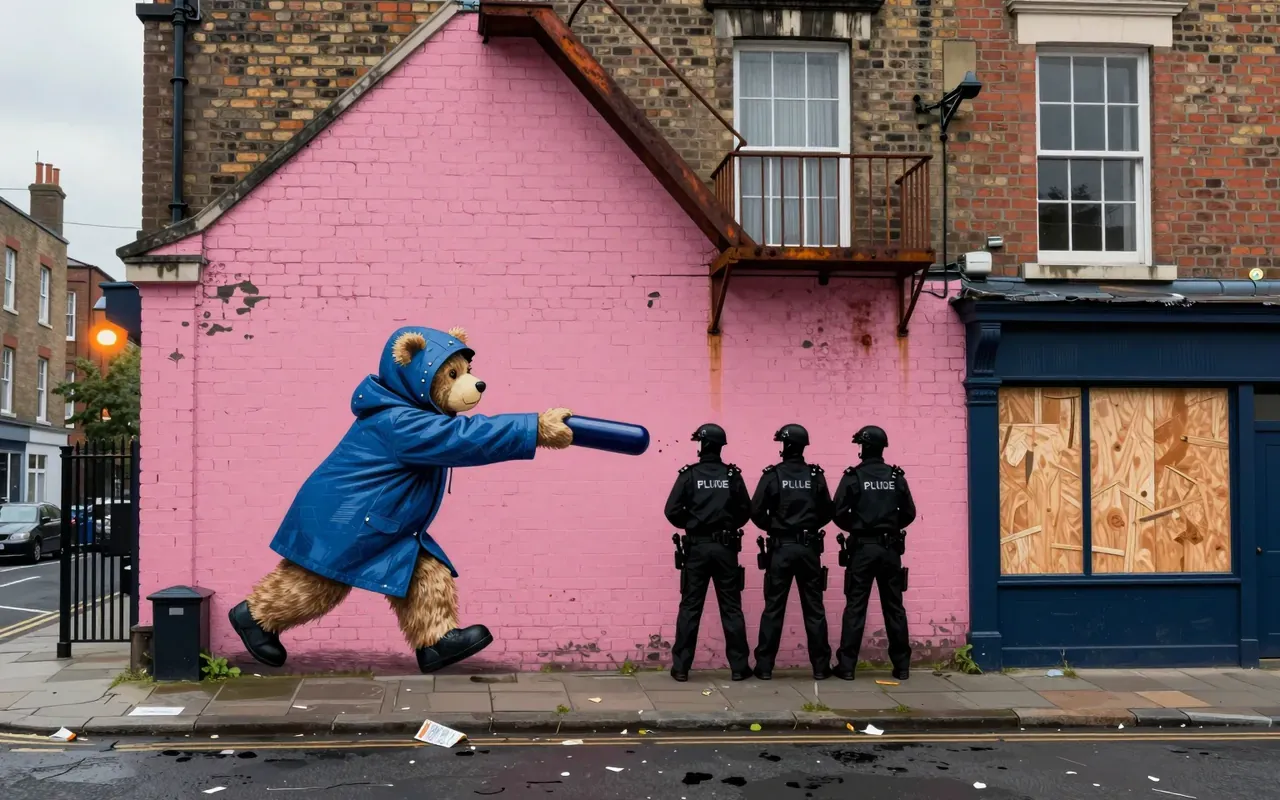
BanksyBanksy is a pseudonymous England-based street artist whose practice centres on stencilled, satirical interventions placed on publicly visible surfaces. He emerged from the Bristol underground scene in the 1990s. His first known large-scale mural was The Mild Mild West in 1997 on Stokes Croft. Banksy makes satire legible on city walls. His stencils deliver punchlines fast. They occupy surfaces people pass daily. They force confrontation without requiring attention. The method relies on evasion—but that evasion obscures authorship, dilutes accountability, and turns political gesture into branded ambiguity. His work established a template for art that operates outside institutions but trades on their validation—exposing the friction between subversion and market absorption.
10:31
Batik in IndonesiaBatik is a wax resist-dyeing textile tradition from Indonesia. It is most highly developed in Java, where the technique has been used for centuries. The oldest surviving physical example is a 700-year-old blue-white valance. Raffles described it in his 1817 History of Java — the first European scholarly account. In 2009, UNESCO inscribed batik tulis, batik cap, and their associated education as Masterpieces of Oral and Intangible Heritage — prompting annual Batik Day and institutional preservation.
10:17
Cante flamencoCante flamenco is the vocal art at flamenco’s core—not its decoration. It formed in Andalusia through overlapping traditions. Its Golden Age codified it. Its 1922 ‘rescue’ privileged one strain over others. It matters because it shows how preservation can erase as much as it saves.
10:04
FrescoFresco is a method, not a style. It demands wet plaster, water-based pigment, and no binder. Its permanence comes from chemistry—not skill or fame. It began in Bronze Age Aegean and predates classical Greece. Today, its misuse blurs technical precision into vague ‘wall art’. It matters because it shows how material limits define what survives—and what gets remembered.
Up next in Culture

Impostor syndrome

· 8:45

It is not a disorder. It is not universal. It is not neutral—and naming it changes nothing unless you name what it hides.

8:45