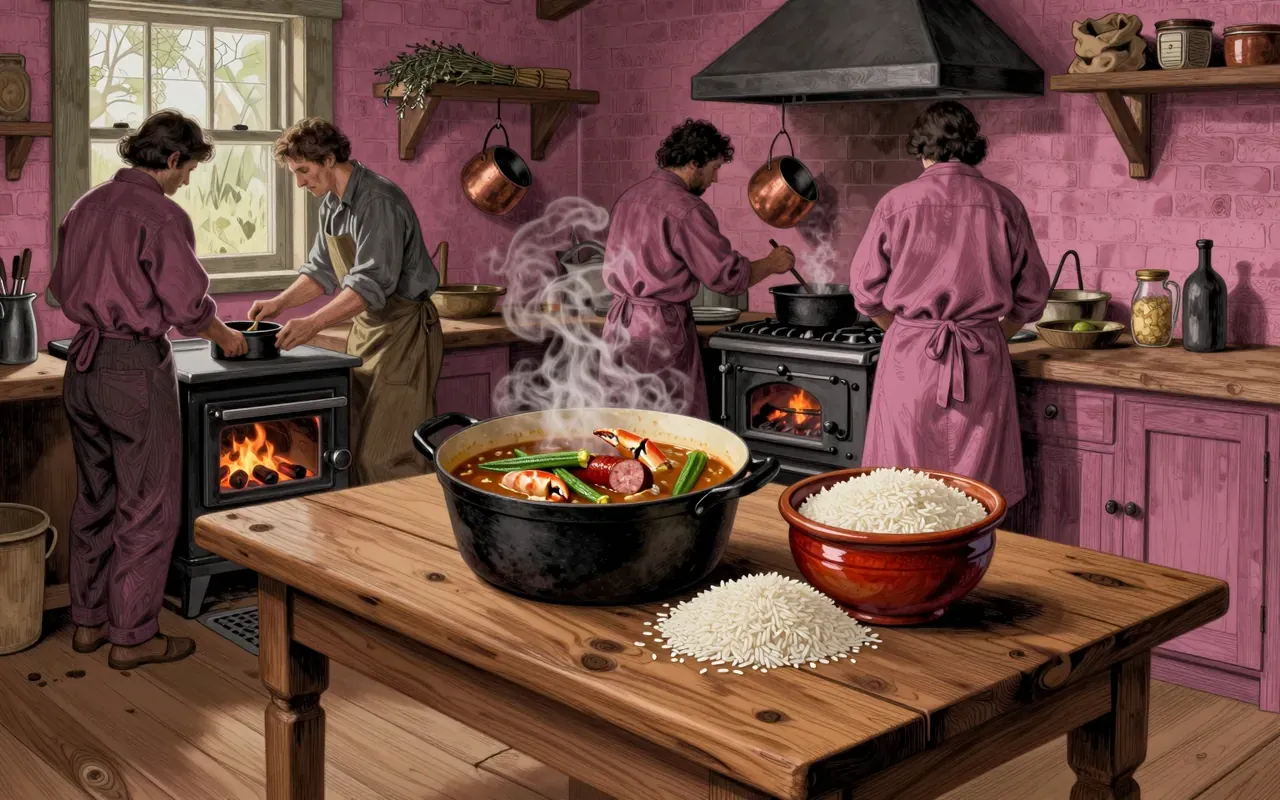
What the thing is
Gumbo is a stew from the U.S. Gulf Coast. It is defined by stock, meat or shellfish, the Creole ‘holy trinity’, and one of three thickeners: okra, filé powder, or roux.
Where it came from
It originated in Louisiana in the early 18th century. It combines culinary practices from Central and West African, French, German, Spanish, and Native American Choctaw cultures.
What it gets right
It honours layered cultural cohabitation without flattening it into fusion. The trinity, the roux, the okra, the filé—each thickener anchors a distinct lineage. It demands time: three hours minimum. It insists on rice as vessel, not garnish.
What it gets wrong
It obscures hierarchy. The French-inspired dark roux is named ‘preferred’ in New Orleans—but the sources do not say who preferred it, or when that preference became dominant. Okra and filé are presented as alternatives, not as practices with unequal access, suppression, or erasure.
Why it matters now
Because it is a documented site of uncredited synthesis—where colonial power, Indigenous knowledge, and enslaved expertise converged in daily practice, not theory. Its persistence contradicts the myth that cultural mixing requires permission.
Is it worth your time
Yes—if you care how food encodes survival, negotiation, and refusal in a single pot.