culturebriefs
9:54in productionCh. 1 · Not from nowhere/ 9:54 · ceiling 15 min
Food · Society

Gyūdon

Gyūdon didn’t rise because it tasted good—it rose because Tokyo burned down.

Gyūdon is a Tokyo-born, post-Meiji beef-and-rice bowl that evolved from gyūnabe, spread via street vendors and Yoshinoya, and achieved cross-class adoption only after the 1923 earthquake destroyed alternatives. It is a functional food—not an aesthetic one—and its significance lies in how it exposed the fragility of culinary hierarchy when infrastructure failed.

Chapters & takeaways4
  1. 0:57
    Not from nowhere

    Gyūdon began as a Tokyo-only offshoot of gyūnabe—not a national dish, but a local adaptation.

  2. 2:25
    Yatai to chain

    It launched from street stalls and a single fish-market shop—not a chef’s vision, but a vendor’s pragmatism.

  3. 4:20
    The sauce changed

    Its modern form—thin beef, onions, warishita sauce over rice—crystallised only around 1923.

  4. 6:02
    Disaster made it universal

    Class boundaries dissolved not through marketing, but because it was one of the few hot meals left standing after the earthquake.

Worth your time?

Yes. Study the whole thing.

4/ 5
What works
  • as a case study in pragmatic adaptation
  • as evidence of how meat-eating normalised in Meiji Japan
  • as a lens on Tokyo’s 1923 recovery
What does not
  • define a decade
  • influence named chefs
  • start a movement
  • represent national identity
Study it if
  • historians of urban Japan
  • students of food systems
  • readers interested in how crisis reshapes culture
Skip it if
  • those seeking origin myths
  • fans of culinary romanticism
  • readers who conflate popularity with innovation
The written brief1 min read

What the thing is

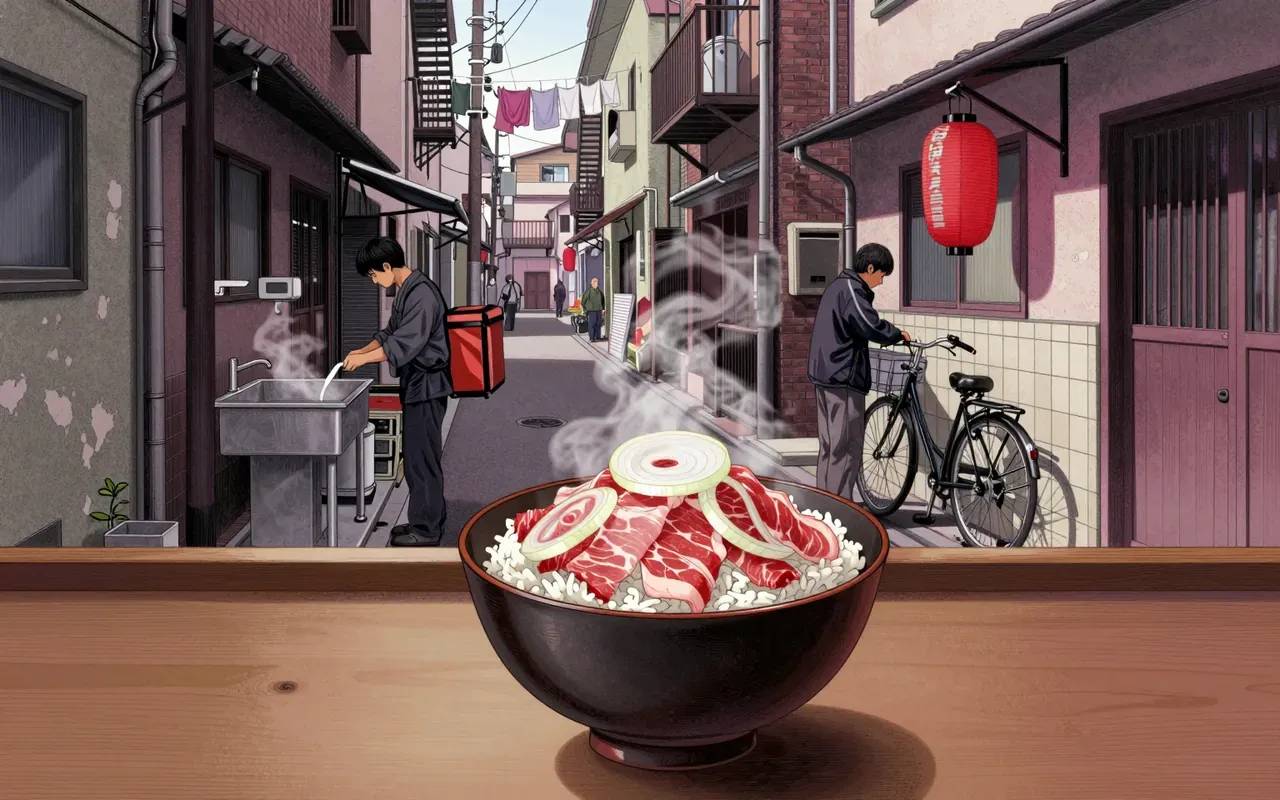
Gyūdon is a bowl of steamed rice topped with thin-sliced beef and onion simmered in a dashi-soy-mirin sauce. It is served hot, eaten quickly, and designed for portability and speed.

Where it came from

It emerged in Tokyo in the 1890s as a derivative of gyūnabe, a Kantō-region beef hot pot. It was sold as kamechabu from yatai in Ueno and Asakusa, and formalised by Yoshinoya in Nihonbashi in 1899.

What it gets right

It delivers cheap, hot, protein-rich sustenance fast. It uses available ingredients—beef scraps, onions, rice—and transforms them with a simple, repeatable sauce. It scales from yatai to chain restaurant without losing core function.

What it gets wrong

It carries the stigma of low status for decades. Its early form relied on miso-based broth before standardising on warishita—a shift that erased regional variation and narrowed flavour vocabulary.

Why it matters now

It reveals how disaster—specifically the 1923 Great Kantō Earthquake—can erase class barriers around food overnight. It shows how infrastructure failure, not taste or trend, drives culinary diffusion.

Is it worth your time

Yes—if you care how a working-class Tokyo street food reshaped Japanese eating habits, class perception, and the donburi format. It is not a story of invention but of adaptation, timing, and infrastructure collapse.

Same beat · Food4 of 217
10:50
Full breakfastThe full breakfast is a Victorian-era invention codified in 1861, designed as an efficient, affordable adaptation of aristocratic fare for the rising middle class. It peaked in Edwardian Britain, re-emerged as a working-class staple in the 1950s thanks to new food tech, and has since retreated from daily use due to health concerns and preparation time. Regional variants persist, and formal societies now curate its legacy rather than sustain its practice.
8:13
GrappaGrappa is a legally protected Italian pomace brandy, made since pre-1300s to prevent waste. Its production evolved via water-cooled distillation (1300–1400), Jesuit codification (c.1600), and modern refinements beginning in 1979. It is consumed as a digestif, especially in northern Italy and among the Italian diaspora in Argentina and Uruguay.
9:03
Jerk (cooking)Jerk is a direct line from Taíno barbacoa to modern Jamaican grills—unbroken, ingredient-specific, and method-bound. It resists romantic origin myths because its evidence is botanical (allspice, Scotch bonnet), archaeological (barbacoa), and linguistic (barabicu). Its strength is continuity. Its weakness is the false impression that formal recognition—like a 2015 GI—matters more than daily practice. It matters now because it proves Indigenous techniques did not vanish—they evolved, persisted, and fed generations without needing a label.
8:36
MujaddaraMujaddara is a Levantine lentil-and-rice dish, documented since 1226, eaten across Arab, Christian, Jewish, and Druze communities. It functions as both Lenten observance and daily sustenance. Its endurance lies in its neutrality—not as symbol, but as practice.
Up next in Culture

Lower Haight, San Francisco

· 10:26

A neighbourhood named by conflict, not consensus.

10:26