Guacamole is not a condiment—it’s a 10,000-year-old argument about who controls the avocado.
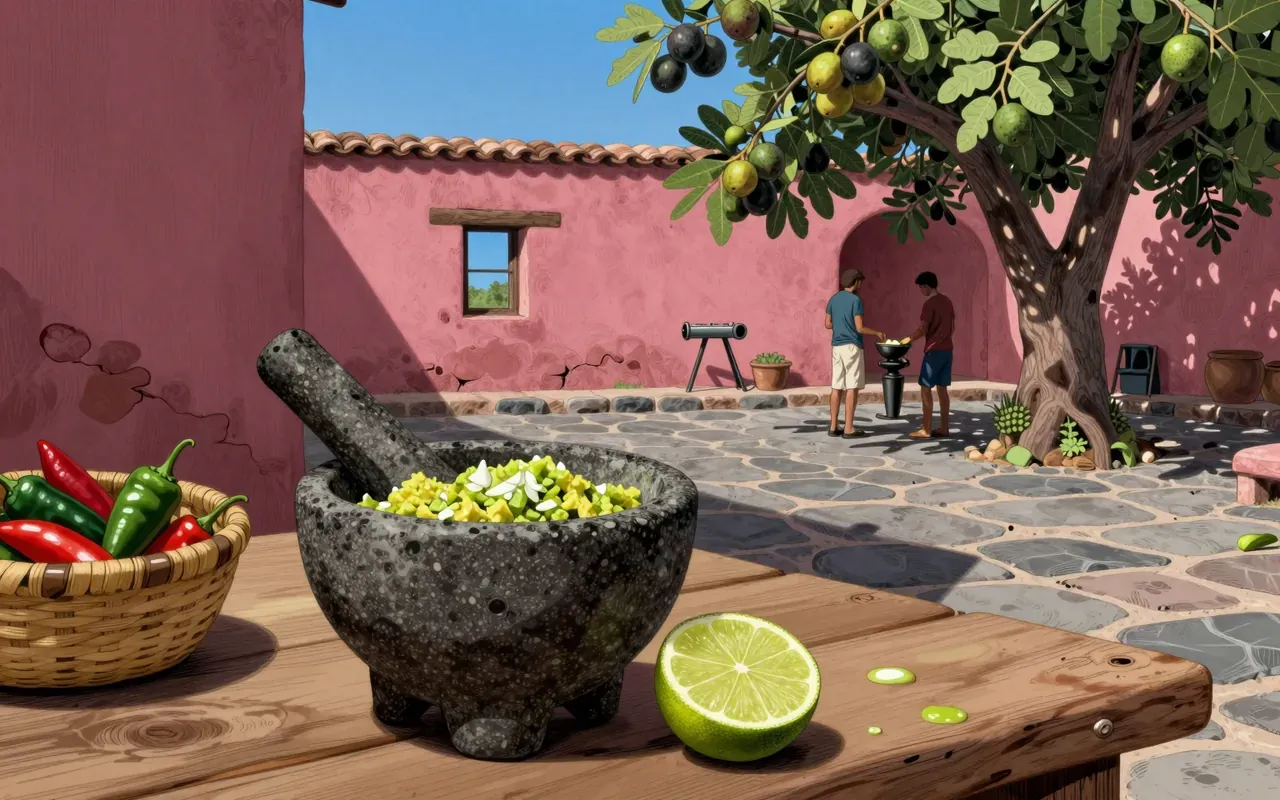
Guacamole is an avocado-based dip, spread, or salad first developed in Mexico. Its name comes from Classical Nahuatl āhuacamōlli, meaning 'avocado sauce'. William Dampier described a native preparation of avocados, sugar, and lime juice in 1697—the earliest known written record. Enzymatic browning occurs when polyphenol oxidase in avocado reacts with oxygen. In 2022, Peribán, Mexico set a Guinness World Record with a 4,972 kg serving prepared by 500 people.
Guacamole is defined by its base: mashed avocado—not herbs, not heat, not texture.
2:18
The name is the origin
The word ‘guacamole’ is Nahuatl, not Spanish—a linguistic anchor to pre-colonial practice.
3:26
First written, not first made
William Dampier’s 1697 description is the earliest written record—but he named no dish, only observed a method.
4:48
It turns brown because it breathes
Browning isn’t spoilage—it’s chemistry: polyphenol oxidase meeting air.
5:49
Record size, rooted place
Peribán’s 4,972 kg guacamole wasn’t spectacle—it was scale as sovereignty.
Worth your time?
Yes. Study the whole thing.
4.5/ 5
What works
culture/food
culture/society
culture/ideas
What does not
culture/art
culture/literature
culture/photography
Study it if
cooks
historians
chemists
Skip it if
trend-watchers
gourmet tourists
The written brief1 min read
What the thing is
Guacamole is an avocado-based dip, spread, or salad.
Where it came from
It was first developed in Mexico. Its name comes from Classical Nahuatl āhuacamōlli, meaning ‘avocado sauce’.
What it gets right
It centres the avocado as a cultivated plant with deep human history. It preserves a functional, modular form: mash, acid, salt, optional additions.
What it gets wrong
It implies universality. Guacamole is not a neutral dip. It carries colonial erasure—Dampier recorded it as ethnographic curiosity, not culinary exchange.
Why it matters now
Because its 2022 record-breaking preparation in Peribán—4,972 kg made by 500 people—reasserts local knowledge as collective infrastructure, not exportable trend.
Is it worth your time
Yes—if you care about food as material culture, not just flavour.