culturebriefs
9:38in productionCh. 1 · What it is—and what it isn’t/ 9:38 · ceiling 15 min
Society · Movements & scenes

Capoeira

1600

Capoeira wasn’t legitimised in 1937—it was disarmed.

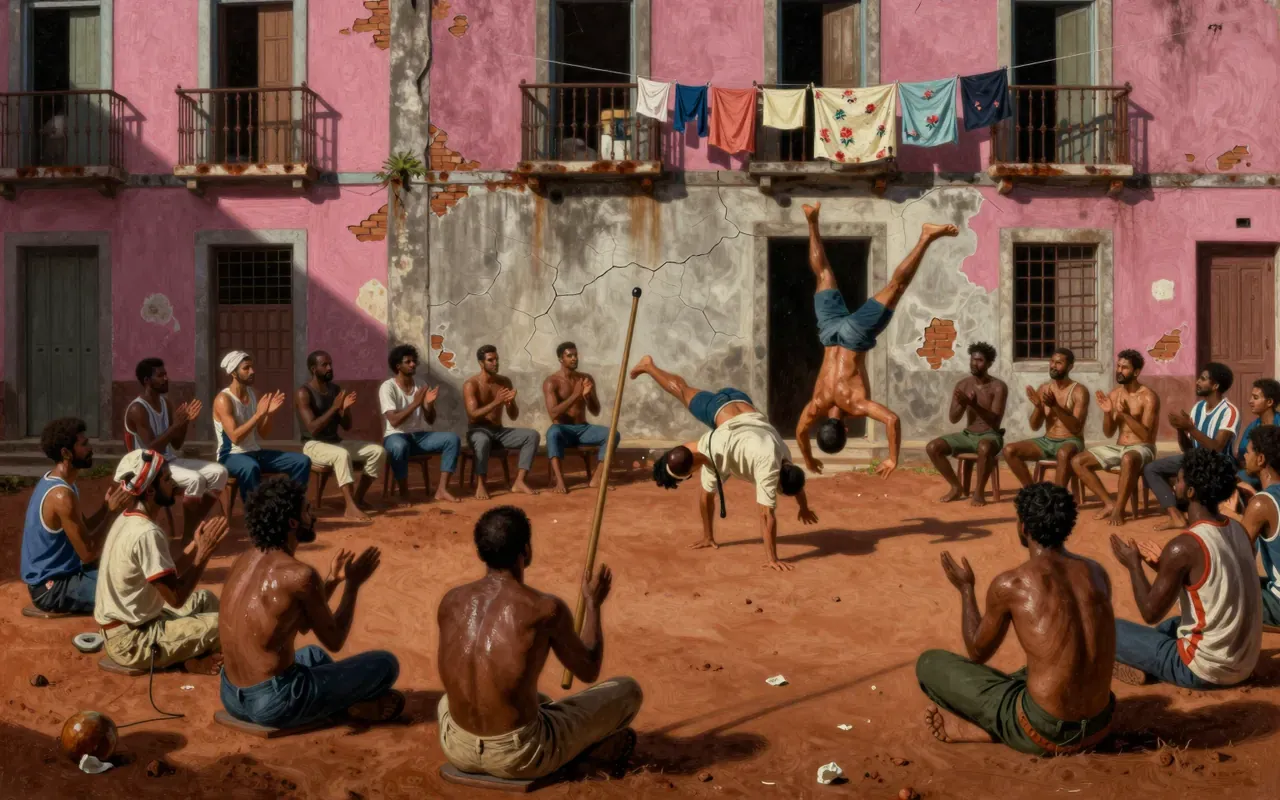
Capoeira is a centuries-old Afro-Brazilian practice integrating combat, music, dance, acrobatics and spirituality. It originated among enslaved Africans in Brazil, with roots in Angolan engolo. First documented as criminal in 1789, it was further suppressed as capoeira carioca in the 19th century. Legalised in 1937 after Mestre Bimba’s reforms, it was promoted as national culture—while Mestre Pastinha, also from Bahia, founded a school in 1941 to preserve capoeira Angola as distinct from both criminality and state-sanctioned sport.

Chapters & takeaways4
  1. 1:13
    What it is—and what it isn’t

    Capoeira is not dance disguised as fighting—it is fighting disguised as dance, rooted in Angolan engolo and sustained by Black Brazilians for centuries.

  2. 2:33
    Criminalised from the start

    From 1789, capoeira was criminalised—not because it was violent, but because it was autonomous Black assembly.

  3. 4:13
    How it got legalised

    Mestre Bimba’s reform in the early 1930s created capoeira regional—a teachable, linear system that enabled legalisation in 1937.

  4. 5:40
    The split that held the line

    Mestre Pastinha founded his school in 1941 to defend capoeira Angola against both criminalisation and nationalism—keeping its circular, ritual, non-linear form alive.

Worth your time?

Yes. Study the whole thing.

4.5/ 5
What works
  • capoeira regional
  • capoeira Angola
  • the roda
What does not
  • capoeira carioca
  • engolo
  • Bahia
Study it if
  • Black Brazilians
  • students of cultural co-option
  • practitioners of embodied resistance
Skip it if
  • those seeking apolitical tradition
  • casual observers of 'world dance'
The written brief1 min read

What the thing is

Capoeira is an Afro-Brazilian martial art and game. It combines combat, dance, acrobatics, music, and spirituality. It is not sport first. It is resistance first.

Where it came from

It emerged among Africans in Brazil during the early colonial period. Its roots lie in the Angolan Bantu martial art engolo. It was first officially documented in 1789—as a crime.

What it gets right

It preserves African bodily knowledge under colonial erasure. Its integration of music, acrobatics, dance and spirituality reflects a coherent Afro-Brazilian worldview—not performance for spectacle, but embodied continuity.

What it gets wrong

The 1937 legalisation did not liberate capoeira. It recast it as national culture—removing its criminalised, communal, anti-authoritarian character in favour of pedagogy, sport, and state symbolism.

Why it matters now

It reveals how cultural forms are flattened by official recognition. Capoeira’s journey from outlawed practice to national symbol mirrors wider patterns of co-option: Black vernaculars made safe for export, stripped of their friction with power.

Is it worth your time

Yes—if you want to understand how resistance becomes ritual, and how state power reshapes Black cultural practice. Capoeira is not a relic. It is a living record of constraint, adaptation, and reclamation.
Same beat · Society4 of 306
Up next in Culture

Cardamom

· 9:12

Cardamom isn’t a flavour—it’s a trade route fossilised in seed.

9:12