culturebriefs
8:24in productionCh. 1 · What It Is/ 8:24 · ceiling 15 min
Food

Tiramisu

Tiramisu is not tradition—it’s a 1969 restaurant stunt that rewrote Italian dessert history.

Tiramisu is a postwar Italian restaurant dessert, invented in 1969 in Treviso. It has no folk roots. Its rapid lexical adoption—in dictionaries by 1980 and English by 1982—shows how institutional recognition, not longevity, confers authenticity.

Chapters & takeaways4
  1. 0:55
    What It Is

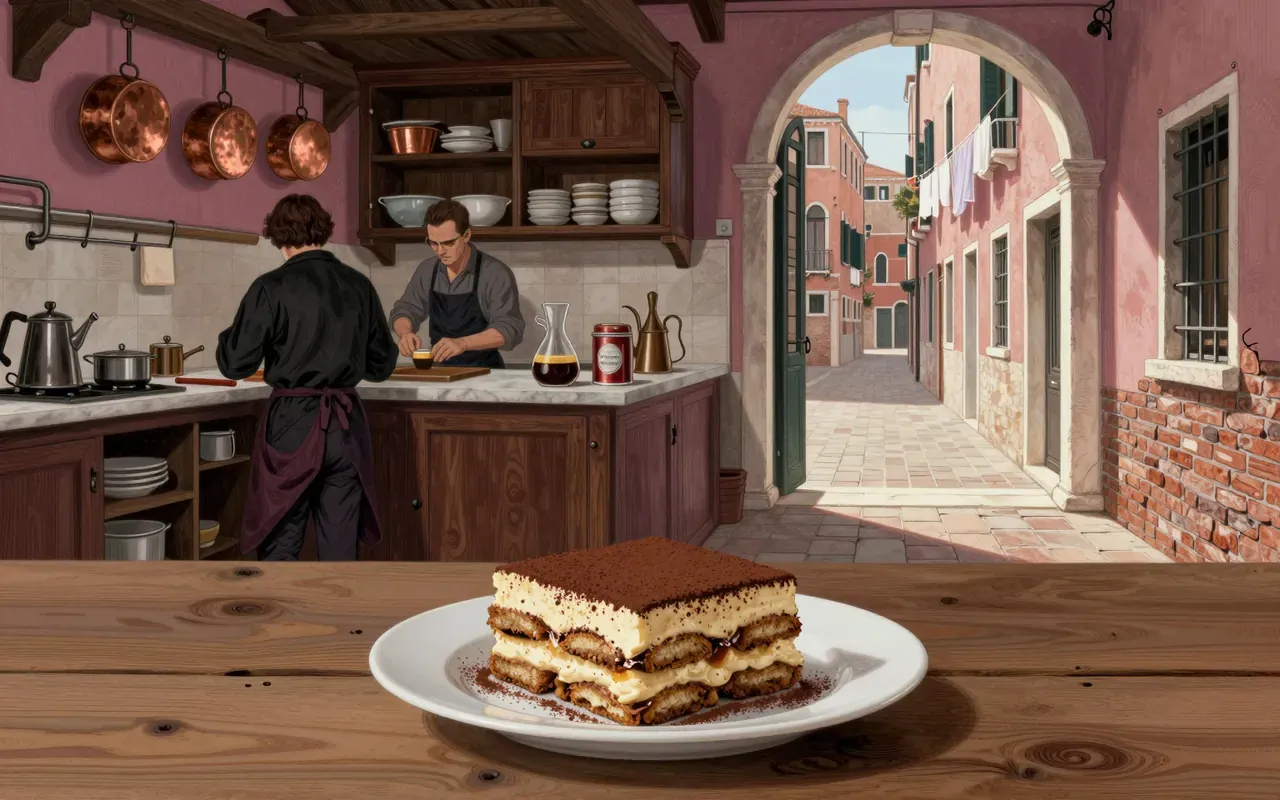
    It is defined by four precise components: coffee-soaked savoiardi, egg yolk–sugar–mascarpone cream, and cocoa powder.

  2. 1:54
    Where It Was Made

    It was invented at Le Beccherie in Treviso—not in nonna’s kitchen, not in Florence, not centuries ago.

  3. 3:20
    When It Entered the Record

    No pre-1960s cookbook contains it; it first appeared in dictionaries in 1980 and 1982.

  4. 4:57
    How Fast It Spread

    It crossed borders fast: cited in Sydney in 1978 and in a Veneto regional cookbook in 1983.

Worth your time?

Yes. Study the whole thing.

4/ 5
What works
  • as a case study in how institutions confer legitimacy
  • as evidence against the myth of timeless recipes
What does not
  • influence chefs named in the source
  • displace earlier desserts named in the source
  • define a generation or movement
Study it if
  • readers who question culinary origin stories
  • people who notice when a 'traditional' dish has no pre-1960s trace
Skip it if
  • those seeking nostalgic comfort without scrutiny
  • readers who treat popularity as proof of heritage
The written brief1 min read

What the thing is

Tiramisu is a composed dessert of coffee-soaked ladyfingers layered with a cream of egg yolks, sugar, mascarpone, and dusted with cocoa powder.

Where it came from

It originated in northeastern Italy, specifically at Le Beccherie in Treviso, on 24 December 1969—per obituaries naming Alba di Pillo and Roberto Linguanotto as its creators.

What it gets right

It delivers layered texture and contrast: soft coffee-soaked savoiardi, rich mascarpone cream, bitter cocoa powder.

What it gets wrong

It pretends to be rustic or traditional, but it is a restaurant invention with no folk lineage.

Why it matters now

It exposes how culinary legitimacy is retroactively constructed: absent from pre-1960s cookbooks, it entered dictionaries only in 1980 (Italian) and 1982 (English), then became synonymous with ‘Italian dessert’ despite its recent, documented birth.

Is it worth your time

Yes—if you care how a dish becomes universal without being ancient.
Same beat · Food4 of 210
Up next in Culture

Tommy Hilfiger

Tommy Hilfiger · 8:28

Preppy wasn’t born on Ivy League quads—it was rebuilt in Times Square after a bankruptcy.

8:28