culturebriefs
9:05in productionCh. 1 · A Bridge Between Two Eras/ 9:05 · ceiling 15 min
Subcultures · Movements & scenes

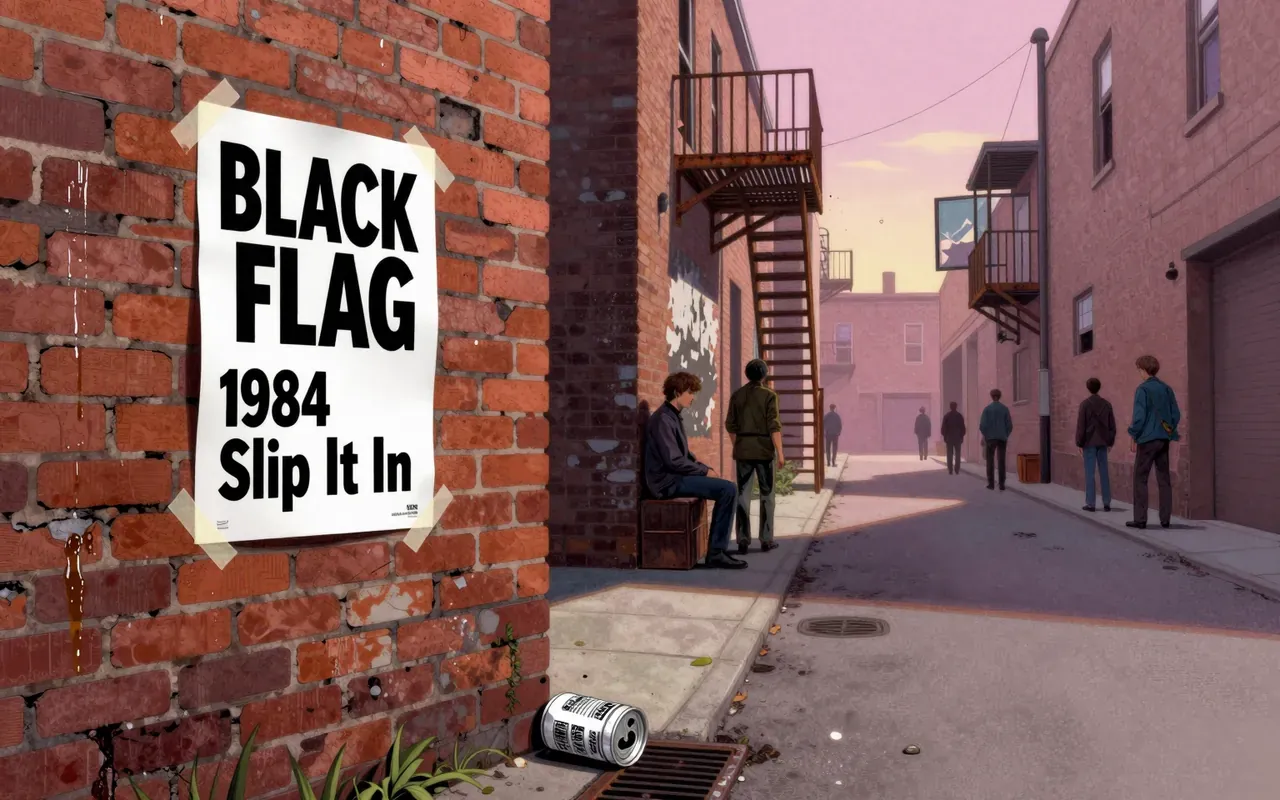
Slip It In

1984

Black Flag didn’t evolve—they exploded outward, and Slip It In is the shrapnel.

Slip It In is not a refinement. It is an intensification—of duration, density, dissonance and stylistic friction. It does not resolve Black Flag’s contradictions. It amplifies them.

Chapters & takeaways5
  1. 1:06
    A Bridge Between Two Eras

    Slip It In is Black Flag’s fourth album—and a deliberate fusion of Damaged’s fury and My War’s sprawl.

  2. 2:28
    Heavier, Longer, Denser

    It extends My War’s heavy, cathartic, dense and progressive sound—and pushes song lengths further than before.

  3. 3:32
    Instrumentals and Hybrid DNA

    Greg Ginn’s increasingly complex playing appears in instrumentals—and across a hybrid palette: sludgy metal, thrash, jazz and blues rock.

  4. 4:34
    Made on the Road, Not in the Lab

    It was recorded mid-tour, mid-My War cycle—proof that this wasn’t studio revisionism, but live evolution.

  5. 5:41
    A Style Before Its Name

    ‘My Ghetto’ contains traces of what would later be named powerviolence—before the term existed.

Worth your time?

Yes. Study the whole thing.

4/ 5
What works
  • as a document of artistic restlessness
  • as evidence of hardcore’s capacity for expansion
  • as a counterpoint to retrospective canonisation
What does not
  • define a decade
  • influence a named artist
  • start a movement
  • achieve consensus
Study it if
  • listeners who value process over polish
  • students of genre mutation
  • fans of unmediated band evolution
Skip it if
  • those seeking accessibility
  • those requiring narrative cohesion
  • those who equate influence with popularity
The written brief1 min read

What the thing is

Slip It In is the fourth album by the American hardcore punk band Black Flag, released in 1984 by SST Records.

Where it came from

It was recorded on a brief break during the continuous My War tour. It fuses styles from Damaged and My War. It draws inspiration from heavy metal, hardcore punk, thrash, blues rock and jazz.

What it gets right

It extends My War’s heavy, cathartic, dense and progressive sound. It pursues lengthier song arrangements. It fuses Damaged’s aggression with My War’s sprawl. It uses instrumentals to spotlight Greg Ginn’s increasingly complex playing.

What it gets wrong

It makes no claim to coherence or resolution. It offers no stylistic synthesis—only collision: sludgy ‘pre-grunge’ metal beside jazz, thrash beside blues rock, powerviolence traces beside hardcore punk. That is not wrongness—it is refusal.

Why it matters now

It matters now because it documents a band refusing to stabilise—refusing genre loyalty, refusing audience expectation, refusing to treat its own past as canon—while still on the road, still under contract, still intact.

Is it worth your time

Yes—if you want to hear how Black Flag stretched hardcore beyond its limits in real time, not as myth but as a working band mid-tour, mid-evolution, mid-collapse.
Same beat · Subcultures4 of 61
Up next in Culture

Stocking

· 8:30

A stocking is not an accessory. It’s a hinge between medieval function and modern display.

8:30