culturebriefs
9:32in productionCh. 1 · Not a time, but a frame/ 9:32 · ceiling 15 min
Movements & scenes · Ideas

Renaissance

The Renaissance wasn’t a rebirth—it was a rebranding of power using ancient fonts.

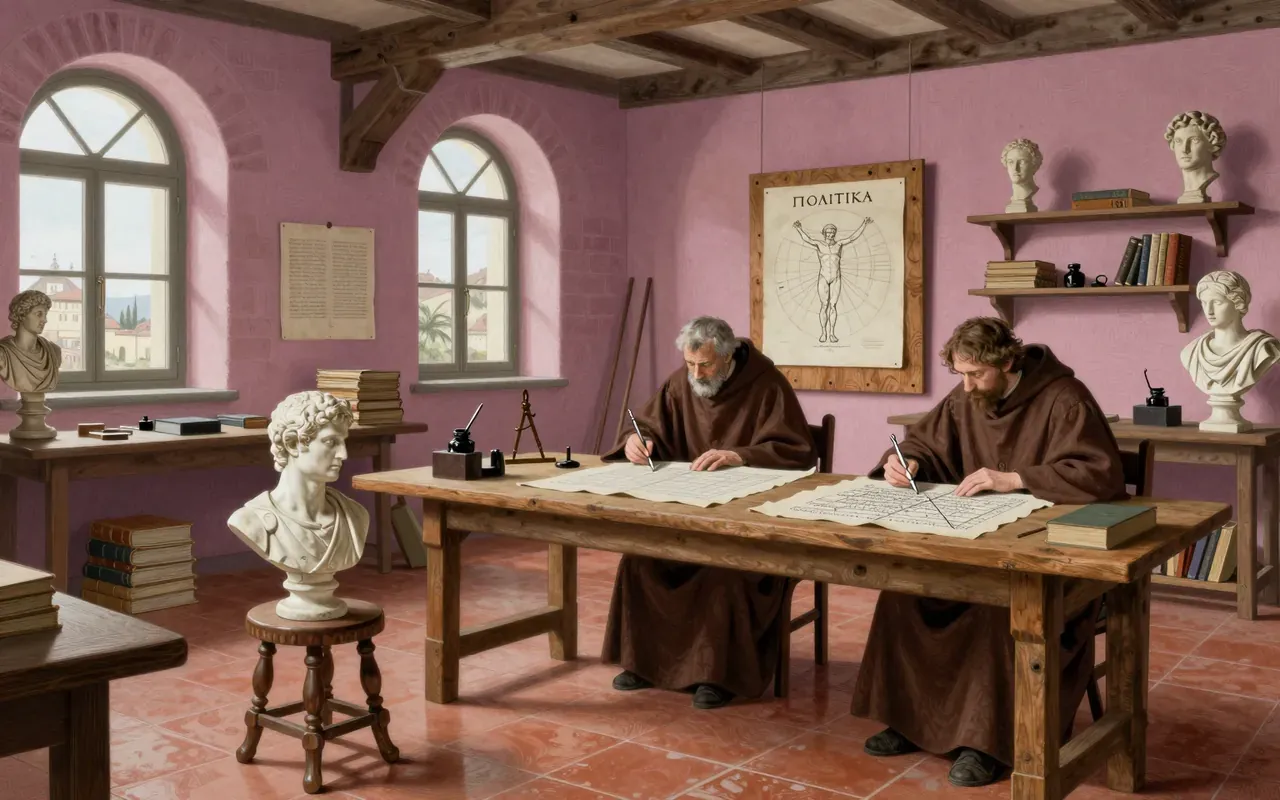
The Renaissance was a European cultural movement rooted in the rediscovery and revival of classical antiquity, centred first in Florence and spreading across Italy and Europe. It is variably dated from the 14th to the 17th century. Its methods included humanist scholarship, recovery of Latin and Greek texts, pursuit of realism in art, vernacular literary expansion, and educational reform.

Chapters & takeaways4
  1. 1:04
    Not a time, but a frame

    It was a period label applied later—not a self-declared era.

  2. 2:54
    Humanism was philology, not empathy

    Humanism meant reading Protagoras, not inventing human rights.

  3. 4:17
    A toolkit, not a revolution

    Florence exported perspective, poetry and pedagogy—not democracy.

  4. 5:25
    Perspective was power made visible

    Realism required new math—and new gatekeepers.

Worth your time?

Yes. Study the whole thing.

4/ 5
What works
  • reformation
  • enlightenment
  • neoclassicism
What does not
  • arguably
  • perhaps
  • in many ways
  • seminal
Study it if
  • elite male scholars
  • urban patricians
  • patron families like the Medici
Skip it if
  • peasants
  • women
  • non-Christians
The written brief1 min read

What the thing is

The Renaissance was a European cultural movement defined by the selective recovery and reinterpretation of classical antiquity. It was not a sudden break, but a recalibration of authority—from scripture and scholasticism toward ancient texts, observed nature and individual judgment.

Where it came from

It began in Florence in the 14th century, fuelled by humanist scholars searching monastic libraries for Latin texts and by Greek émigrés arriving after the fall of Constantinople in 1453. It spread through patronage, printing, and elite education.

What it gets right

It correctly identifies the Renaissance as a self-conscious revival of classical texts, methods and aesthetics. It locates that revival in Florence first, then Italy and Europe. It names humanism, linear perspective, vernacular literature and educational reform as core features.

What it gets wrong

It presents the Renaissance as a coherent, unified movement rather than a contested, uneven set of practices. It implies continuity with antiquity while ignoring how much was invented, misread or selectively recovered. It omits who was excluded: women, peasants, most clergy, non-Christians.

Why it matters now

It established the template for Western cultural prestige: the idea that progress flows from rediscovering lost wisdom. That logic still shapes museum curation, curriculum design, and tech-industry origin myths—often without scrutiny.

Is it worth your time

Yes—if you want to understand how European elites redefined knowledge, authority and beauty by repackaging antiquity. No—if you expect it to explain medieval or non-European thought.
Same beat · Movements & scenes4 of 139
9:24
Adbusters1989Adbusters is a Canadian anti-capitalist activist foundation founded in 1989 in Vancouver by Kalle Lasn and Bill Schmalz. It uses culture jamming—especially subvertisements and campaigns like Buy Nothing Day and Occupy Wall Street—to challenge consumerism and corporate control of information flows. It publishes the reader-supported, advertising-free Adbusters magazine. Its founding premise is that citizens lack equal access to information flows compared to corporations.
8:14
Crypto-anarchyCrypto-anarchy is a movement, not a prophecy. It uses cryptography to enable anonymity, free speech and trade. It emerged from Timothy C. May’s 1988 manifesto and the 1992 cypherpunk founding. It gets right that code can constrain power—but wrong that it will collapse the state. A 2022 study confirms its political irrelevance—yet its architecture remains vital for Internet-native dissent.
8:35
Culture jammingCulture jamming is anti-consumerist protest that uses détournement to subvert corporate media forms. It began in the 1950s, was named in 1984 by Don Joyce of Negativland, and draws directly from the Letterist and Situationist Internationals. It correctly identifies media as a tool of perception-shaping and conformity-enforcement. But it wrongly assumes irony alone can resist power—and ignores how quickly its tactics are absorbed into branding. It matters now because corporate language has colonised every channel of attention, yet its methods remain stuck in the logic of the 1980s media landscape. It is worth your time if you want to understand why resistance so often looks like the thing it opposes.
8:55
Free software movementThe free software movement is a precise, principled refusal of proprietary control over software. It began in 1983 with GNU and institutionalised in 1985 with the FSF. It gets right that software freedom must be guaranteed—not merely permitted. It gets wrong that licence compliance alone secures user agency. Its relevance has grown as software becomes infrastructural—but its methods remain rooted in individual refusal and collective development.
Up next in Culture

Suit

· 8:34

The suit isn’t formal wear—it’s the uniform of unspoken control.

8:34