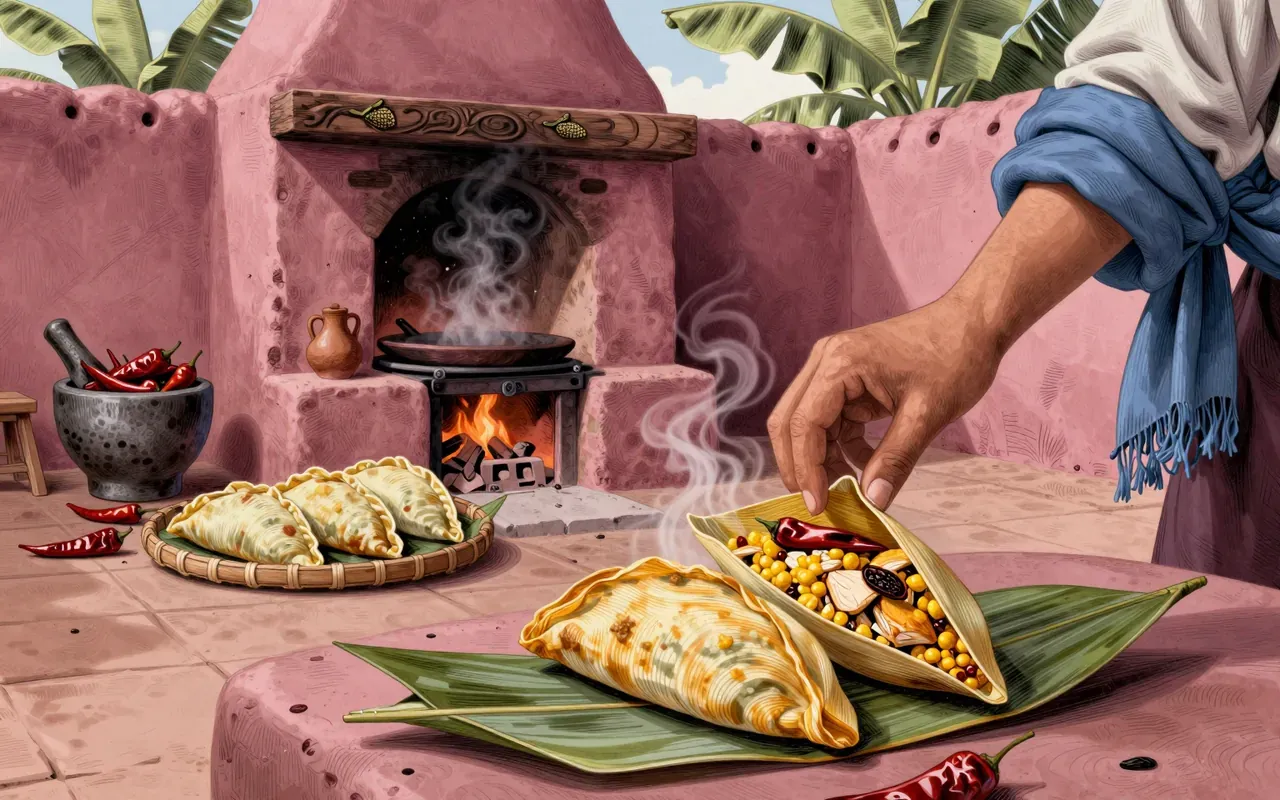
What the thing is
A steamed maize dough parcel, wrapped in corn husk or banana leaf, containing savoury or sweet fillings.
Where it came from
Mesoamerica, between 8000 and 5000 BC. Confirmed use by the Toltecs (250 BCE–750 CE) at Teotihuacan; pictorial evidence from ~100 AD in San Bartolo, Guatemala.
What it gets right
Tamales encode corn’s sacred centrality in Mesoamerican cosmology. They were portable ritual objects—fed to armies, carried on hunts, offered to gods. Their form is function: steamed in husks, sealed for travel and ceremony alike.
What it gets wrong
Nothing in the sources supports claims of tamale ‘influence’ beyond indigenous diffusion. It does not establish global reach, adaptation, or modern reinvention—only pre-Columbian use and spread across the Americas via indigenous networks.
Why it matters now
It disrupts the myth that ancient foods are static or folkloric. Tamales were state-scale logistics tools—ritual, military, and nutritional—long before ‘street food’ or ‘artisanal’ entered the lexicon.
Is it worth your time
Yes—if you care about food as cultural infrastructure, not just flavour.