8:56in productionCh. 1 · Not invented. Adapted./ 8:56 · ceiling 15 min
Food
Taco
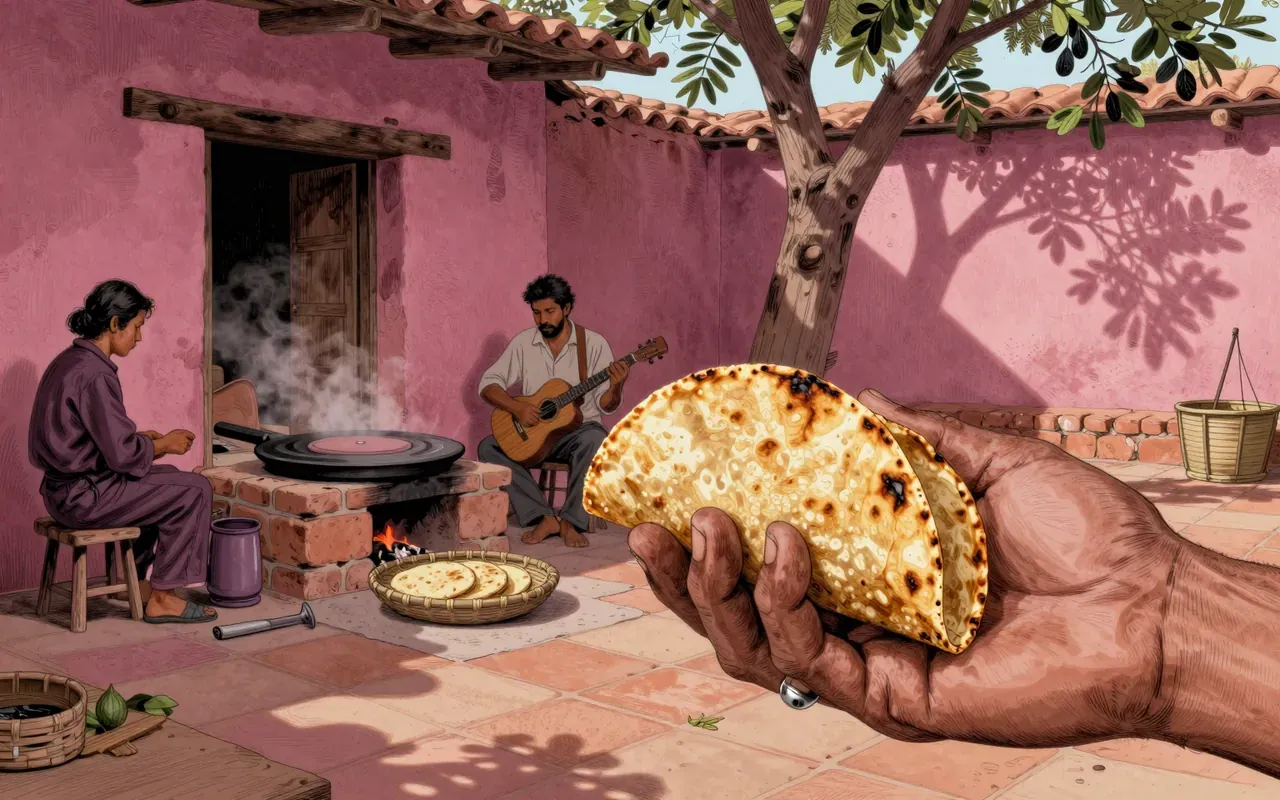
Tacos are not Mexican street food—they’re a folding technique that survived conquest, mining, and translation.
Tacos are a folding technique rooted in Pre-Columbian practice, renamed in 19th-century mining slang, then codified in cookbooks and novels before crossing borders. Their global form obscures their precise, contested, and linguistically charged origin.
Tacos descend from Pre-Columbian tlaxcalli—not invented in the 19th century.
2:04
A mining term became a cooking verb.
The word 'taco' entered cooking via miners’ slang for gunpowder plugs—then appeared in an 1836 cookbook as a folding instruction.
3:13
First eaten by Cortés’ captains. First named in print by Payno.
Europeans ate tacos in 1520. Mexicans wrote about them in novels by 1861.
4:26
Form over filling.
Folding—not rolling, frying, or topping—is what makes a taco a taco.
5:48
Not a burrito. Not a tostada.
Burritos are rolled. Taquitos are rolled and fried. Chalupas are fried first. Tacos are folded—and only folded.
Worth your time?
Yes. Study the whole thing.
4/ 5
What works
Nuevo y sencillo arte de cocina
El hombre de la situación
What does not
iconic
groundbreaking
seminal
Study it if
historians of food
linguists
readers of 19th-century Mexican literature
Skip it if
people seeking recipes
fast-food marketers
culinary trend forecasters
The written brief1 min read
What the thing is
A folded tortilla with filling. Eaten by hand. Not rolled. Not fried first. Not open-faced.
Where it came from
Pre-Columbian Mesoamerica, via tlaxcalli. Named ‘taco’ in 1836 as a culinary metaphor drawn from silver mining—‘plug’—then documented in 1861 as a chile-filled tortilla taco in Mexico City.
What it gets right
It preserves Pre-Columbian form: a folded tortilla as edible vessel. It holds regional variation without standardisation. It names itself in action—‘taco’ as verb before noun.
What it gets wrong
It misleads when treated as a single stable dish. The term named a technique (folding), not a recipe. Its modern global uniformity erases distinctions like tlaxcalli, chalupa, and burrito that the source explicitly separates.
Why it matters now
Because it is the most widely displaced food object in the world—and yet the least examined as a linguistic and colonial artefact. Its ubiquity masks its specificity.
Is it worth your time
Yes—if you care how everyday food encodes history, language, and colonial encounter.