8:04in productionCh. 1 · Born in Osaka, branded in 1952/ 8:04 · ceiling 15 min
Food
Shabu-shabu
A trademarked onomatopoeia that turned borrowed technique into national ritual.
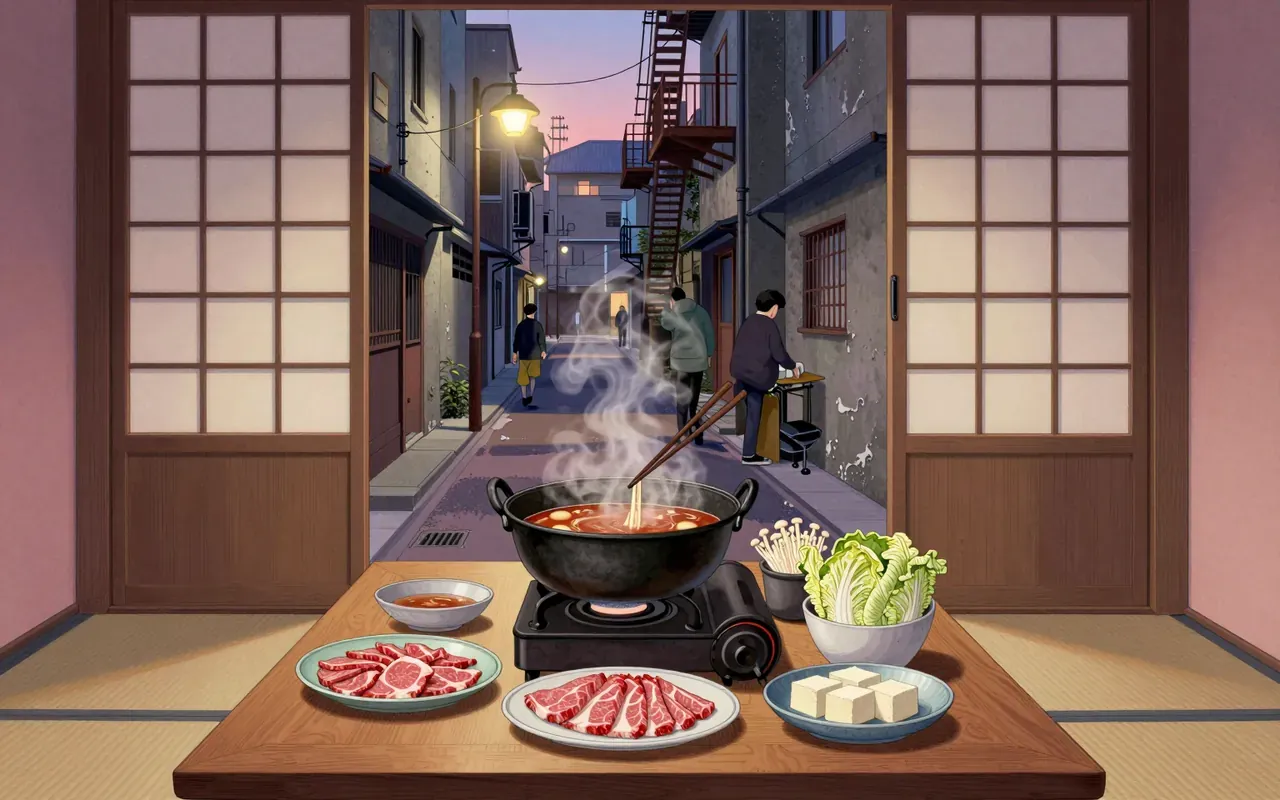
Shabu-shabu is a Japanese nabemono hotpot dish of thinly sliced meat and vegetables boiled in water and served with dipping sauces. The term is onomatopoeic, derived from the sound – 'swish swish' – emitted when the ingredients are stirred in the cooking pot. The food is cooked piece by piece by the diner at the table. Shabu-shabu was invented in Japan in the 20th century with the opening of the restaurant Suehiro in Osaka, where the name was also invented. The president of the restaurant, Chūichi Miyake, registered the name as a trademark in 1952. Shabu-shabu became more and more popular in the Kansai region and in 1955 it was also added to the menu of restaurants in Tokyo and then spread throughout Japan. The first is that it comes from the Inner Mongolian hot pot known as instant-boiled mutton (shuàn yángròu), which was introduced to Japan after World War II by Japanese who had lived in Beijing. Both dishes are prepared by briefly swirling thin slices of meat in boiling broth, then eaten with sauce.
Shabu-shabu was invented in Osaka in the 20th century—and immediately trademarked.
2:06
Swish-swish, not simmer
The name mimics the sound of stirring; the method puts cooking in the diner’s hands.
3:07
A borrowed rhythm
It shares technique and structure with Inner Mongolian instant-boiled mutton—introduced to Japan after WWII.
4:18
Menu rollout, not cultural revolution
It moved from Kansai to Tokyo in 1955—then across Japan—as a menu item, not a movement.
Worth your time?
Yes. Study the whole thing.
3.5/ 5
What works
as a case study in culinary branding
as evidence of post-war transregional exchange
What does not
iconic
groundbreaking
seminal
timeless
Study it if
food historians
Japanese culinary students
menu designers
Skip it if
casual diners seeking novelty
those expecting deep philosophical resonance
The written brief1 min read
What the thing is
Shabu-shabu is a Japanese nabemono hotpot dish. Thinly sliced meat and vegetables are cooked piece by piece at the table in boiling water or dashi. It is served with dipping sauces.
Where it came from
It was invented in Osaka in the 20th century at the restaurant Suehiro. Chūichi Miyake registered ‘shabu-shabu’ as a trademark in 1952. It spread from Kansai to Tokyo in 1955, then nationwide.
What it gets right
It makes cooking social and immediate. Diners control timing, temperature, and sequence. The onomatopoeic name anchors the experience in sound and motion.
What it gets wrong
It obscures its hybrid origin by branding itself as purely Japanese. The Inner Mongolian shuàn yángròu connection is structural—not incidental—but the trademarked name and Osaka origin story flatten that exchange.
Why it matters now
It reveals how post-war culinary adaptation was branded as domestic innovation—erasing cross-border influence while institutionalising it as ritual.
Is it worth your time
Yes—if you care about how everyday rituals encode cultural negotiation, not just what to eat.