9:25in productionCh. 1 · Not all roast duck is Peking duck/ 9:25 · ceiling 15 min
Food
Peking duck
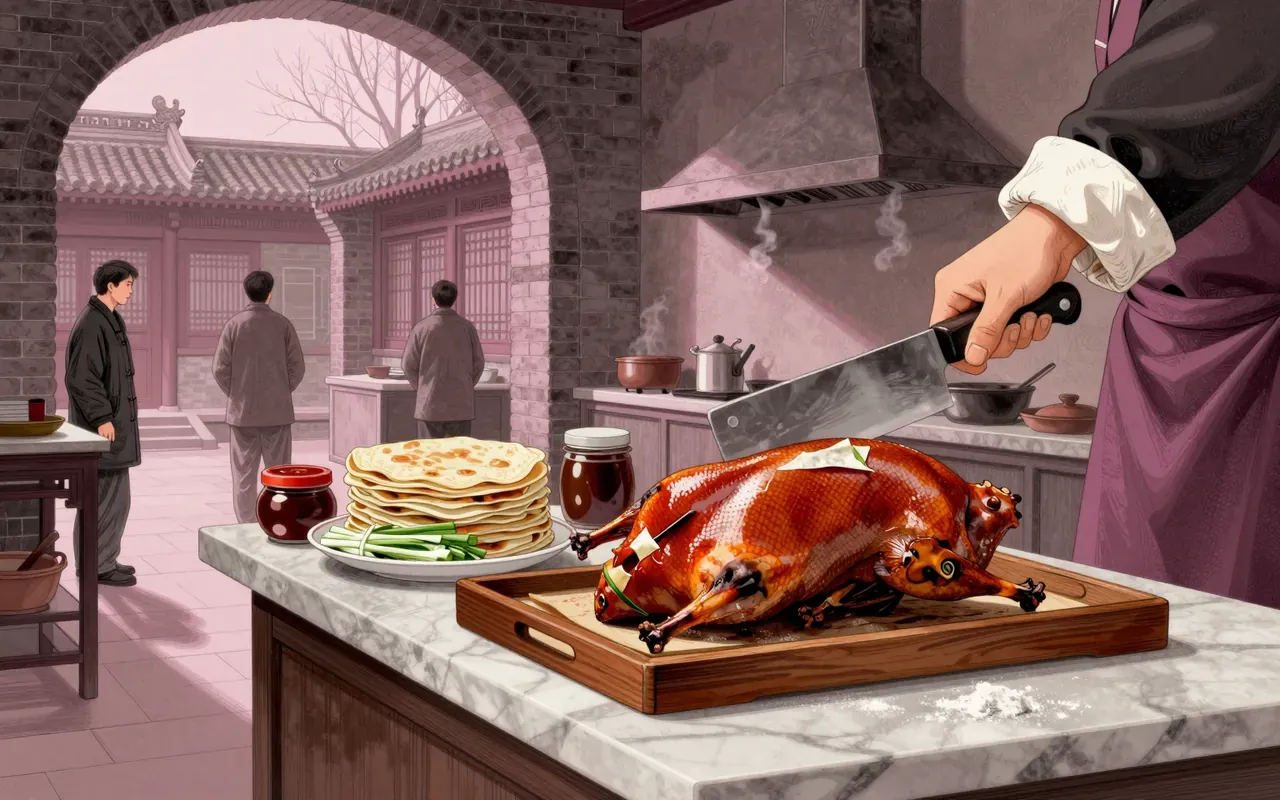
Peking duck isn’t ancient tradition—it’s imperial branding, refined by Beijing restaurants over six centuries.
Peking duck is a Beijing-originated dish with verifiable imperial roots and commercial milestones—not a timeless folk tradition. Its significance lies in its documented institutional life: court adoption, restaurant founding, and technical innovation. It matters because it shows how place, power, and profit coalesce in food.
Roast duck predates ‘Peking duck’ by centuries—but the name, place, and court association begin in Beijing’s Imperial era.
3:06
The 1330 origin is real—but it’s not Peking duck yet
‘Shāo yāzi’ in 1330 was Yuan imperial roast duck—not yet ‘Peking’ duck, but the first documented ancestor on court menus.
4:25
The restaurant came before the reputation
Bianyifang (1416) was the first dedicated restaurant—marking the shift from palace kitchen to public commerce.
5:54
Two innovations made it modern: status and heat
Upper-class adoption in the Qianlong era and Quanjude’s 1864 hung oven turned it into a social and technical institution.
Worth your time?
Yes. Study the whole thing.
4/ 5
What works
Peking duck
What does not
it is not a folk dish
it is not pan-Chinese
it is not unchanged since antiquity
Study it if
historians of Chinese urban life
students of culinary institutions
readers who question national food narratives
Skip it if
those seeking ‘authentic’ home cooking
general audiences expecting cultural shorthand
The written brief1 min read
What the thing is
Peking duck is a roasted duck dish from Beijing, defined by its association with imperial courts and later commercial restaurants. It is not simply ‘roast duck’. It is a named, place-anchored preparation with specific historical milestones.
Where it came from
It originated in Beijing during the Imperial era. Antecedents date to the Southern and Northern dynasties. A Yuan dynasty imperial version appeared by 1330. The Peking-specific form matured in the later Ming dynasty and entered court menus then.
What it gets right
It honours Beijing’s imperial lineage. The dish anchors itself in documented court use from the Yuan (1330) through Ming and Qing dynasties. Its restaurant history—Bianyifang (1416), Quanjude (1864)—is verifiable and urban.
What it gets wrong
It misrepresents continuity. Roast duck existed long before ‘Peking duck’; the name and method evolved separately. The 1330 ‘shāo yāzi’ was not Peking duck—it was an imperial roast duck, unconnected to Beijing’s later hung oven technique or regional identity.
Why it matters now
It reveals how culinary branding works across centuries: a local dish becomes a national emblem through institutional repetition—not taste alone. Its endurance reflects Beijing’s political centrality, not culinary universality.
Is it worth your time
Yes—if you care about how food encodes imperial power, regional craft, and commercial innovation in China. It is not a universal symbol of Chinese cuisine. It is a Beijing-specific dish with layered historical claims.