8:02in productionCh. 1 · What it is/ 8:02 · ceiling 15 min
Food · Society
Pão de queijo
A cheese roll born of slavery and scarcity—not wellness trends—is how Brazil baked resistance into breakfast.
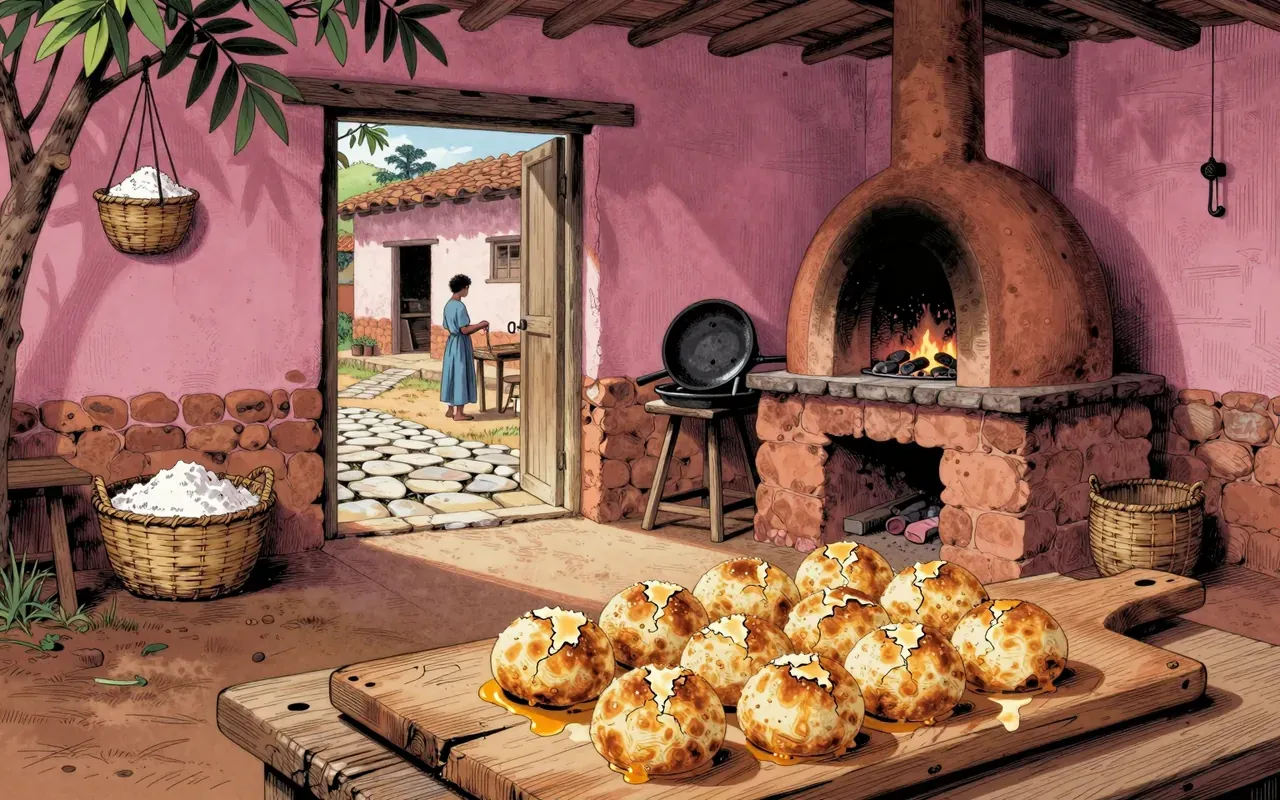
Pão de queijo is a small, baked cheese roll or cheese ball. It originates in Minas Gerais. It was developed by enslaved people in southeast Brazil after 1700 using cassava starch because wheat was unavailable. Hard cheese was added only in the late 19th century. Cassava flour gives it its distinct chewy, elastic, crunchy-on-the-outside texture. Small pockets of air expand during baking and are contained by the elasticity of the starch paste. It contains no gluten. Traditionally, both sour and sweet cassava flour are used; the Brazilian recipe excludes corn starch, all-purpose flour, black pepper, sugar, fennel and baker's yeast.
It is not a loaf or a slice—it is a small, self-contained roll or ball.
1:58
Where it came from
Minas Gerais. Enslaved people. Cassava—not wheat—after 1700. Cheese came later.
3:13
How it works
Cassava flour delivers chew, elasticity and crunch. Air pockets expand and stay trapped.
4:08
Why it’s gluten-free
It contains no gluten—because it uses cassava flour, not wheat.
5:03
What modern versions get wrong
Traditional Brazilian versions use both sour and sweet cassava flour—and exclude corn starch, all-purpose flour, black pepper, sugar, fennel and baker’s yeast.
Worth your time?
Yes. Study the whole thing.
4.5/ 5
What works
resists erasure
embodies constraint-as-innovation
remains materially specific
What does not
iconic
groundbreaking
seminal
Study it if
people who study food as social technology
Skip it if
people seeking novelty snacks
The written brief1 min read
What the thing is
Pão de queijo is a small, baked cheese roll or cheese ball.
Where it came from
It originated in Minas Gerais among enslaved people in southeast Brazil after 1700, following the discovery of mines near Ouro Preto. Wheat was unavailable. Cassava starch was used, learned from Tupiniquins. Hard cheese was added only in the late 19th century.
What it gets right
It uses cassava flour to create a gluten-free bread with chewy-elastic-crunchy texture. Air pockets expand during baking and are held by starch elasticity.
What it gets wrong
Nothing is wrong in the thing itself—but many modern recipes misrepresent it by adding corn starch, all-purpose flour, black pepper, sugar, fennel or baker’s yeast.
Why it matters now
It is a living artifact of adaptation under constraint—gluten-free not by choice but necessity—and resists homogenisation when made traditionally.
Is it worth your time
Yes—if you care about food as material history, not just flavour.