9:23in productionCh. 1 · Court cuisine, not common fare/ 9:23 · ceiling 15 min
Food
Korma
Korma isn’t mild—it’s aromatic. And its name isn’t a menu category—it’s a verb.
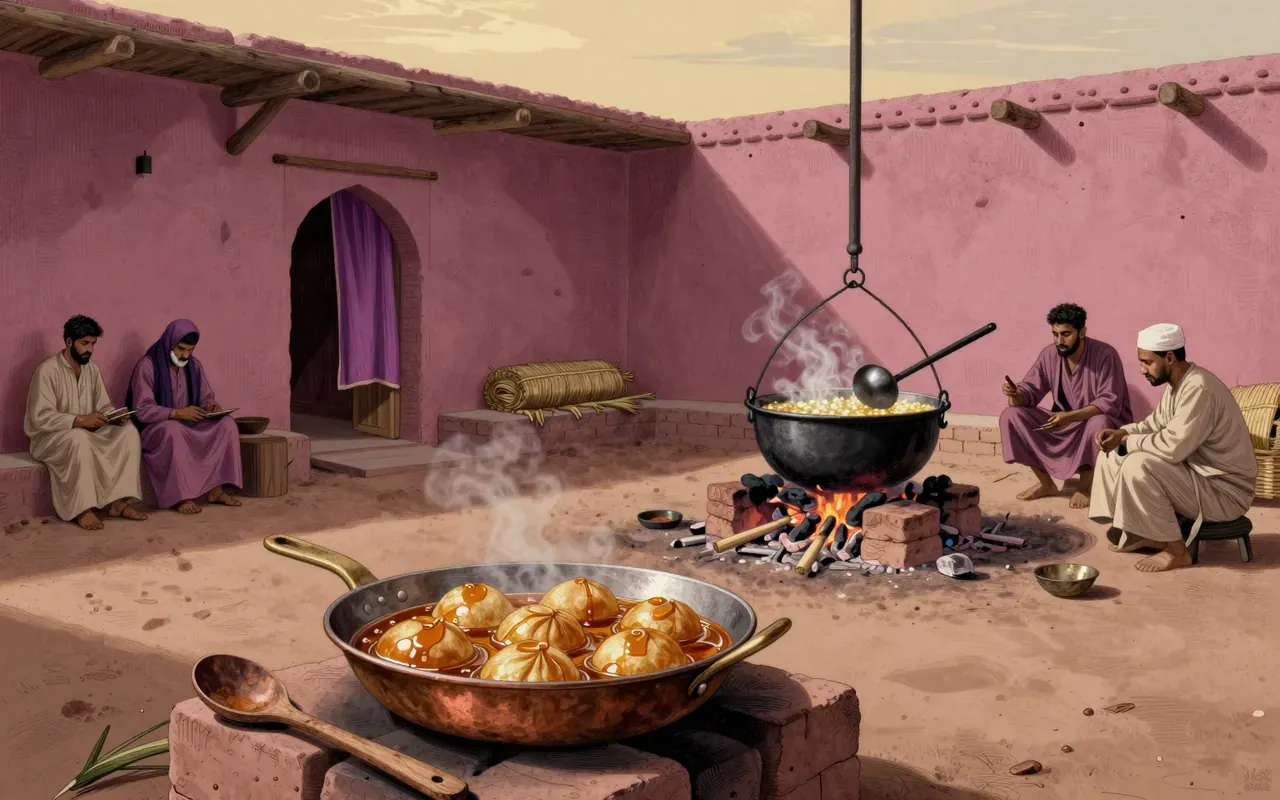
Korma is a braised curry rooted in Mughlai court cuisine, defined by yoghurt, slow heat, and aromatic depth—not mildness. Its English name comes directly from the Hindi-Urdu word for 'braising'. First recorded under Shah Alam (1643–1712), it evolved through Persian stew enrichment in the 18th century and appeared as a pilau variant in Hyderabad in 1832. Today it is misread as a generic 'safe' curry, obscuring its technical precision and imperial lineage.
Korma is Mughlai—not generic Indian—and emerged from imperial kitchens, not village hearths.
2:54
A verb, not a flavour
Its name means 'braising', and its method defines it—not its spice level or colour.
4:14
Fragrance over fire
Almonds, garlic and yoghurt made it fragrant, not bland—a deliberate contrast to fiercer curries.
5:10
From stew to rice dish
It appeared in royal cookbooks by 1643 and evolved into a pilau variant in Hyderabad by 1832—proving its mobility across formats.
Worth your time?
Yes. Study the whole thing.
4/ 5
What works
korma
What does not
iconic
groundbreaking
seminal
timeless
Study it if
food historians
cooks interested in technique
readers tracking linguistic translation of culinary terms
Skip it if
those seeking origin myths
fans of retro British curry house menus
readers who conflate popularity with historical weight
The written brief1 min read
What the thing is
Korma is a braised curry dish. It uses yoghurt, stock or water, and spices to build a thick, aromatic gravy around meat or vegetables.
Where it came from
It originated in the Indian subcontinent under Mughlai influence. It was prepared in Mughal court kitchens and first documented in cookery books from the reign of Shah Alam (r. 1643–1712).
What it gets right
It prioritises fragrance over heat. It uses yoghurt and slow braising to tenderise without aggression. It adapts Persian stews into something distinctively Mughlai.
What it gets wrong
It is often reduced to a mild, creamy British curry—erasing its courtly origins, its almonds and garlic, and its role in pilau in Hyderabad in 1832.
Why it matters now
It reveals how colonial translation flattens technique: ‘korma’ names a method—braising—but now signifies a flavour profile it was never meant to monopolise.
Is it worth your time
Yes—if you care how a cooking technique became a cultural shorthand, and why its quiet aromatics displaced bolder flavours in imperial kitchens.